Contents
Phonics is the method of teaching children to read by connecting letters and sounds, then blending those sounds to make words. It’s systematic, proven, and the foundation of early reading success in UK schools.
If you’ve ever found yourself nodding politely at a teacher who’s talking about phonemes, graphemes, and blending—all while wondering what on earth they’re on about—you’re definitely not alone.
This guide is here to translate it all into plain English, so you can feel confident supporting your child’s reading journey. All you need is ten minutes a day, a curious kid, and a willingness to cheer them on.
Why phonics? (the big picture in 60 seconds)
If reading feels like magic, phonics is the trick revealed. It’s the bit that explains how those squiggly letters become sounds, and how sounds turn into words.
Here’s why schools love it—and why you will too:
- It’s step-by-step: children learn one sound at a time, then build them into words. No guesswork, no tears (well, fewer tears).
- It builds independence: once your child knows a few sounds, they can read new words all by themselves. That’s a huge confidence boost.
- It works for everyone: whether your child races ahead or takes it slow, phonics lets them move at their own pace.
- It’s proven: research and classroom experience agree—phonics gives children the best start in reading.
- Phonics lessons start simple: Think s, a, t, p, as a starting point, before growing steadily more complex, introducing new sounds and spellings each week. Bit by bit, children learn to decode any word they see. And once they can decode, they can read anything.
- Your role matters: little-and-often practice at home turns classroom learning into everyday reading confidence.
Bite-sized reading tips, straight to your inbox
Get confidence-boosting tips to help your child learn to read. Short, useful, and easy to fit into (real) family life!
Even better? You'll also get 30% off your first month of Reading Chest.
Phonics 101: sounds, letters & blending
Okay, time to lift the lid on the basics. Here’s the stuff teachers talk about all the time—and what it actually means.
The key players
- Phoneme: a single sound in a word. There are around 44 in English. Examples: s, a, sh, oi.
- Grapheme: the letter or group of letters that spell a sound. So a can be written a, ai, or ay depending on the word.
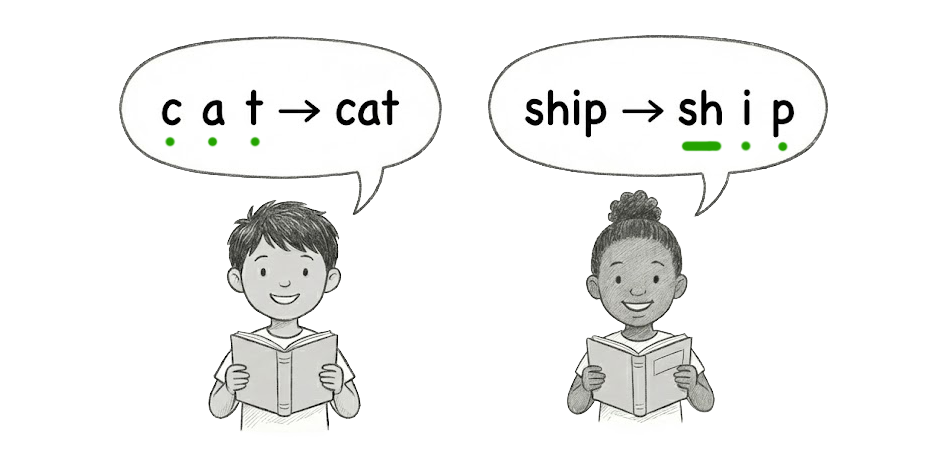
- Blending: saying the sounds together to read the word. c a t = cat.
- Segmenting: breaking a word apart to spell it. ship = sh i p.
- Digraph: two letters, one sound (like sh, ch, oa).
- Trigraph: three letters, one sound (like igh in night).
- Tricky words: words that don’t follow regular patterns yet, like the, said, or one. We learn these by sight at first.
A word about pronunciation
Getting the sounds right makes a world of difference. Try saying mmm, sss, and ttt—not muh, suh, or tuh. That tiny vowel you add can make blending a nightmare.
(We’ve all done it. The good news? You can fix it in about 30 seconds.)
A quick blending script
You: “Let’s sound this out—s… a… t.”
Them: “sat!”
You: “Perfect! High five.”
Keep it playful. Celebrate the wins. And remember—blending isn’t just reading; it’s their first taste of decoding, and it’s seriously empowering.
How school teaches phonics
Let’s peek behind the classroom curtain. Most UK primary schools teach phonics every day in short, snappy sessions—usually 15–30 minutes. Children learn a new sound (or spelling of a sound), practise reading and writing it, then use it in words or short sentences. Quick, focused, and full of repetition.
Here’s roughly what happens when:
Nursery / early reception: phase 1
Before letters even appear, children tune into sounds around them—songs, rhymes, and silly listening games (“Can you hear the sound at the start of dog?”). It’s all about building ears for language.
Reception: phases 2–4
This is where phonics officially begins. They learn single-letter sounds first—s, a, t, p, i, n—and start blending them into words (sat, pin, tip). Then come digraphs like sh, ch, and th, and longer words with blends (frog, hand). By the end of Reception, many children can read short sentences and write simple ones too.
Year 1: phase 5
New and alternative spellings appear—ai, ay, a-e—and children learn that one sound can be written in different ways. They also practise reading “tricky” high-frequency words (sometimes called “red words), like the, said, or was.
At this stage, they take part in the Year 1 Phonics Screening Check—a quick one-to-one activity where they read 40 real and made-up words aloud. It’s not a test to worry about (no scores on the fridge required). It simply checks their decoding skills.
Year 2: phase 6 and beyond
Fluency is the goal. Children start focusing on spelling patterns, prefixes (un-, re-) and suffixes (-ing, -ed, -er), and using what they’ve learned automatically. Reading becomes smoother, faster, and far more fun.
Unsure about “reading schemes” in schools? You might hear names like Little Wandle, Read Write Inc., Floppy’s Phonics, or Jolly Phonics. They all teach the same core skills in slightly different ways. The aim’s the same: confident, fluent readers who love books.
By the end of Year 2, most children can decode new words on sight and are ready to move from learning to read to reading to learn. That’s when the world of books really opens up.
(And yes, it’s the perfect time to fill your house with stories… luckily, we know a place that can help with that.)
Decodable books & book bands
Early readers need books that match what they’ve learned in phonics lessons. Enter: decodable books. These are specially written so your child can sound out almost every word—no guessing, no frustration, just small wins on every page.
Each school (and Reading Chest!) organises these books by book bands—those coloured levels you’ve probably seen on spines: Pink, Red, Yellow, Blue, Green, Orange, and so on. The colours simply show progression. As your child learns more sounds, they move up the bands.
A good rule of thumb:
- If a book is too easy, your child will breeze through with no challenge.
- If it’s too hard, they’ll stumble and lose confidence.
- The sweet spot? about 95% success—with just enough new words to stretch them.
Reading Chest lets you choose or adjust book bands anytime, so your child always has the right level of challenge without running out of new stories.
Decodable books are just one part of the mix. Keep reading aloud from picture books too. The phonics builds the skill; the stories build the love.
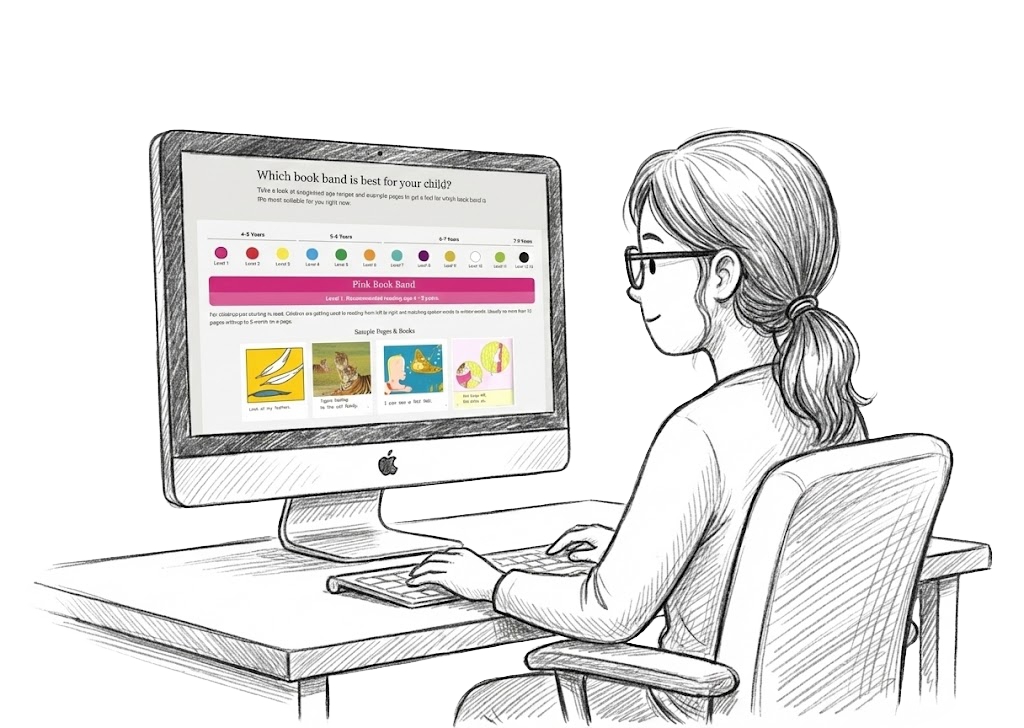
We have a really handy tool that lets you quickly find the right book band for your child.
Helping at home: 5 simple ways to make phonics fun
A few minutes a day is all it takes. These ideas don’t need special equipment—just your voice, a few books, and a splash of silliness.
Sound of the day
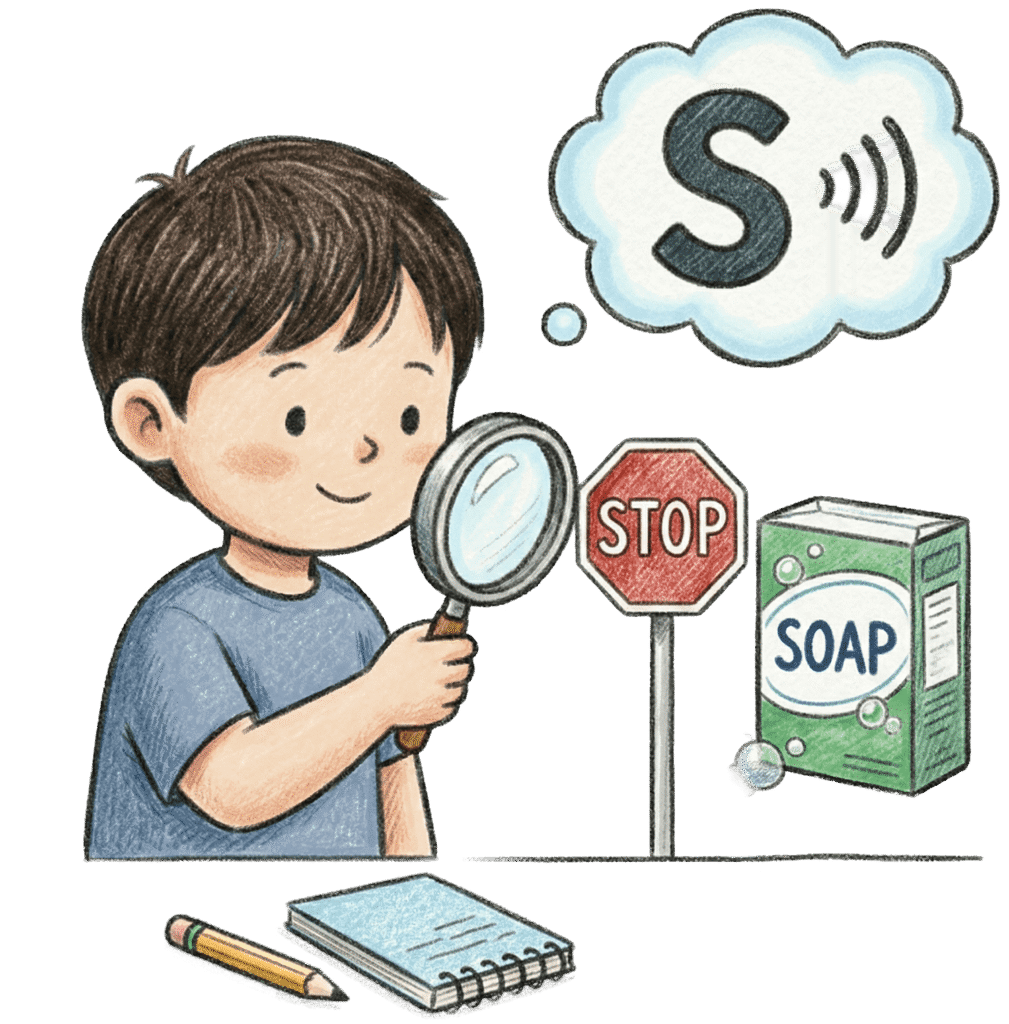
Pick one sound and spend the day noticing it everywhere — on signs, packets, toys, and out in the world. Quick to set up, surprisingly addictive.
Goal
Help your child notice sounds in everyday life — building phonemic awareness without needing to sit down and "do phonics".
You'll need
Just a focus sound — like sh or ee — and your normal day.
How to do it
Pick a sound in the morning. Say it together clearly: sh, ee, m — whatever you're working on. That's your sound of the day.
Then just keep going with your normal day. Whenever you spot it — on a cereal box, a road sign, a shop name, a toy — point it out and say the sound together. Let your child spot them too and make a fuss when they do.
By the end of the day, you'll have done phonics practice a dozen times without sitting down once. That's the magic of making it ambient rather than formal.
Word-building magic
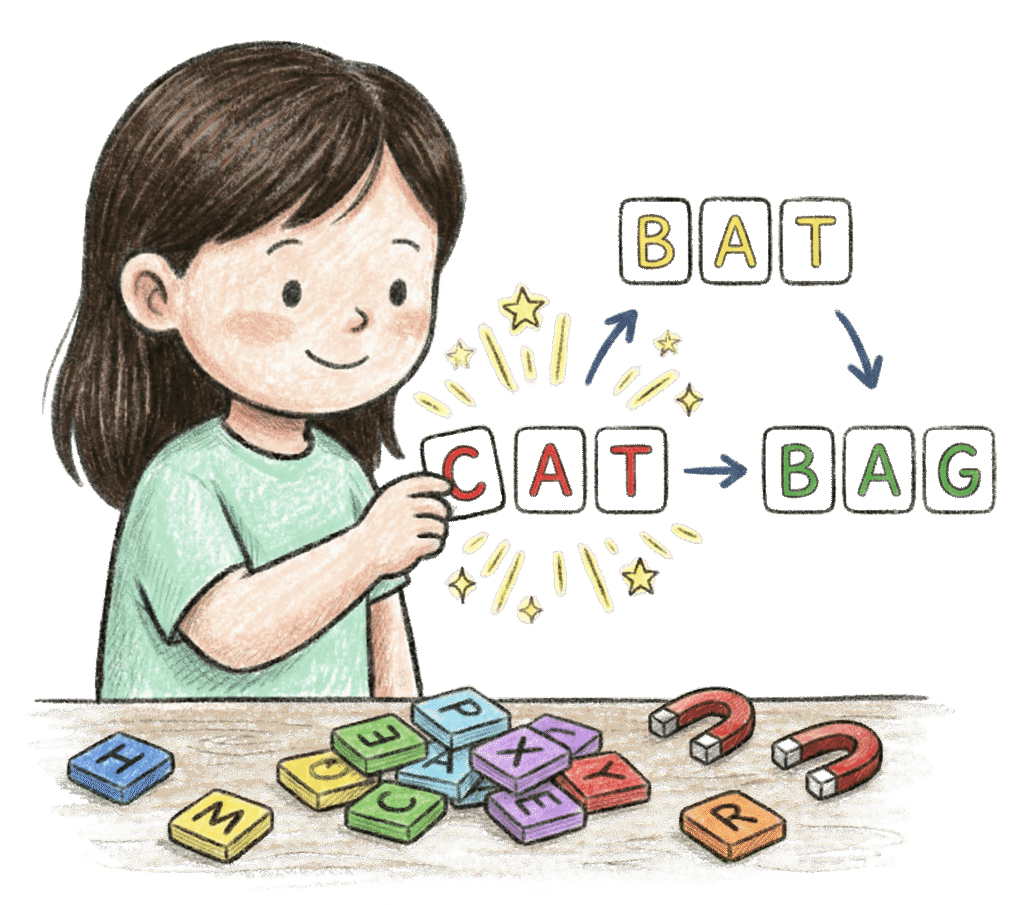
Start with a simple word and change one letter at a time — cat, cot, hot, hop, ship. Each step makes a new word. Blending and spelling at the same time.
Goal
Strengthen blending and spelling by showing how changing one letter changes everything — builds both phonics skills and a feel for how words work.
You'll need
Letter tiles, fridge magnets, or letters written on scraps of paper — whatever you have.
How to do it
Start with a simple word — "cat" is a classic. Lay it out with your tiles or magnets. Now change one letter: swap the c for an h and you have "hat". Swap the a for an o and you have "hot".
Say each word together as you make it. Blend out loud, then say it naturally. Take turns — you make a change, they read the new word; they make a change, you read it.
See how long a chain you can make before you get stuck. "Cat → hat → hot → hop → shop → ship" is a satisfying run. The physical act of swapping letters makes the phonics very visible — you can see exactly what changed and why the word sounds different.
Grab our resources
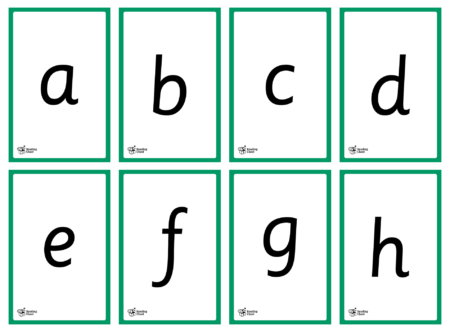
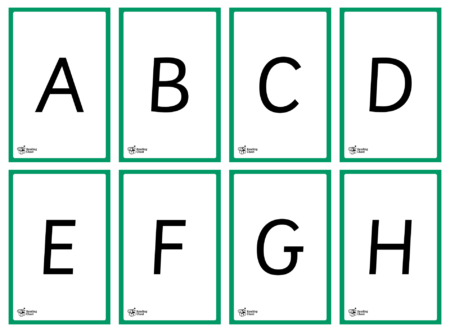
Print off our simple alphabet letter flashcards to have a quick way to build your own words.
Tricky-word snap
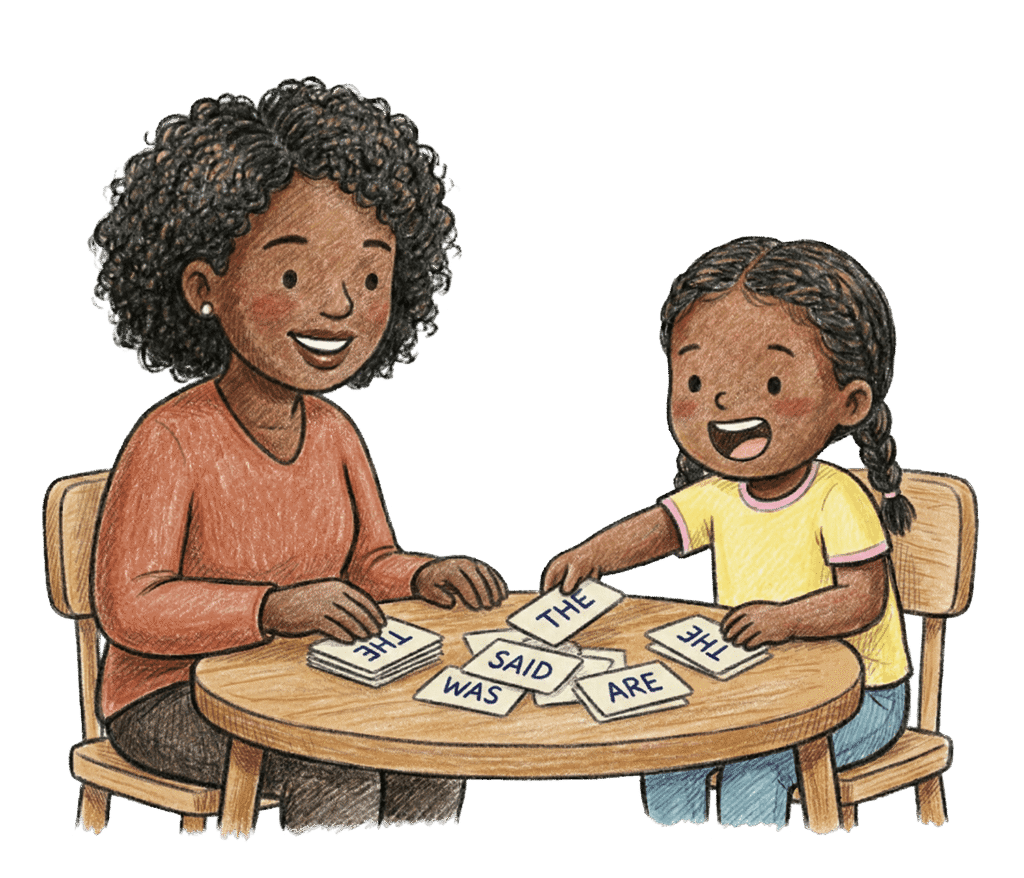
Play snap with tricky word cards — but instead of shouting "snap!", shout the word. Fast, fizzy, and surprisingly effective.
Goal
Learn common tricky words by sight — through speed and repetition, not drilling.
You'll need
Tricky word cards — or just write common words on slips of paper.
How to do it
Deal the cards and play snap. When a match appears, shout the word aloud instead of "snap!" First one to say it correctly takes the pile.
If that's too chaotic — and it can be — try a calmer version: spread the cards out and take turns picking one up and reading it. Any word read correctly goes in your pile.
You can also call out a word and challenge your child to find it in the spread-out cards. That's a good middle ground between game and practice. Finish by reading through your pile together — a nice, low-key way to end the session.
Picture-cover reading
Cover the pictures and read the words first. Then uncover and re-read. It sounds simple — but it makes a real difference to how children approach a page.
Goal
Encourage real decoding rather than guessing from pictures — a habit that pays off as books get harder and illustrations get fewer.
You'll need
- A decodable book
- Two sticky notes
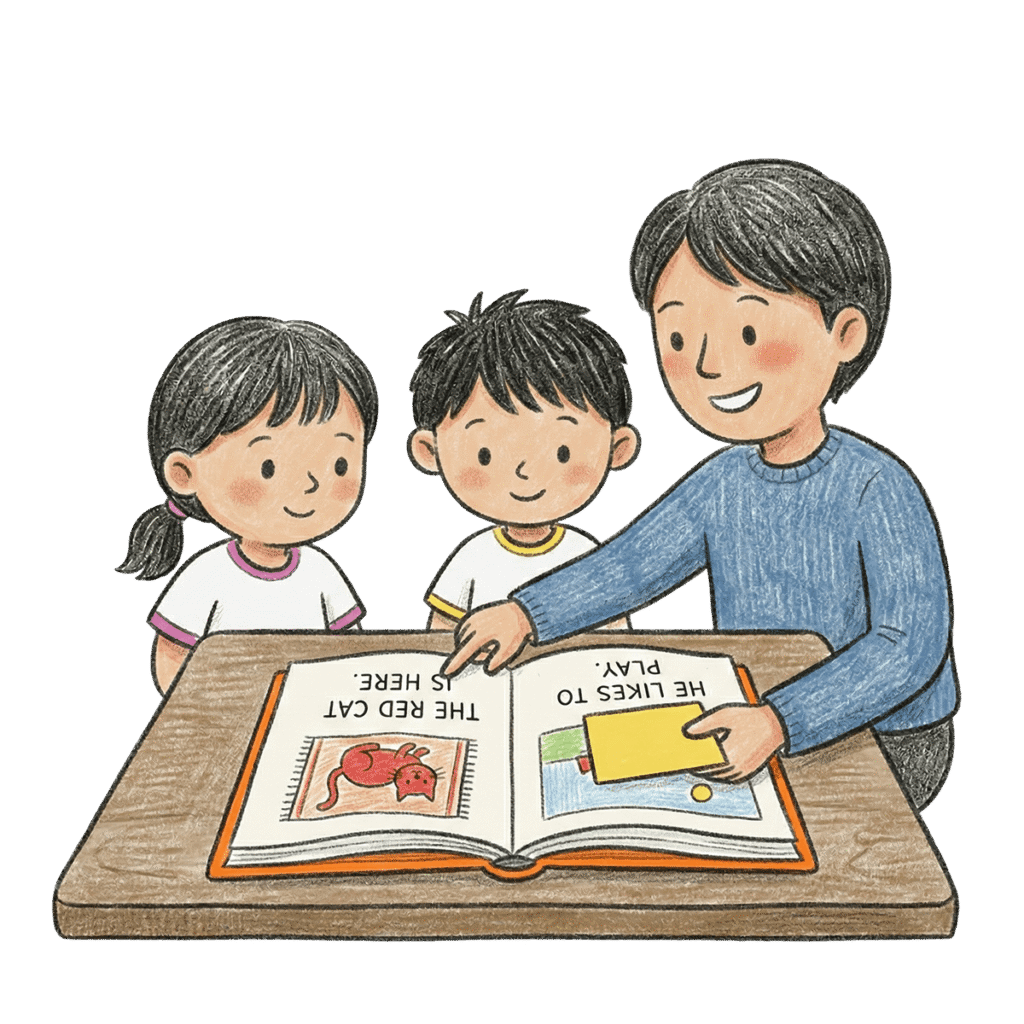
How to do it
Open the book to a page and cover the illustration with a sticky note. Ask your child to read the words first — just the text, no picture clues.
Once they've had a go (stumbles and all), take away the sticky note and re-read the page together with the picture revealed. Talk about what the picture adds. Did it match what they imagined? Did it help them understand anything differently?
This doesn't need to be every page — even doing it once or twice in a session is enough. The goal is to build the habit of trusting the words, not just guessing from the picture. That's a big deal as books get longer.
Grab our resources
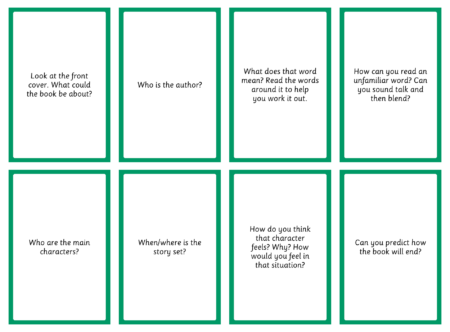
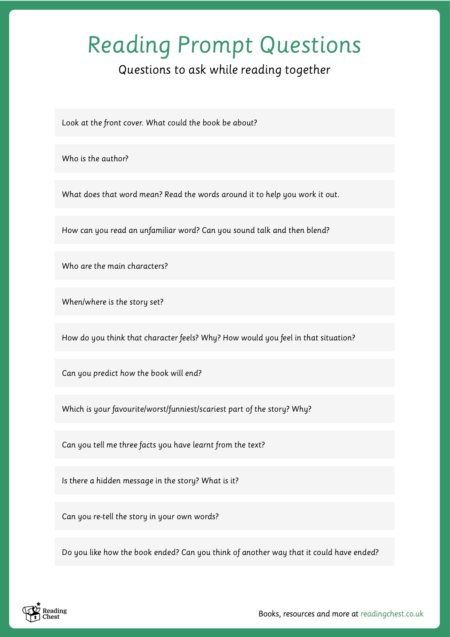
Looking for some help with questions to ask after your reading session? These prompts give you a great starting point.
Common questions about phonics
You’re not the only one wondering these things! Here are some of the most common phonics questions parents ask—answered simply and reassuringly.
What if my child’s school isn’t doing phonics?
Don’t worry—almost every UK primary school teaches reading through systematic synthetic phonics. It’s a requirement of the national curriculum. Some independent or international schools may use different programmes, but the same principles still apply: children learn to connect sounds and letters to read new words. Everything in this guide will still be useful at home.
…phonics should be emphasised in the early teaching of reading to beginners when they start school (gov.uk)
My child can already read some words by sight. Do we still need phonics?
Absolutely. Recognising familiar words (like the or and) by sight is great, but phonics teaches children how to tackle new words they’ve never seen before. It’s like giving them a decoder tool for the whole English language. So yes—keep practising phonics even if your child has a few favourite words memorised.
Sight words are like remembering your friends’ faces. Phonics is like learning how to read a map so you can find anyone, anywhere.
Why is my child reading nonsense words at school?
Ah yes—the mysterious “alien words” from the Year 1 Phonics Screening Check! These nonsense or made-up words (like bim or stog) aren’t meant to confuse children. They’re used to check that your child can decode using phonics rather than just memorising real words. If they can confidently sound out nonsense words, they’ve truly grasped the skill of blending.
You can practise this at home for fun—draw some silly aliens and name them with made-up words!
What if my child is struggling with phonics?
Firstly—don’t panic. All children learn to read at different speeds. If phonics feels tricky, take a step back and revisit earlier sounds in a playful way. Keep sessions short, positive, and full of praise. Reading should feel like success, not stress.
If progress feels slow even after extra practice, chat to your child’s teacher. They can offer guidance or extra support. Occasionally, hearing issues or specific learning differences (like dyslexia) can make phonics harder—but catching challenges early helps enormously.
Struggle doesn’t mean failure—it means they’re learning something new.
How do phonics and book bands fit together?
Book bands (those Pink, Red, Yellow, Blue levels) roughly match your child’s phonics progress. Early bands (Pink, Red) use simple words with single sounds. Later bands add new sounds and longer words as phonics knowledge grows. If books seem too easy, it’s usually because the focus is on fluency—making reading smooth and confident.
If you’re unsure about your child’s level, ask their teacher—or check Reading Chest’s online book band guide to compare levels across schemes. The goal is always success, not struggle.
Should I be teaching phonics at home if the school is doing it?
Think of school as the lesson and home as the practice. You don’t need to introduce new sounds or teach formal lessons—just reinforce what they’re learning with five minutes of fun daily reading, spotting, or blending.
Learning to read is like learning to play an instrument. The teacher shows how—it’s the short, regular practice at home that makes the magic happen.
When do we move on from phonics books?
Usually by the end of Year 2, your child will have a solid grasp of phonics and can decode almost any word. At that stage, reading shifts focus from learning to read to reading to learn—building vocabulary, fluency, and comprehension.
You’ll notice books becoming more like real stories, with richer language and fewer purely decodable patterns. That’s a good sign! Phonics has done its job. But its influence lasts forever—your child will still use those decoding skills every time they meet a new word.
Keep reading aloud together, even once they’re fluent. It’s the best way to nurture comprehension, curiosity, and a lifelong love of books.
Every child’s phonics journey looks a little different. Some sprint, some stroll—but they all get there with time, support, and encouragement. Your calm confidence at home makes a bigger difference than you think.
Quick-reference glossary
- Phoneme: a single speech sound.
- Grapheme: the written symbol(s) for a sound.
- Digraph: two letters, one sound (sh, ch, oa).
- Trigraph: three letters, one sound (igh).
- Blending: combining sounds to read.
- Segmenting: splitting a word into sounds to spell.
- Tricky words: words that don’t follow normal spelling rules yet.
- Decodable book: a book that only uses words built from taught sounds.
- Book band: colour-coded reading level used in UK schools.
Phonics sound chart — common digraphs & trigraphs
If you ever find yourself thinking “Wait, which sound does ‘au’ make again?” — this page is for you. Here’s a quick parent-friendly guide to the most common digraphs (two letters, one sound) and trigraphs (three letters, one sound) your child will meet in Reception to Year 2.
Consonant digraphs — two letters, one sound
| Sound | Example words | Notes |
|---|---|---|
| ch | chip, much | can sound like ch or sh (as in chef) |
| sh | shop, wish | hush and shoe! |
| th | this, thin | two versions – voiced (this) and unvoiced (thin) |
| ph | phone, dolphin | makes the f sound |
| wh | when, whisper | gentle breathy w sound |
| ck | duck, back | only after a short vowel sound (e.g. pack) |
| ng | ring, song | never at the start of words |
| qu | queen, quick | says kw together |
| ff | off, cliff | common double letter at word end |
| ll | hill, bell | |
| ss | kiss, mess | |
| zz | buzz, fizz |
Vowel digraphs — long and short vowel teams
| Sound | Example words | Notes |
|---|---|---|
| ai | rain, train | long a sound (middle of words) |
| ay | play, day | long a sound (end of words) |
| a-e | cake, made | split digraph – the magic e makes the vowel long |
| ea | sea, beach | long ee sound |
| ee | tree, sheep | pure long ee sound |
| ie | pie, tie | long i sound |
| igh | light, night | technically a trigraph – long i sound |
| oa | boat, coat | long o sound |
| oe | toe, goes | long o at word end |
| o-e | home, bone | split digraph |
| oo | moon, food | long oo sound |
| oo | book, look | short oo sound |
| ue | blue, clue | long oo sound (word end) |
| u-e | cube, flute | split digraph |
| ew | new, grew | long oo or yoo sound |
| ou | out, shout | says ow |
| ow | cow, down | ow as in cow |
| ow | snow, grow | oa as in snow |
| oi | coin, boil | oy in middle of words |
| oy | boy, toy | oy at word end |
| au | author, August | aw sound |
| aw | saw, claw | aw at word end |
| ir | bird, shirt | ur sound |
| ur | burn, turn | ur sound |
| er | her, ladder | ur or schwa sound |
| ar | car, star | ar sound |
| or | fork, storm | or sound |
| ore | more, score | or at word end |
| air | fair, chair | air sound |
| ear | hear, near | ear sound |
| are | care, share | air sound (word end) |
| ure | pure, sure | yoor or er sound |
Trigraphs — three letters, one sound
| Sound | Example words | Notes |
|---|---|---|
| igh | light, night | long i sound |
| tch | catch, fetch | ch sound after short vowels |
| dge | bridge, edge | j sound after short vowels |
| ear | hear, dear | ear sound |
| air | chair, hair | air sound |
| ure | sure, picture | yoor or er |
| our | colour, sour | er or ow sound (varies) |
| eau | beauty, bureau | yoo or oh (less common) |
Split digraphs (the ‘magic e’ trick)
These have a vowel, a consonant, then an ‘e’ that makes the vowel say its name:
| Pattern | Example words |
|---|---|
| a-e | cake, make |
| e-e | these, theme |
| i-e | bike, slide |
| o-e | home, bone |
| u-e | cube, flute |
Bonus: alternative or tricky spellings
These show up a little later but are handy to know:
| Pattern | Example words | Notes |
|---|---|---|
| ei | vein, ceiling | ay or ee sound |
| ey | key, monkey | ee sound |
| eigh | eight, weight | ay sound |
| ough | though, through, cough, rough | multiple sounds—English at its weirdest! |
| au / augh / aw / al / aul | caught, walk, talk | aw sound |
| gn / kn / wr | gnat, knee, write | silent initial letters |
Quick note for parents
You don’t need to memorise every one of these—schools introduce them gradually. But having this chart nearby helps you spot patterns and cheer on your child when they meet a new sound.
When in doubt, let your child sound it out—then check how it sounds in the word. Even teachers keep a chart handy!
The reading journey ahead
If phonics once felt like a secret code, we hope this guide has helped you crack it. You now know what your child is learning at school, how to help at home, and how each sound, word, and story builds towards fluent, confident reading.
The truth is, there’s no single “right” way to support your child—just the moments that work for you. A few minutes of practice, a shared laugh over a tricky word, or a bedtime story that sparks a question—all of it counts.
Reading Chest was created to make that journey easier. With thousands of levelled phonics and reading-scheme books to borrow by post, we help families keep reading fresh, fun, and perfectly matched to every stage. Think of Reading Chest as your reading partner—ready with new adventures whenever your shelves feel a little empty. Interested? Here’s how it works.
So take a breath, pick up a book, and enjoy the ride. You’re doing brilliantly—and your child is too. Every sound mastered and every sentence read brings you both one step closer to a lifetime love of reading.
