Contents
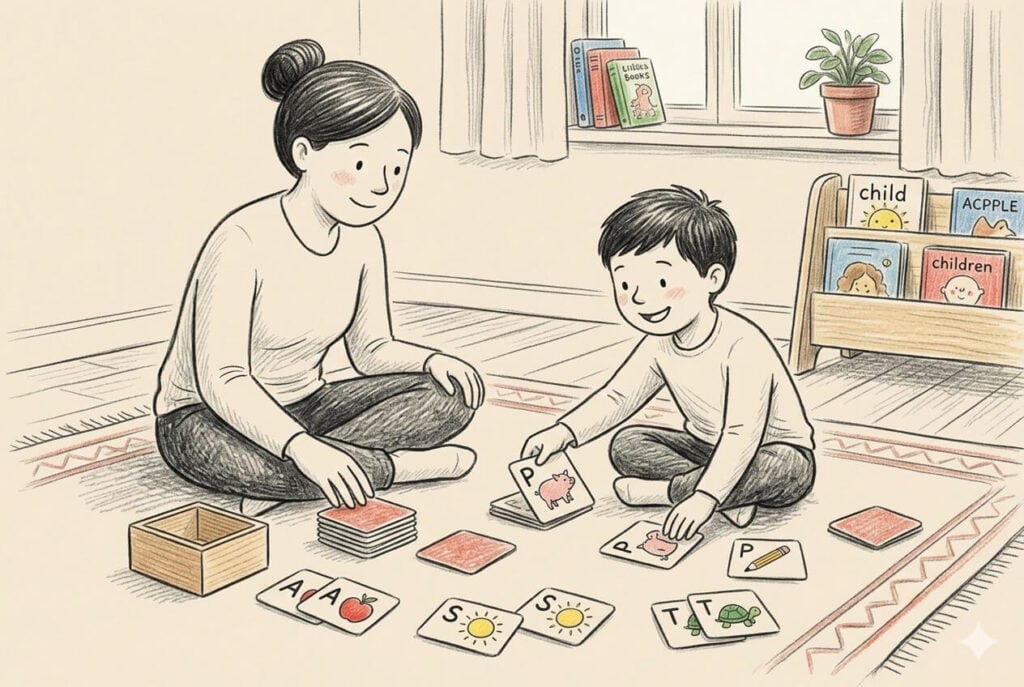
The best home reading practice doesn’t always feel like practice. Games, activities, and play-based approaches can develop exactly the same skills as drilling — phonological awareness, letter-sound knowledge, sight word recognition, vocabulary — while keeping the session something your child looks forward to rather than dreads.
Here are games that genuinely work, organised by the skill they build, with no-prep options at the top of each section.
Why games work better than drilling
Games reduce performance anxiety. When a child is playing, they’re focused on winning (or making you laugh, or beating their own score), not on whether they’ll get the answer right. That shift in focus makes it possible to practise skills that might otherwise trigger avoidance — particularly for children who’ve had negative experiences around reading.
Games also provide natural repetition. A snap game where you match tricky words involves looking at each word many times per session, without it feeling like drilling. The repetition that builds automaticity happens without the child noticing.
Bite-sized reading tips, straight to your inbox
Get confidence-boosting tips to help your child learn to read. Short, useful, and easy to fit into (real) family life!
Even better? You'll also get 30% off your first month of Reading Chest.
Games for phonics and sound awareness
These build the letter-sound knowledge and phonological awareness that underpins decoding:
- I Spy (with sounds, not letter names) — “I spy with my little eye something beginning with the /s/ sound.” Say the sound, not the letter name. Simple, zero prep, can be played anywhere.
- Car sound challenge — pick a sound before you get in the car. Every time you see something that starts with that sound (or contains it), call it out. Whoever spots the most wins.
- Digraph Detective — choose a digraph like sh and go on a hunt for words containing it: in books, on packaging, on signs. Works well for children working on digraphs in Year 1.
- Sound sorting — write some words on cards and sort them by their initial sound, their vowel sound, or a specific phonics feature. Works best with word sets from your child’s current phonics level.
- Clapping syllables — say a word and clap out the syllables together: “el-e-phant” (3 claps). Works for any word, any time, no materials needed.
Games for tricky word recognition
Tricky words need to be recognised automatically — rapid recognition built through repetition. These games make that repetition enjoyable:
- Tricky word snap — make two sets of tricky word cards (write them on small pieces of card) and play snap. When the same word appears twice in a row, the first player to say it wins the pile. Focus on the words your child’s school has sent home.
- Memory pairs — the same cards laid face down for a pairs game. Turning over cards and reading them aloud provides repeated exposure even when you don’t find a match.
- Fly swat — spread word cards on the table or floor. Call out a word and see who can swat it first. Competitive, physical, and effective.
- Word hunt in books — pick a tricky word your child is learning (like said) and see how many times you can find it in a book you’re reading together. Contextual exposure alongside game-play.
Our free tricky words list is a useful starting point for making your own sets of cards at home.
Games for vocabulary
Vocabulary development matters throughout the reading journey and responds well to playful approaches:
- 20 questions — one player thinks of something; the other asks yes/no questions to guess it. Develops vocabulary through the need to describe, categorise, and infer.
- Word associations — say a word; the next player says the first word that comes to mind. Keep going for as long as you can without repeating. Good for car journeys.
- Silly sentence builder — give yourself a category each (animals, foods, places, feelings) and build a sentence with one word from each category. The sillier the result, the better. Encourages experimenting with language.
- Word of the day — choose an interesting word in the morning and try to use it as many times as possible during the day. Keeps new vocabulary active.
Games for comprehension
Comprehension — understanding what you’ve read — is as important as decoding, and it develops through practice too:
- Predict-the-next-page — stop at the end of a page or chapter and ask: “What do you think will happen next?” Then read to find out. No special materials, just an engaged conversation.
- Story retelling — after finishing a book or chapter, ask your child to tell you what happened. This requires sequential processing and summarising — genuine comprehension skills.
- Character hot seat — you or your child “becomes” a character from a book they’ve read, and the other person asks questions. Develops inference and perspective-taking.
- Before-and-after questions — before reading, ask what they think the book will be about based on the cover and title. After, compare with what actually happened.
Quick-start activities from Reading Chest
These two activities from our collection are specifically designed for home use with early readers — no preparation needed:
Car sound challenge
Pick a sound before you set off, then race to spot it on signs, number plates and shop fronts. First to five wins. Road-trip phonics.
Goal
Turn travel time into quick, playful phonics practice — no prep, no extra kit, and works just as well for a 10-minute school run as a long motorway stretch.
You'll need
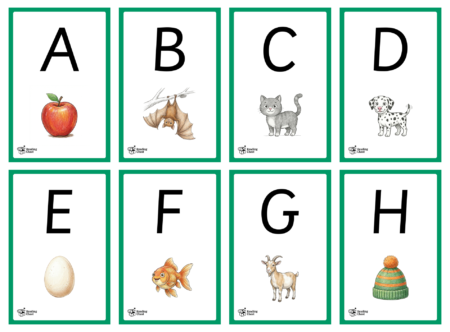
- Alphabet Picture Flashcards (Uppercase)
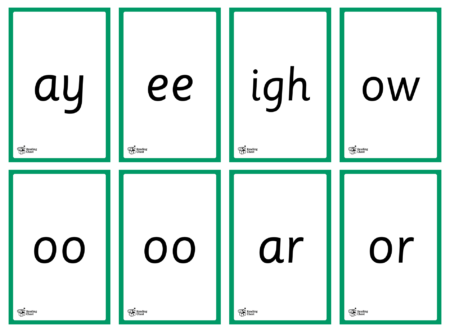
- Digraphs & Trigraphs Flashcards
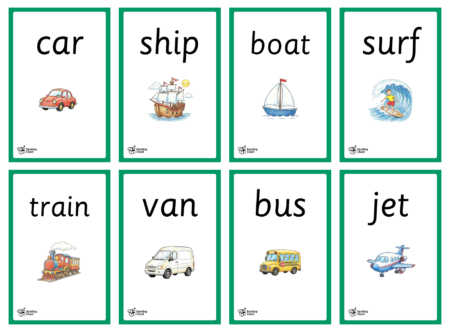
- Transport Phonics Flashcards

How to do it
Before you set off (or at a red light), choose a sound together — s, m, sh all work well. Say it a couple of times so it's in your heads.
As you drive, take turns spotting that sound: shop signs, number plates, lorry names. "Stop" has s and t and p — depending on your rules, that could be three points. First to five wins.
Use the flashcards as a reminder before you leave if needed. And yes, the driver does stay focused on the road.
Grab our resources
Print our alphabet picture flashcards (uppercase) and digraphs & trigraphs flashcards to get started.
Letter-sound treasure hunt
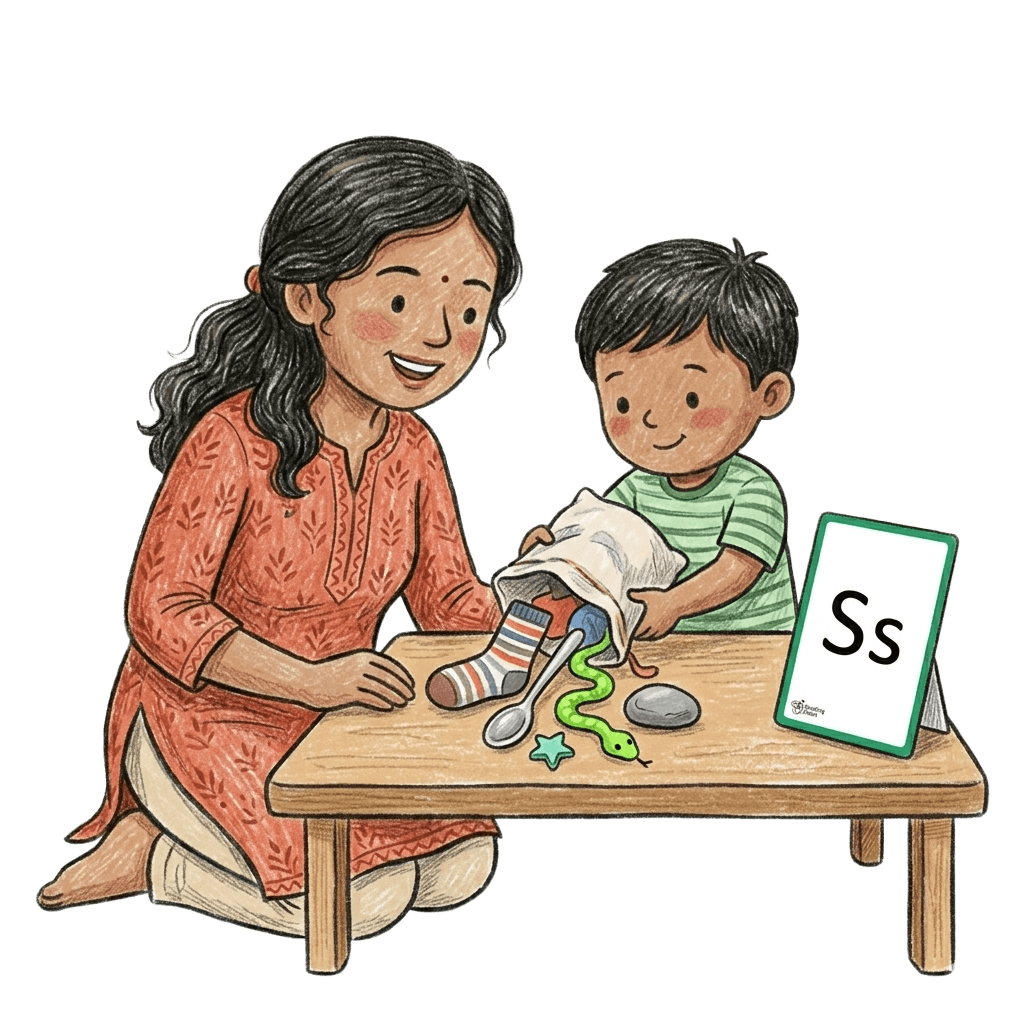
Choose a sound, then go on a hunt for things around the house that start with it. Say the sound each time you find one. Simple, active, effective.
Goal
Connect letter-sounds to real objects in the world — building phonemic awareness through a hunt that gets kids up and looking.
You'll need
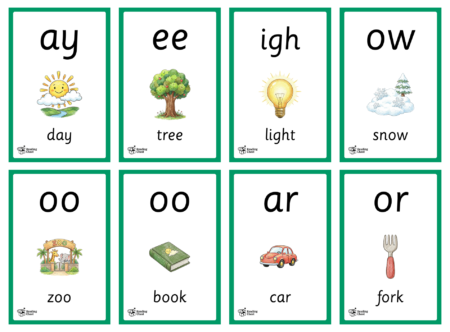
- Digraphs & Trigraphs Picture Flashcards
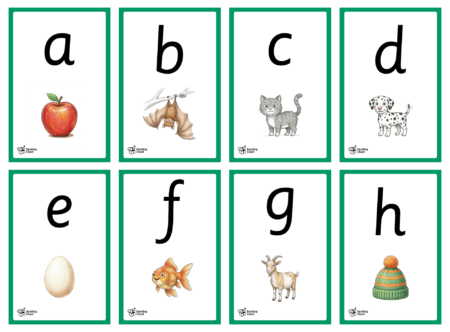
- Alphabet Picture Flashcards (Lower Case)
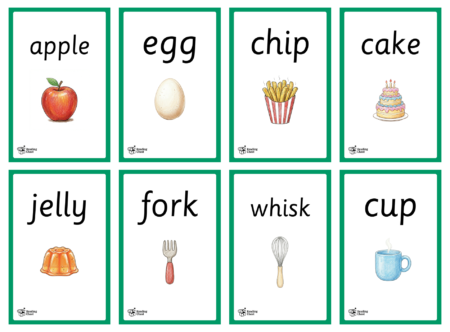
- Food Phonics Flashcards
How to do it
Choose a sound — s, p, ch or sh are good ones to start. Say it together clearly.
Now go on a hunt. How many things can you find around the house that start with that sound? Grab a bag or box and collect them, or just point and say the sound each time. You can use the food flashcards as a prompt — or check the kitchen for real examples.
Count up your finds at the end. Try a different sound next time and see which one wins. Great for getting children away from the table and still learning.
Grab our resources
Print our digraphs & trigraphs picture flashcards and alphabet picture flashcards (lower case) to get started.
For a broader set of phonics and reading activities matched to every stage, our full activities library has options you can filter by skill and age.
Frequently asked questions
Are phonics apps any good?
Some are. The best phonics apps — Phonics Hero, Reading Eggs, The Phonics App — are genuinely aligned with systematic phonics principles and provide good practice for the sounds being taught. The risk is that apps reward speed and completion in ways that encourage guessing rather than careful decoding. They’re best used alongside, not instead of, book reading and phonics practice with a parent. Our guide to the best phonics apps has more detail on which ones are worth using.
How long should a reading game session be?
Keep it short: five to ten minutes is plenty, especially for young children. The goal is to end the session while your child is still enjoying it, not to squeeze in as much practice as possible. Two five-minute sessions across a day are more effective than one twenty-minute session, and much more effective than one reluctant thirty-minute session. Stop before the enthusiasm runs out.
My child only wants to play the same game every day — is that okay?
Yes. Familiar games reduce the cognitive load of learning the rules, so more mental resource goes to the actual reading content. If your child wants to play the same snap game with tricky words every day for two weeks, that’s two weeks of spaced repetition with those words — which is exactly what builds automatic recognition. Follow their enthusiasm, even when it points at the same game repeatedly.
