Contents
A sight word is any word a reader recognises instantly — without needing to sound it out. It’s a fluency concept: words become “sight words” once a reader has encountered them enough times that recognition becomes automatic.
A tricky word, by contrast, is a specific UK phonics term for words that don’t follow regular phonics patterns and can’t easily be decoded — like the, said, or was. These need to be learned partly by sight because sounding them out doesn’t always work.
If you’ve seen both terms used and wondered whether they’re the same thing, they’re not — though they overlap. Here’s the difference, why it matters, and what to do at home.
What is a sight word?
The term “sight word” is most commonly used in American reading education and refers to words that fluent readers recognise on sight — instantly, without conscious decoding. Technically, any word can become a sight word once it’s been read enough times.
In US classrooms, “sight words” usually refers to high-frequency words from lists like the Dolch or Fry lists — common words that appear repeatedly in texts. The idea is that if children memorise these, they’ll be able to read more fluently because they’re not stopping to decode the most common words every time.
In UK phonics-based teaching, the term “sight word” is used much less. You’re more likely to hear “tricky words” or “common exception words” instead. But if your child is using an American reading app, or you’ve been looking at resources online, you’ll encounter “sight words” frequently — and it can create confusion if you’re not sure how it maps to what their school teaches.
Bite-sized reading tips, straight to your inbox
Get confidence-boosting tips to help your child learn to read. Short, useful, and easy to fit into (real) family life!
Even better? You'll also get 30% off your first month of Reading Chest.
What is a tricky word?
A tricky word, in the UK phonics context, is a word that contains a phoneme that’s represented in an unexpected or irregular way — one that a child can’t reliably decode using only the letter-sound knowledge they’ve been taught so far.
Classic examples:
- the — the e at the end is not silent in the usual way, and the th here is the voiced version
- said — the ai makes an /e/ sound, not the /ai/ sound a child would expect
- was — the a makes an /o/ sound
- come — the o makes a /u/ sound
- their, there, they — the ey or eir patterns aren’t what a beginner would predict
The tricky bit isn’t always that the word is impossible to decode; it’s that children encounter it before they’ve been taught the relevant spelling pattern. Said does follow a spelling rule — it’s just one that comes later in the programme.
Note: “common exception words” is the official National Curriculum term in England. “Tricky words” is programme-specific language used by RWI and others. They mean essentially the same thing.
Sight words vs tricky words: the key difference
Sight words are defined by how they’re read (automatically, without decoding). Tricky words are defined by their spelling (they don’t follow the phonics rules a child currently knows).
Over time, tricky words become sight words — once a child has encountered said enough times, they stop having to consciously work through it. It becomes automatic. So tricky words are a subset of eventual sight words.
The implication for parents is this: when your child’s school sends home tricky words to practise, they’re asking you to help your child build automatic recognition for words that their phonics knowledge alone won’t reliably decode. The goal is fluency, not just memorisation.
Common tricky words by year group
The National Curriculum specifies “common exception words” that children should be able to read by the end of each year group. These are the words that appear most frequently in early reading texts and that contain at least one irregular element.
Reception tricky words typically include: the, a, do, to, today, of, said, says, are, were, was, is, his, has, I, you, your, they, be, he, me, she, we, no, go, so, by, my, here, there, where, love, come, some, one, once, ask, friend, school, put, push, pull, full, house, our.
How to practise tricky words at home
Most phonics programmes advise against sounding out tricky words phonetically, because that can reinforce an incorrect reading. Instead, the recommended approach is rapid recognition practice: the child sees the word, says the word, moves on. Repetition over time builds automaticity.
Games work well for this because they reduce the performance pressure. Speed, competition, and repetition are all naturally present without it feeling like a drill.
These two activities are specifically designed for tricky word practice:
Tricky-word snap
Play snap with tricky word cards — but instead of shouting "snap!", shout the word. Fast, fizzy, and surprisingly effective.
Goal
Learn common tricky words by sight — through speed and repetition, not drilling.
You'll need
Tricky word cards — or just write common words on slips of paper.
How to do it
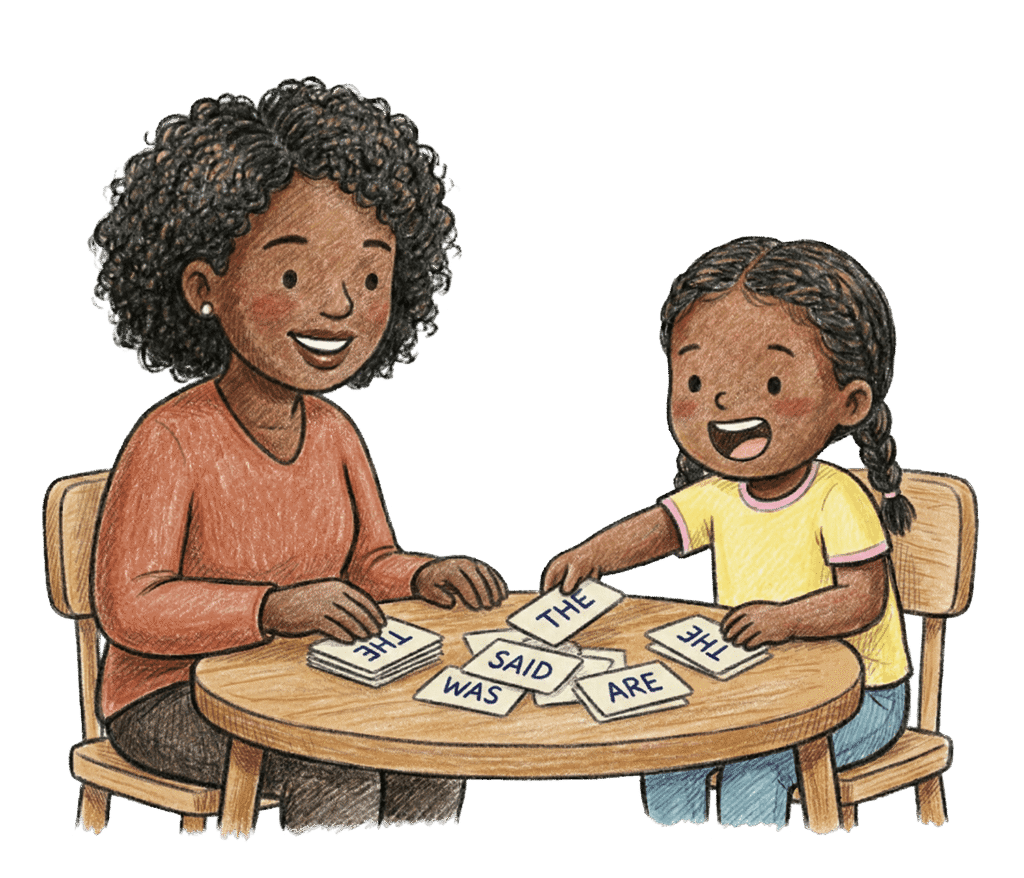
Deal the cards and play snap. When a match appears, shout the word aloud instead of "snap!" First one to say it correctly takes the pile.
If that's too chaotic — and it can be — try a calmer version: spread the cards out and take turns picking one up and reading it. Any word read correctly goes in your pile.
You can also call out a word and challenge your child to find it in the spread-out cards. That's a good middle ground between game and practice. Finish by reading through your pile together — a nice, low-key way to end the session.
Tricky-word memory
Play pairs with tricky word cards — turn two over, read them both, find a match. Classic memory game with real phonics value.
Goal
Practise recognising tricky words through a familiar game that makes repetition feel like play.
You'll need
- Tricky Word Cards
How to do it
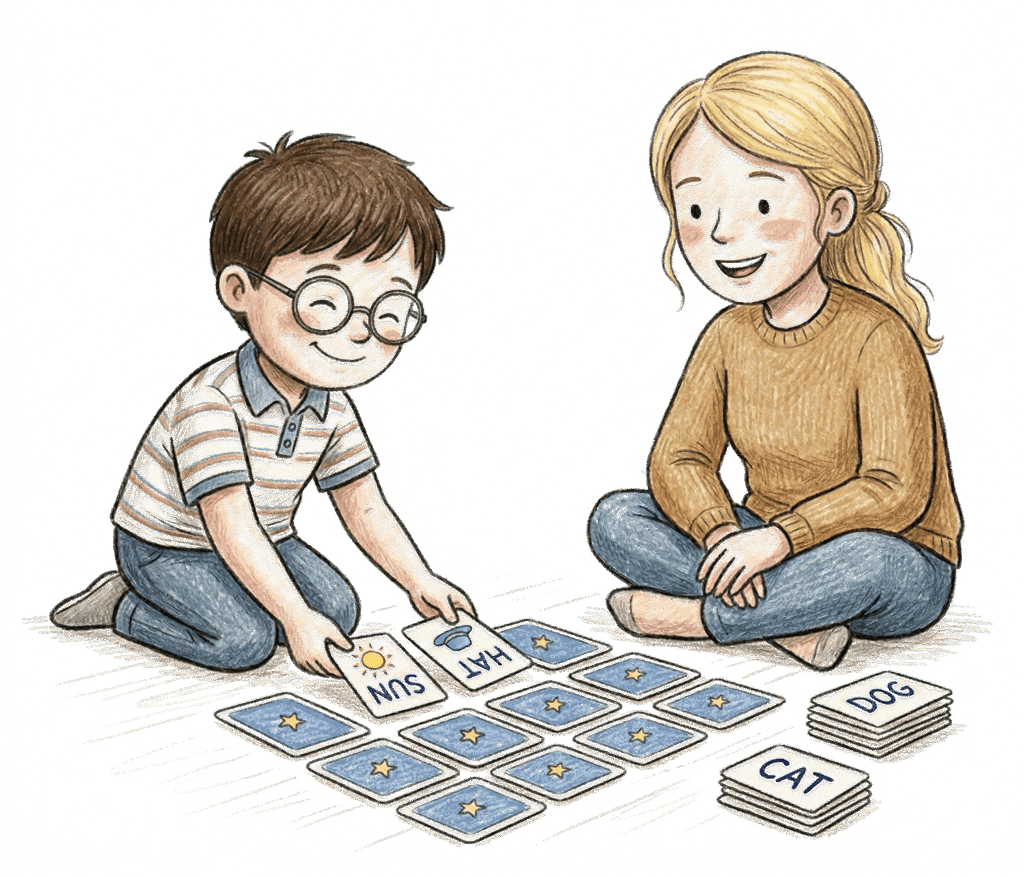
You'll need two of each tricky word card (print duplicates if needed). Place them face down in a grid. Take turns turning over two cards. Read each word aloud when you flip it — even if it's not a match.
If they match, keep the pair and go again. If not, turn them back over. The reading-aloud rule is important: every flip is a chance to practise the word, not just find pairs.
Play until all pairs are found. The winner is whoever has the most pairs — but honestly, the number of times each word gets read is the real prize. Tricky words need repetition, and this is a genuinely painless way to get it.
Grab our resources
Print our tricky word cards to get started.
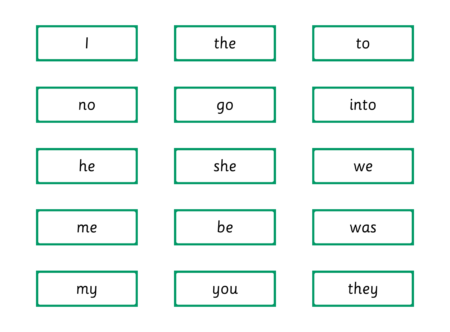
We also have a free printable tricky words list and tricky word cards in our resources section — handy for making your own sets for games at home.
Frequently asked questions
Are tricky words just memorised?
Partly, but not entirely. Children are taught that tricky words have one part that’s tricky (the irregular bit) while the rest may be decodable. For said, the tricky part is the ai (which makes an unexpected sound) — but the s and d are phonics-friendly. The goal is for the whole word to become automatically recognised with practice, not memorised letter by letter.
Should I correct my child when they try to sound out a tricky word?
Gently, yes. If your child sounds out said as sighed or sayed, you can say “that’s a tricky word — it’s said” and move on. Don’t dwell on it. Repeated gentle correction over time, combined with recognition practice, is what builds the right response.
Avoid saying “just remember it” — that doesn’t give children a strategy. “That’s a tricky word” signals that there’s a reason it doesn’t sound right, which is genuinely reassuring.
My child’s school calls them “common exception words” — is that the same thing?
Yes. “Common exception words” is the National Curriculum terminology; “tricky words” is the term used by programmes like Read Write Inc. They refer to the same category of words — high-frequency words with at least one irregular spelling element.
Do sight words differ between the UK and US?
Yes — quite a bit. US sight word lists (Dolch and Fry) were developed for a reading approach that relies heavily on memorisation. UK phonics programmes focus on decoding first and only introduce “tricky words” for genuine exceptions. The word lists overlap, but the teaching philosophy is different. If you’re using American resources with a UK-schooled child, be aware that not everything will map directly onto what their teacher expects.
