Contents
A digraph is two letters that work together to make a single sound — like sh in shop or ai in rain. The two letters can’t be sounded out separately; they always act as a team.
If you’ve come home from parents’ evening with the word “digraph” bouncing around your head, you’re in the right place. Here’s everything you need to know — with examples — plus some easy ways to practise at home.
Digraphs are one of the concepts that can catch parents off-guard because the word sounds more complicated than the idea actually is. Once you’ve got it, it makes a lot of other phonics vocabulary click into place too.
Consonant digraphs
Consonant digraphs are the most common type. They’re formed from two consonants that combine to make a single sound — different from either letter on its own.
The ones children typically encounter first are:
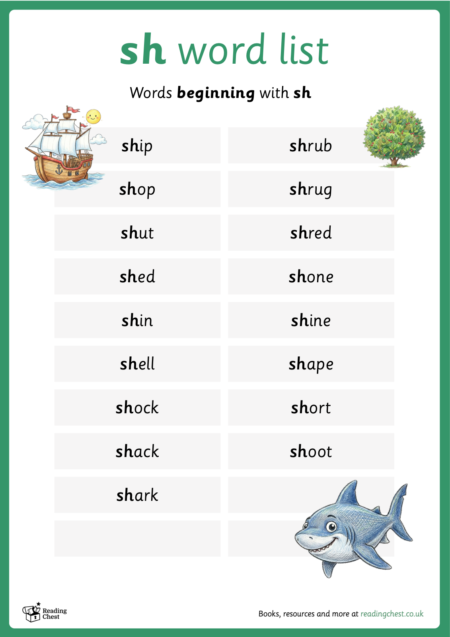
- sh — ship, fish, shell
- ch — chin, much, chat
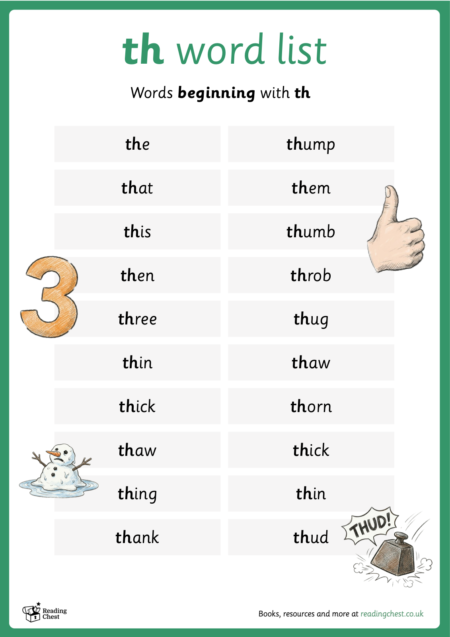
- th — this, thin, with (note: th has two sounds — the voiced version in this and the unvoiced version in thin)
- wh — when, what, wheel
- ph — phone, photo, graph
- ck — back, duck, trick
- ng — ring, song, long
- nk — think, bank, sink
Note: some programmes treat nk as a digraph, others as a consonant cluster. How it’s taught depends on which phonics scheme your child’s school uses — but either way, the sound is the same.
Bite-sized reading tips, straight to your inbox
Get confidence-boosting tips to help your child learn to read. Short, useful, and easy to fit into (real) family life!
Even better? You'll also get 25% off your first month of Reading Chest.
Vowel digraphs
Vowel digraphs are two vowels (or a vowel and a consonant) that combine to make a single vowel sound. These come later in most phonics programmes because there are more of them and they can represent sounds in multiple ways.
Common vowel digraphs include:
- ai — rain, tail, paid
- ee — feet, tree, green
- oa — boat, road, coat
- oo — moon, book (note: oo can represent two different sounds, as in moon vs book)
- ou — shout, cloud, found
- oi — coin, boil, point
- aw — paw, saw, draw
- ew — new, grew, flew
This is often where children start to notice that English spelling isn’t entirely logical. The sound represented by ai in rain can also be spelled ay (as in day) or a-e (as in make). That’s just how English works — and schools teach these alternative spellings as children move through the programme.
Split digraphs (magic e)
A split digraph is a special type of vowel digraph where the two letters are separated by a consonant. The most familiar example is the “magic e” or “silent e” pattern:
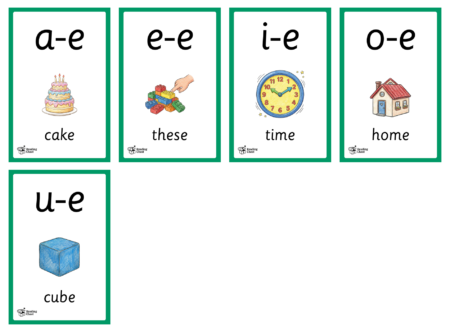
- a-e — make, cake, name
- i-e — ride, kite, time
- o-e — home, bone, note
- u-e — tune, cube, flute
- e-e — these, theme, eve
The “e” at the end makes the vowel in the middle say its long sound. Children are often taught this as “the e at the end waves to the vowel in the middle and changes its sound.” It’s a simplification, but a genuinely useful one at this stage.
Split digraphs are technically still digraphs — two letters, one vowel sound — but because the letters are split apart, many teachers introduce them separately rather than alongside simple digraphs.
How digraphs are taught in school
In most phonics programmes, children learn consonant digraphs fairly early — often in the second half of Reception or beginning of Year 1 — once they have a secure set of individual letter sounds. Vowel digraphs typically come next, followed by split digraphs and more complex patterns.
The teaching approach is the same as for single sounds: the child learns that sh is one sound (not “s” and then “h”), practises reading and spelling words that contain it, and then applies it in decodable books that use only the sounds they’ve been taught so far.
Some schools — particularly those using Read Write Inc — call digraphs “special friends.” The name is different but the concept is identical. Our guide to special friends explains the RWI terminology if that’s what your child’s school uses.
How to practise digraphs at home
The most effective practice is spotting digraphs in real words — reading and writing, not just pattern-matching in isolation. Here are a few approaches that work well:
- Digraph hunt — open any page of a book together and look for all the words containing a particular digraph. sh is a good one to start with because it’s easy to spot and appears frequently.
- Word sorting — write some words on slips of paper and sort them by digraph. This helps children internalise the pattern rather than just memorise individual words.
- Sound swapping — take a CVC word like cat and swap the first sound for ch to make chat. Which other digraphs can go at the start? This kind of play with sounds builds flexibility.
This activity is a good structured way to practise spotting digraphs in the wild — it works well for sh, ch, th and beyond:
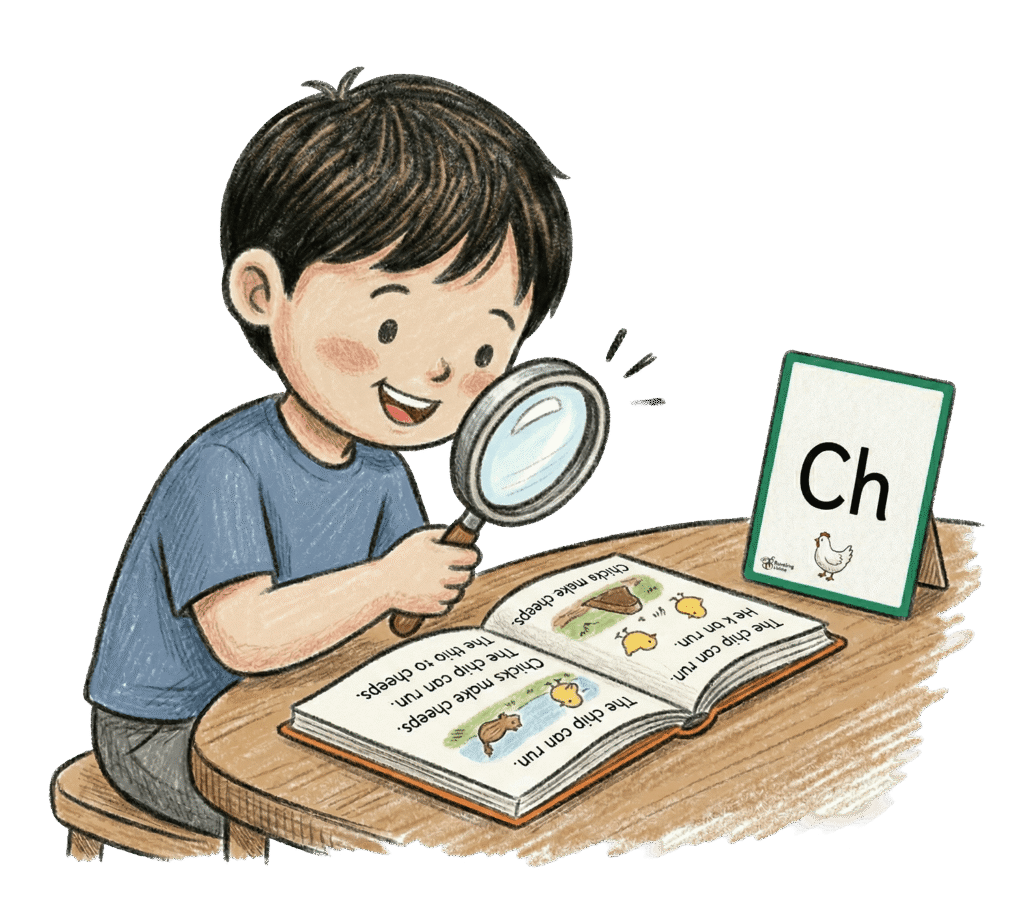
Digraph detective
Pick a digraph — sh, th, ch, ng — and go hunting. How many times can you spot it hiding in words on a page, a sign, a cereal box? Detective hats on.
Goal
Train your child's eye to spot digraphs in real text — so they stop seeing two letters and start seeing one sound.
You'll need
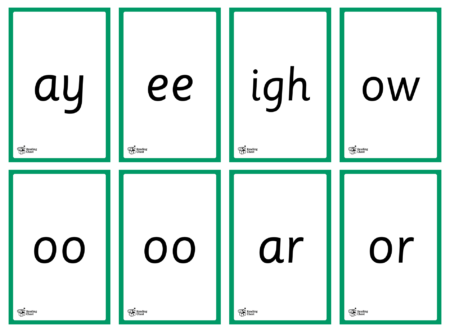
- Digraphs & Trigraphs Flashcards
- Phonics "sh" words list
- Phonics "th" words list
How to do it
Choose one digraph to focus on — sh, th, ch or ng are all great options. Say it together a couple of times so it's fresh in their mind.
Then hunt. Open a book, use a word list, or scan whatever's nearby — packaging, posters, signs. Every time they spot the digraph in a word, they point and say the sound. Count how many you find.
Keep it relaxed. You're not testing whether they can read every word — you're just training their eye to notice the pattern. That noticing is half the battle with digraphs.
Grab our resources
Print our digraphs & trigraphs flashcards and phonics "sh" words list to get started.
If your child is starting to work on split digraphs (magic e), this one is specifically designed for that pattern:
Split digraph spotlight
Focus on the magic e — words like "make", "bite", "rope", where a silent e at the end changes the whole vowel sound. Once they spot the pattern, it sticks.
Goal
Understand how a silent e turns a short vowel into a long one — one of those rules that unlocks a huge number of new words at once.
You'll need
- Split Digraph Flashcards
How to do it
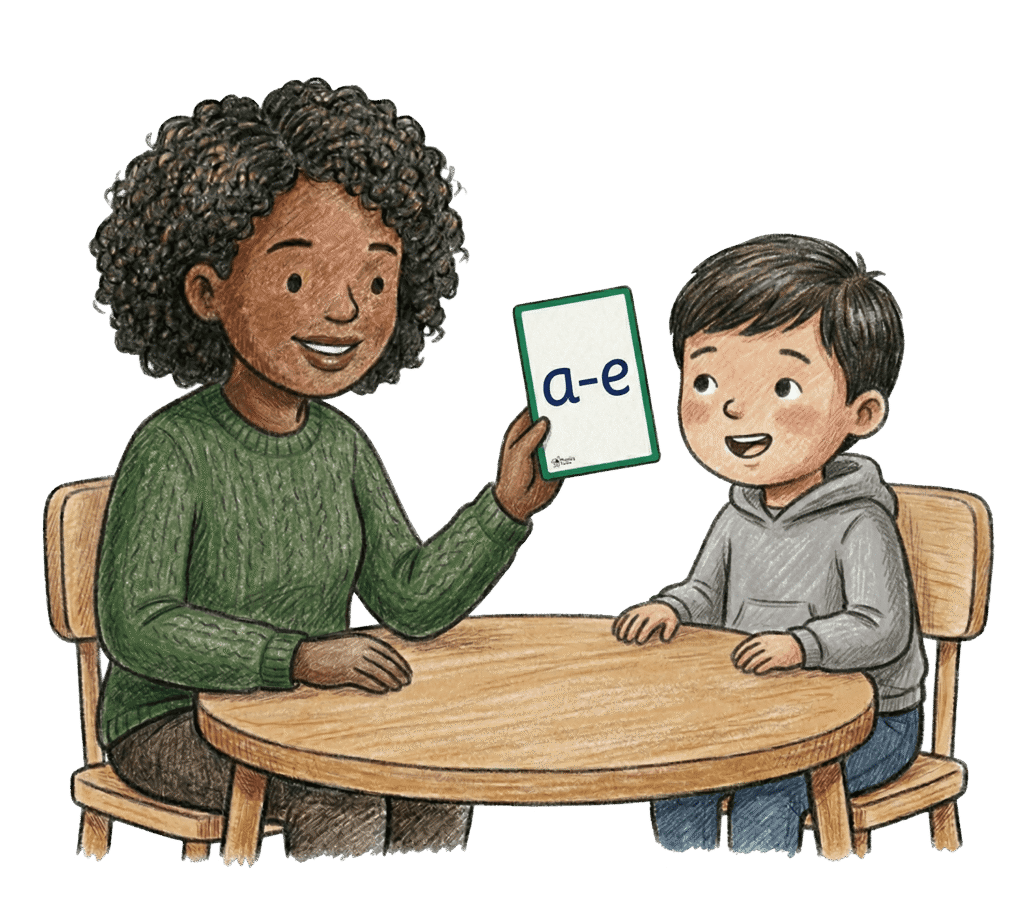
Show your child a split digraph word — "make" or "rope" are good starting points. Point out the pattern: vowel, consonant, then e at the end. The e is silent, but it reaches back across the consonant to change the vowel sound.
Compare pairs: "cap" vs "cape", "bit" vs "bite", "hop" vs "hope". Say both versions together and let the difference land. The silent e is doing a lot of quiet work.
Work through the flashcards. When they've got the pattern, see if they can find split digraph words in a book. That moment of spotting it in the wild is when you know it's clicked.
Grab our resources
Print our split digraph flashcards to get started.
Free digraph resources
We’ve got free printable flashcards for digraphs and trigraphs, plus word lists specifically for sh and th words if you want something to practise with at home. You can find them all in our free resources section.
Frequently asked questions
What is the difference between a digraph and a blend?
A digraph is two letters that make one sound (sh, ch, ai). A blend is two consonants that each keep their own sound but sit together — like bl in black or st in stop. With a blend, you can still hear both letters; with a digraph, the two letters fuse into something new.
How many digraphs are there in English?
There are around 20–25 common digraphs taught in UK primary phonics programmes, including both consonant and vowel digraphs. The exact number depends on how you count alternative spellings for the same sound (for example, ai, ay, and a-e all represent the same vowel sound).
Is “ck” a digraph?
Yes — ck is a consonant digraph. The two letters make a single /k/ sound, as in back, duck, or trick. It appears at the end of words after a short vowel sound, which is one of the patterns children learn when they first encounter it.
What is a vowel digraph?
A vowel digraph is two letters — usually two vowels, or a vowel and a consonant — that work together to make a single vowel sound. Examples include ai (rain), ee (feet), oa (boat), and oo (moon). They’re sometimes called vowel teams.
What comes after digraphs in phonics?
After digraphs, children typically move on to trigraphs (three letters, one sound — like igh in light), alternative spellings for the same sounds, and eventually less common patterns. Our guide to trigraphs explains the next step.
