Contents
A trigraph is three letters that work together to make a single sound — like igh in light or ear in hear. Just like a digraph, the letters can’t be sounded out separately; they act as a team.
Most parents have come across the term “digraph” by the time they encounter “trigraph” — and the principle is exactly the same, just with three letters instead of two. If your child is working on sounds like igh, air, or dge, they’re in trigraph territory.
Here’s a plain-English guide to what trigraphs are, which ones matter most, and how to help at home without needing a phonics qualification.
Common trigraphs in English
There aren’t as many trigraphs as digraphs, which is a relief. The main ones children encounter in UK primary phonics programmes are:
- igh — makes the long /i/ sound: light, night, right, flight, tight
- ear — makes the /ear/ sound: hear, fear, near, dear, year
- air — makes the /air/ sound: hair, fair, pair, chair, stair
- ure — makes the /ure/ sound: pure, cure, sure, lure
- ore — makes the /or/ sound: more, bore, core, store, shore
- dge — makes the /j/ sound at the end of words: bridge, hedge, badge, lodge, nudge
- tch — makes the /ch/ sound: match, catch, fetch, witch, hutch
Some of these will look like perfectly ordinary words to you — which is exactly the point. Once you know the term “trigraph,” you start seeing them everywhere.
Bite-sized reading tips, straight to your inbox
Get confidence-boosting tips to help your child learn to read. Short, useful, and easy to fit into (real) family life!
Even better? You'll also get 25% off your first month of Reading Chest.
Why trigraphs can trip children up
The main challenge with trigraphs is the same as with digraphs: children have to resist the urge to sound out each letter individually. A child who encounters light for the first time and tries to sound out l–i–g–h–t will tie themselves in knots. The key is learning to recognise the unit igh as a single sound, not three.
This takes practice. It’s genuinely not obvious to a child that three letters they know perfectly well (i, g, h) suddenly behave completely differently when they appear together. Give it time — and give it plenty of examples.
Note: some phonics programmes classify ear, air, and ure as trigraphs while others treat them as vowel digraphs followed by /r/. Don’t worry about which camp your child’s school falls into — the sounds and the words are identical either way.
How trigraphs are taught in school
Trigraphs are introduced after children have a solid grasp of single sounds and digraphs — typically in Year 1 or Year 2. They appear later in most phonics programmes precisely because they’re more complex, not because they’re less common (words like light, right, and night come up all the time in reading).
The approach is the same as for digraphs: children learn the sound the trigraph represents, practise reading and spelling words containing it, and apply the knowledge in decodable books that use only sounds they’ve been taught. Repetition across lots of different words is what makes the pattern stick.
If your child’s school uses Read Write Inc, trigraphs tend to appear in the Set 2 and Set 3 sounds — so if your child is working on those, trigraphs are on the agenda.
Digraphs vs trigraphs: what’s the difference?
Just the number of letters involved. A digraph is two letters making one sound; a trigraph is three letters making one sound. Both are examples of graphemes — the written representation of a phoneme.
In practice, children don’t always need to know the technical distinction between the two. What matters is that they recognise the letter grouping as a unit and can reliably read and spell words that contain it. The terminology is useful for parents and teachers communicating about what a child is working on — it’s not a test the child needs to pass.
How to practise trigraphs at home
The best practice is reading words that contain the trigraph, not just drilling the sound in isolation. Here’s what works well:
- Word lists — write out a set of igh words together (or ask your child’s teacher for the current one). Read through them, spell a few, and try to spot them in a book.
- Word families — igh words make a particularly nice word family: light, night, right, tight, fight, sight, might. Rhyming families like this are easy to practise together and they sound satisfying.
- Reading decodable books — once your child’s programme has introduced a trigraph, their school books should contain words with it. If you want extra practice material, you can browse books by level on Reading Chest to find ones that cover the sounds your child is currently working on.
This activity works well for any sound your child is currently learning, including trigraphs:
Digraph detective
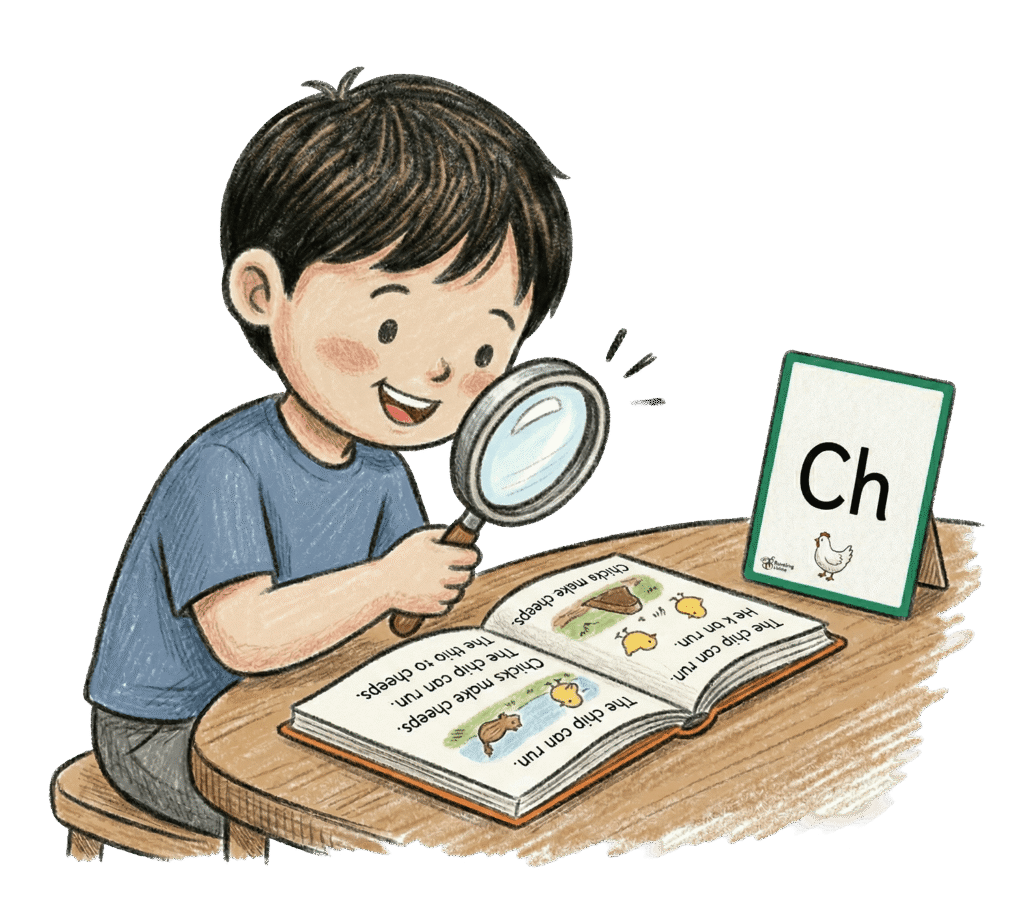
Pick a digraph — sh, th, ch, ng — and go hunting. How many times can you spot it hiding in words on a page, a sign, a cereal box? Detective hats on.
Goal
Train your child's eye to spot digraphs in real text — so they stop seeing two letters and start seeing one sound.
You'll need
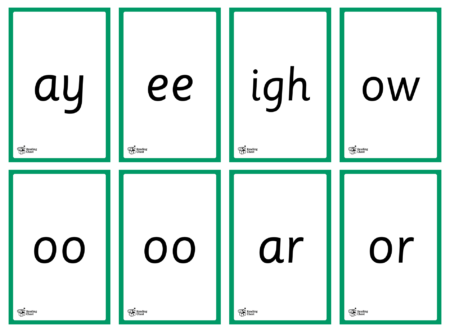
- Digraphs & Trigraphs Flashcards
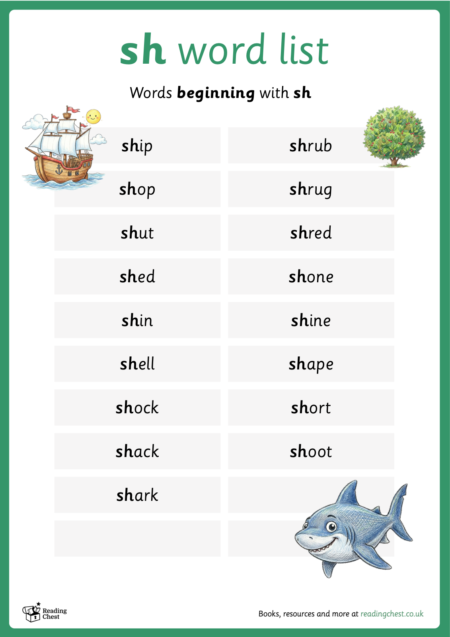
- Phonics "sh" words list
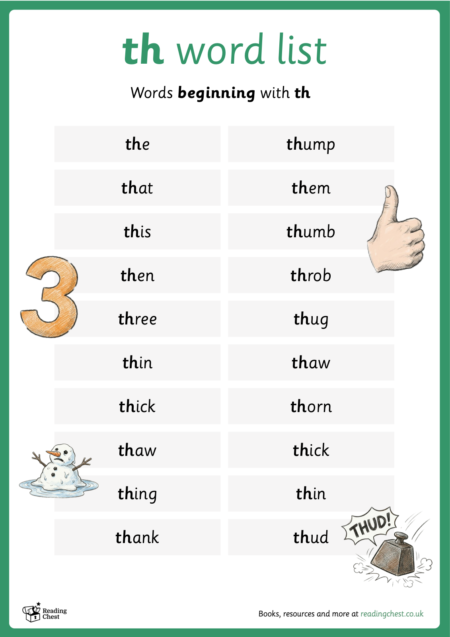
- Phonics "th" words list
How to do it
Choose one digraph to focus on — sh, th, ch or ng are all great options. Say it together a couple of times so it's fresh in their mind.
Then hunt. Open a book, use a word list, or scan whatever's nearby — packaging, posters, signs. Every time they spot the digraph in a word, they point and say the sound. Count how many you find.
Keep it relaxed. You're not testing whether they can read every word — you're just training their eye to notice the pattern. That noticing is half the battle with digraphs.
Grab our resources
Print our digraphs & trigraphs flashcards and phonics "sh" words list to get started.
And this one is particularly good for building familiarity with a whole set of words sharing the same sound:
Sound search in books
Pick a sound, open a book and hunt for it on the page. Quick phonics practice that connects to real text rather than a worksheet.
Goal
Spot target sounds in real text — building the sound-symbol connection in context, where it actually matters.
You'll need
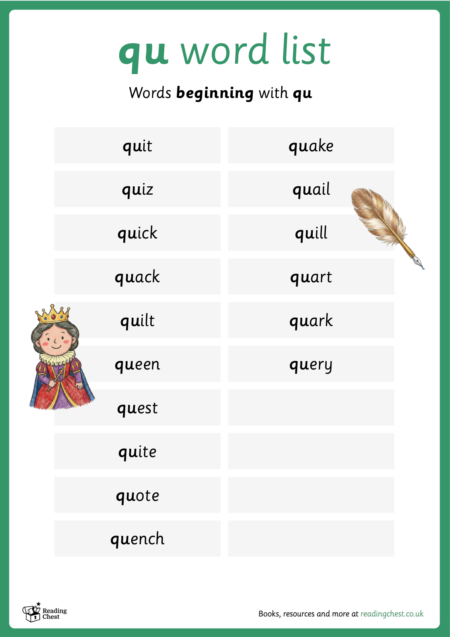
- Phonics "qu" words list
- Phonics "th" words list
- Phonics "sh" words list
How to do it
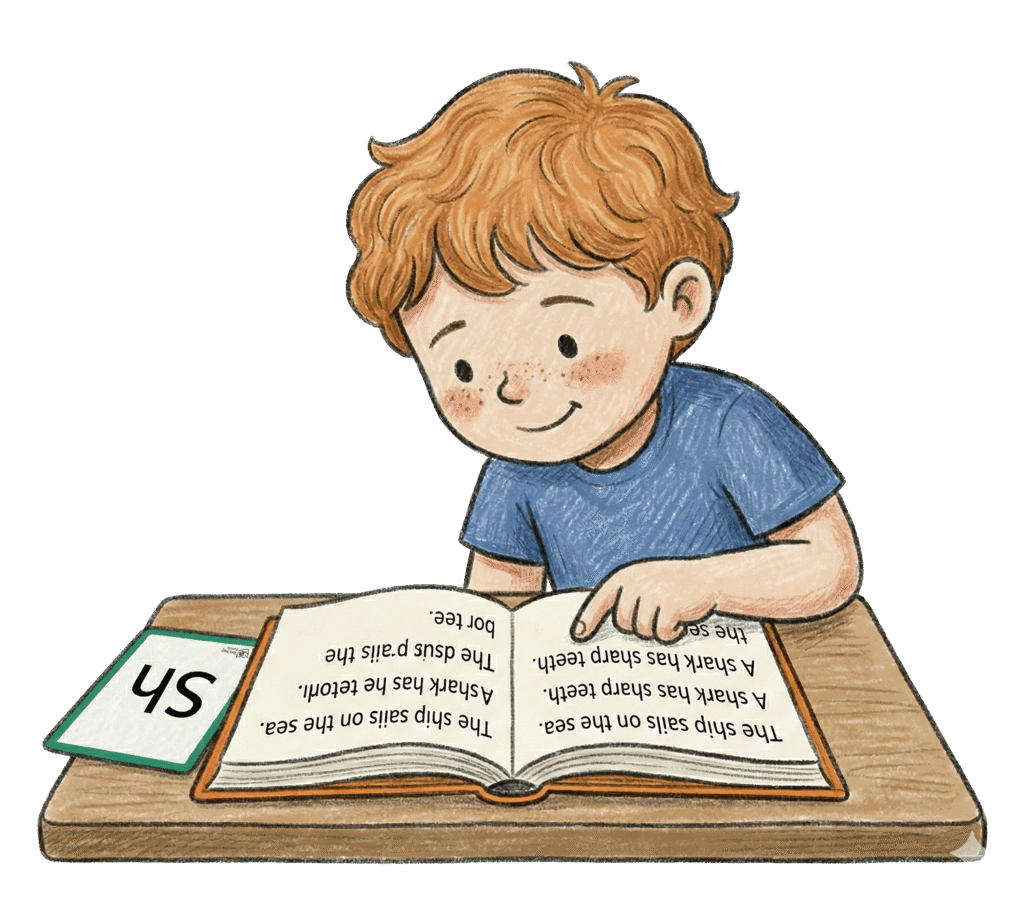
Choose a sound to focus on — sh, th or qu are great starting points. Say it together. Then open a book and start scanning.
Every time your child spots that sound in a word, they point and say it. Count how many you find on one page — then try another. Use the word lists as a warm-up if they need to see the sound in isolation first.
This one's fast — five minutes is plenty. The value is in connecting the sound to real words in real sentences, not just practice words on a card.
Grab our resources
Print our phonics "qu" words list and phonics "th" words list to get started.
Free resources
Our digraph and trigraph flashcards cover all the main letter groups in one printable set — handy to keep on the fridge or bring out for a quick five-minute session. You can find them in our free resources section.
Frequently asked questions
What is the most common trigraph?
igh is probably the trigraph children encounter most often, because it appears in very common words like light, night, right, might, and flight. It’s usually one of the first trigraphs taught.
Is “tch” a trigraph?
Yes — tch is a trigraph. The three letters make the same /ch/ sound as the digraph ch, but tch typically appears after a short vowel at the end of a word — as in catch, fetch, witch, and hutch.
When do children learn trigraphs?
Most children begin learning trigraphs in Year 1 or Year 2, after they’ve covered single sounds and common digraphs. The exact timing depends on which phonics programme their school uses and how quickly they’re progressing through it.
How can I tell if a word contains a trigraph?
Say the word aloud and count the sounds. If three letters in a row make just one sound, it’s a trigraph. In night, the igh is one sound — so those three letters are a trigraph. Once you know the main ones (igh, ear, air, dge, tch), you’ll start spotting them naturally.
