Contents
A children’s book club is one of those ideas that sounds wonderful in theory and then sits in the “one day” pile because it’s not obvious how to start. Who organises it? How do you choose the books? What actually happens at a meeting?
The good news: a children’s book club doesn’t have to be complicated. A small group of children, a shared book, and a few good questions are all you really need. This guide walks through the practical steps — from deciding on the format to keeping it going after the initial enthusiasm fades.
Book clubs work. They give children a reason to read, a community to talk with about books, and practice in expressing and defending opinions. The format just needs to be simple enough to sustain.
Decide on the format first
Before you invite anyone, settle the basics: who, how many, how often, and where.
| Group size | Four to eight children is usually ideal. Small enough for everyone to contribute; large enough to generate different opinions. With younger children (Year 1–2), four is usually plenty. |
|---|---|
| Age range | A mixed-age group can work well if the gap isn’t too large and the books are chosen accordingly. Within two school years tends to be more manageable than a wider spread. |
| Frequency | Monthly is sustainable. Every two weeks if the group is keen and the books are short. More frequent than that tends to burn out quickly, especially for parents organising it. |
| Location | Someone’s home, a library meeting room, a school’s reading corner after hours — anywhere comfortable without too many distractions. Libraries sometimes offer free rooms for community groups; it’s worth asking. |
Bite-sized reading tips, straight to your inbox
Get confidence-boosting tips to help your child learn to read. Short, useful, and easy to fit into (real) family life!
Even better? You'll also get 30% off your first month of Reading Chest.
How to choose what to read
Book selection is often where book clubs get complicated. A few principles that help.
Choose books everyone can actually finish. If children are going to arrive having read the book, it needs to be achievable. For younger readers, picture books or short illustrated chapters. For older readers, a chapter book read over a month — but not an intimidatingly long one.
Rotate who chooses. Letting each child take a turn picking the book gives everyone ownership and exposes the group to books they might not have chosen themselves, which is half the point.
Aim for books with something to talk about. Not every excellent book generates good discussion. Books with moral dilemmas, complex characters, unexpected endings, or themes connected to the children’s own lives tend to produce the most interesting conversations. If the book raises a genuine question — “Was she right to do that?” “Why do you think he lied?” — it’s probably a good book club book.
Some children will arrive not having finished the book. Decide in advance how to handle this — either normalise it (“it’s fine, we’ll talk about what you did read”) or make clear that finishing is the expectation. Both approaches can work; the key is consistency.
Running a book club meeting
A typical children’s book club meeting might last 45 minutes to an hour and follow a loose structure: a few minutes of settling in before you start; an opening question (something general that everyone can answer, like “What was your first reaction when you finished?”); two or three more specific discussion questions; and a closing activity — rating the book out of five, choosing the next one, or a simple creative prompt.
The adult’s role is to facilitate, not lead. Resist the urge to fill silences immediately or provide the “right” answer. Children who are given space to disagree with each other — and with adults — develop genuine critical thinking skills. A book club where everyone ends up agreeing with the facilitator hasn’t quite worked.
Discussion questions that work across any book
- If you could ask the main character one question, what would it be?
- Was there a moment where you didn’t understand why a character did what they did?
- Did the ending feel right to you? What would you have changed?
- What do you think the author is trying to say?
- Would you recommend this book — and if so, who would enjoy it most?
How to keep the book club going
Many book clubs start with energy and then quietly dissolve. The most common reasons: it becomes too complicated to organise, children drift in and out and the group loses coherence, or the books consistently don’t generate good discussion.
The simplest fix is to keep the structure light. Dates set several months ahead, a group chat for reminders and chatter, and a democratic approach to book selection all reduce friction. If it becomes a burden for the organiser, it stops happening — so minimise the admin from the start.
It also helps to give the club an identity. A name, a shared record of books read, a set of running jokes — small things that make children feel they’re part of something rather than just attending a meeting.
Try this activity
This activity gives children a ready-to-use framework for a short, structured book club discussion — ideal for a first meeting or when a group needs a bit of direction:
Start a mini book club
Read the same book as a friend or sibling, then sit down with a review sheet and chat about it. A book club that actually fits into real life.
Goal
Share a reading experience and practise talking about books with someone else — because reading is better when it's discussed.
You'll need
- Beginner Book Review
- Intermediate Book Review
- Advanced Book Review
How to do it
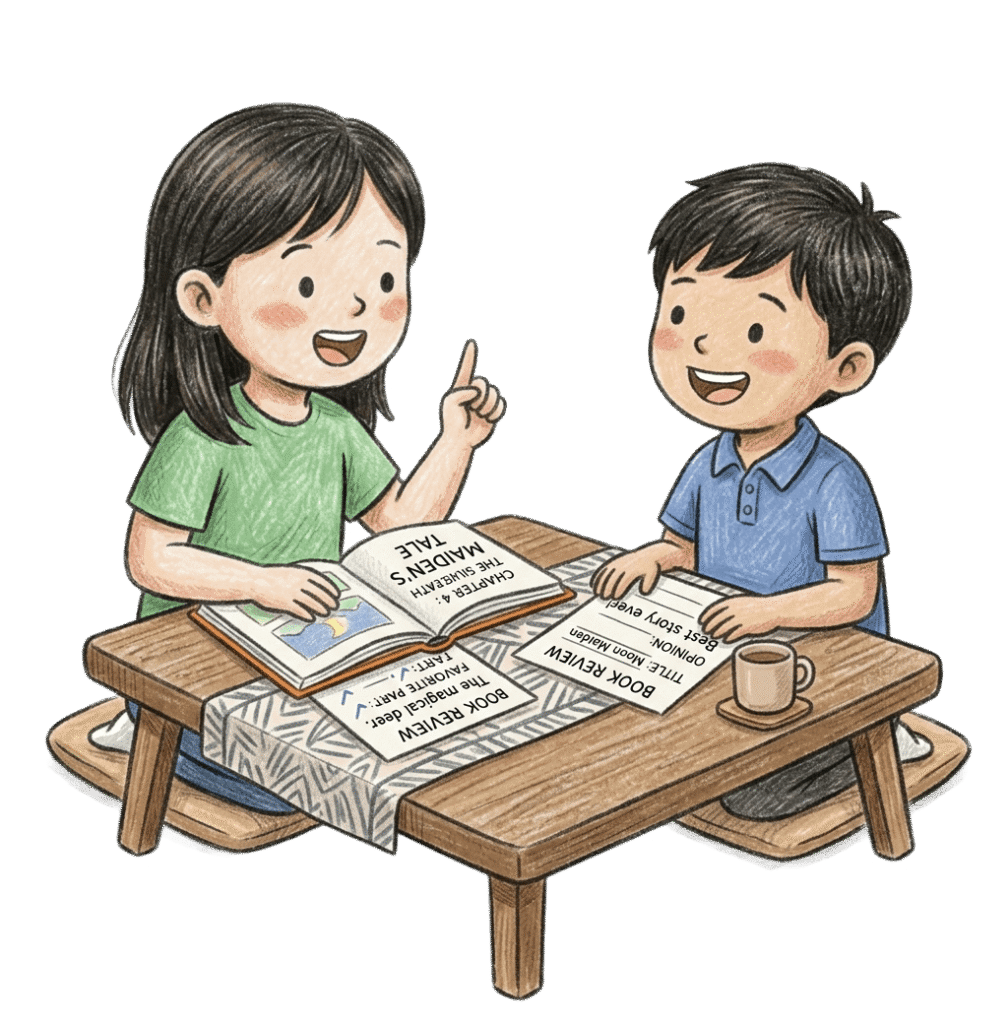
Choose a book with a friend or sibling — either read it together, take turns with the same copy, or each read your own. When you're both done, sit down for the "book club" bit.
Use the book review sheet as a conversation starter. What did they like? What would they change? Did they like the ending? Would they recommend it? There are no wrong opinions — you're just getting used to the idea that books are worth talking about.
Keep it short and relaxed. Ten minutes of genuine conversation beats an hour of answering comprehension questions. The goal is enthusiasm, not analysis.
Grab our resources
Print our beginner book review and intermediate book review to get started.
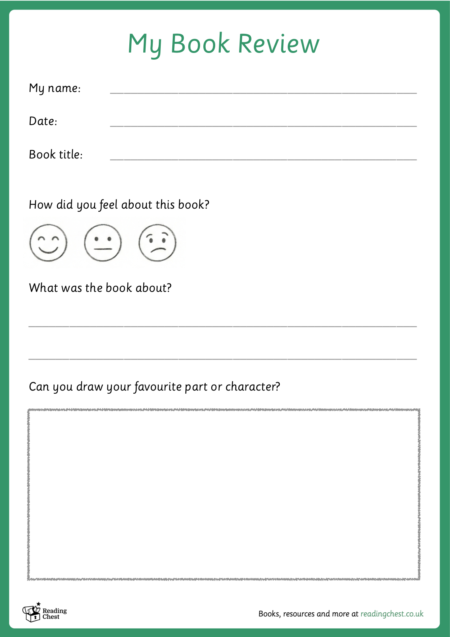
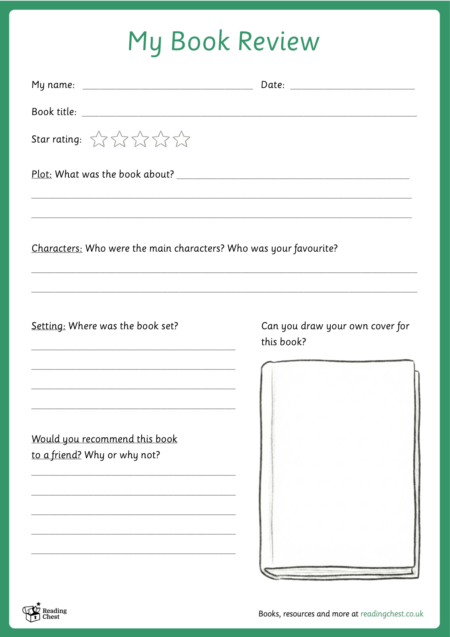
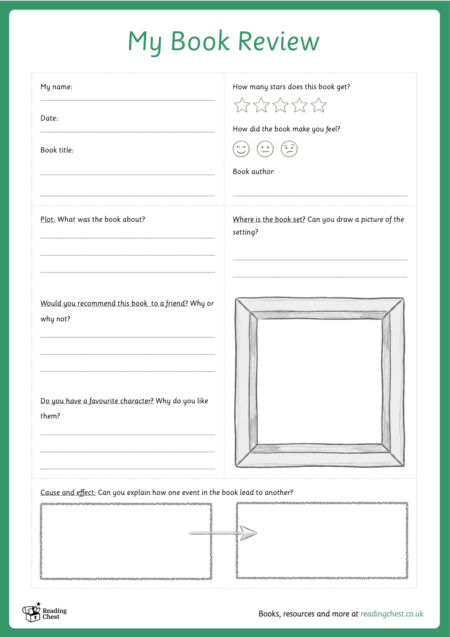
Reviewing the book after discussing it gives children a way to consolidate their thinking and practise writing with a real purpose:
Write a book review
Fill in a short review while the book is still fresh — favourite moments, characters, whether they'd recommend it. Turns opinion into words.
Goal
Help your child organise their thoughts about a book and practise putting opinions into words — a skill that gets easier every time you do it.
You'll need
- Beginner, Intermediate or Advanced Book Review template — pick the right one for your child
- A book they've just finished
- Pencil and colouring pens
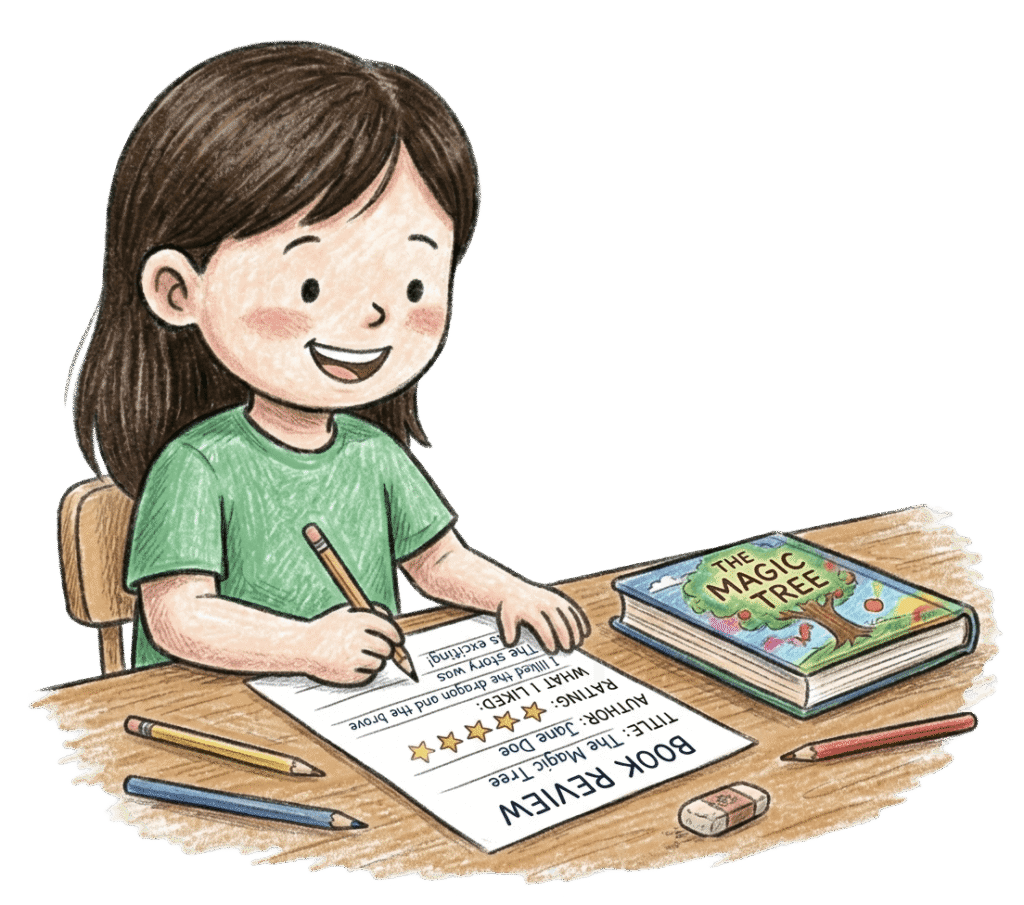
How to do it
Choose the right template — beginner for younger or less confident writers, advanced for those who have plenty to say. Sit down together soon after they've finished the book, while it's all still clear in their mind.
Go through the review together rather than leaving them to fill it in alone. Ask the questions out loud first: "What was your favourite bit? Who was your favourite character? Would you tell a friend to read it?" Let them answer verbally, then help them put the answer into the box.
The goal isn't a perfectly written review — it's the habit of thinking carefully about a book and forming an opinion. That habit, practised regularly, builds real readers.
Grab our resources
We have beginner, intermediate and advanced book review templates — pick the one that matches your child's confidence and let them share their thoughts.
Frequently asked questions
What age can children join a book club?
Book clubs for young children (from around age 5) work best with picture books and simple, guided discussion rather than open-ended conversation. Children from about Year 3 (age 7–8) upwards are usually ready for a more structured format where they read a book independently and then discuss it. Younger than that, a “book club” is more like a shared read-aloud with talking points — which is also great, just a different thing.
Should children read the book before the meeting, or read together at the meeting?
Both approaches work, and the right choice depends on the age of the children and the length of the book. For younger or less confident readers, reading the book together at the meeting removes the barrier of pre-reading and means everyone arrives on equal footing. For older, more fluent readers, reading independently before the meeting allows the discussion to go deeper — everyone has had time to form their own views and react privately before sharing them with the group.
What if some children don’t want to talk?
Some children are quieter in group discussions and that’s fine — listening is also valuable. Writing or drawing a response before speaking can help: give children a few minutes to note down a thought before the discussion begins. Pair sharing (“tell the person next to you before we share with the whole group”) is another technique that helps quieter children find their voice without being put on the spot. The goal is engagement, not equal airtime.
Can a book club work in a school setting?
Yes — school-based book clubs run well as lunchtime or after-school clubs. The logistics are easier because you have a regular slot and a captive audience. The main challenge is keeping membership stable across terms and ensuring children actually read the book. Keeping books short, sessions engaging, and the selection process participatory all help. Some school libraries run their own book clubs, so it’s worth checking before starting one from scratch.
