Contents
Writing a book review is one of those tasks that sounds simple but can feel surprisingly hard when you’re staring at a blank page. What’s the point of a review? What should go in it? How long should it be? Children often know what they thought of a book long before they know how to put it into words.
This guide breaks down the process into straightforward steps — giving children a clear structure to follow and parents the language to help them along. Whether it’s for a school task, a class display, or just for fun, a book review is a genuinely useful piece of writing to practise.
The good news: once a child has the basic structure, it gets much easier — and often more enjoyable too.
What a book review actually is
A book review has two jobs: to describe a book and to evaluate it. That second part is what separates a review from a summary. A summary tells you what happened; a review also tells you what the reviewer thought about it — and why. Both parts matter.
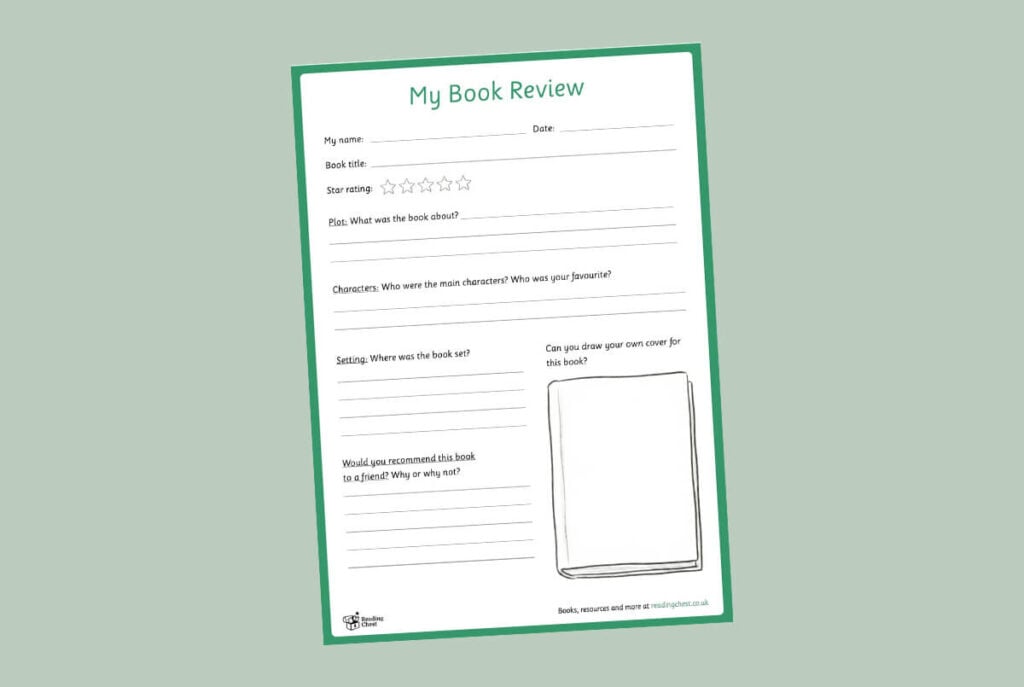
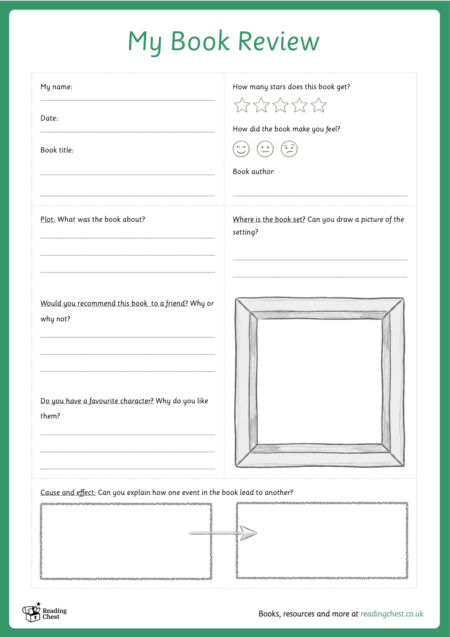
Before you read on, it’s worth taking a look at our free downloadable book review templates. We have three, each aimed a different age group, and they’re the perfect way to get started quickly.
For younger children, a review might be just a few sentences. For older children, it can develop into a more structured piece that includes evidence from the text and more nuanced opinion. The core structure is the same at every stage.
Bite-sized reading tips, straight to your inbox
Get confidence-boosting tips to help your child learn to read. Short, useful, and easy to fit into (real) family life!
Even better? You'll also get 30% off your first month of Reading Chest.
The basic structure of a book review
A good book review for a primary school child typically covers four things:
| Introduction | The title, author, type of book, and who it’s aimed at |
|---|---|
| Summary | A brief description of what the book is about, without giving too much away |
| Evaluation | What the reviewer thought, and why |
| Recommendation | Who they’d suggest the book to, and why |
This structure works whether the review is three sentences or three paragraphs. Younger children can treat each point as a single sentence; older children can expand each section with more detail and evidence.
A simple sentence-starter template
These prompts help children get going when they’re not sure what to write:
- The book I’m reviewing is [title] by [author].
- It’s a [type of book] for children aged [x].
- The story is about…
- My favourite part was… because…
- I thought this book was [word] because…
- I would/wouldn’t recommend this book to… because…
The “because” is important. It pushes children beyond a simple verdict (“I liked it”) towards actual evaluation (“I liked it because the ending was surprising”). That shift is one of the core skills the task is trying to develop.
Avoiding the plot spoiler problem
One of the hardest things for children writing their first reviews is knowing how much of the plot to include. The temptation is to retell the whole thing — but a review that reveals the ending isn’t much use to a reader deciding whether to pick the book up.
A helpful rule of thumb: describe the setup without revealing the resolution. “A girl discovers she has magical powers and tries to keep them secret” is fine. “She ends up defeating the villain by using her power on the mirror” is a spoiler. Children often find it helpful to think about what they’d want to know before starting the book — that’s exactly what belongs in the summary section.
Ask: “If a friend hadn’t read this book, what would you tell them to make them want to read it — without giving the ending away?”
Helping children say more than ‘I liked it’
The evaluation section is where children can find their voice, but it’s also where they most commonly get stuck. “It was good” or “it was boring” are starting points, not conclusions. The aim is to help them be more specific.
Some questions to draw out more detailed opinions:
- Which character did you like most, and why?
- Was there a moment that surprised you or made you feel something?
- Did the book make you think about anything differently?
- If you could change one thing about the book, what would it be?
- Did the story feel believable, or did it feel far-fetched? Does that matter?
Children who’ve been encouraged to discuss books as they read — asking questions, predicting, reacting — find this step considerably easier. The opinions are already there; the task is getting them onto the page.
What’s expected by year group
Book reviews develop significantly across primary school.
- In Years 1 and 2, a review might be three or four sentences covering what the book is about and whether the child enjoyed it — the focus is on expressing a basic opinion in writing. Our beginner book review template is perfect for this age.
- By Years 3 and 4, children are expected to give reasons for their views and refer to specific parts of the text. Try our intermediate book review template.
- In Years 5 and 6, a good review will include more considered analysis: exploring character development, narrative structure, language choices, and comparisons to other books or authors. Our more advanced book review template is a good starting point!
The sentence-starter approach works at every level — it just needs to be adapted in complexity to match the year group.
Try this activity
This activity gives children a guided review template with prompts — a good starting point for a first review or for making review-writing a regular habit:
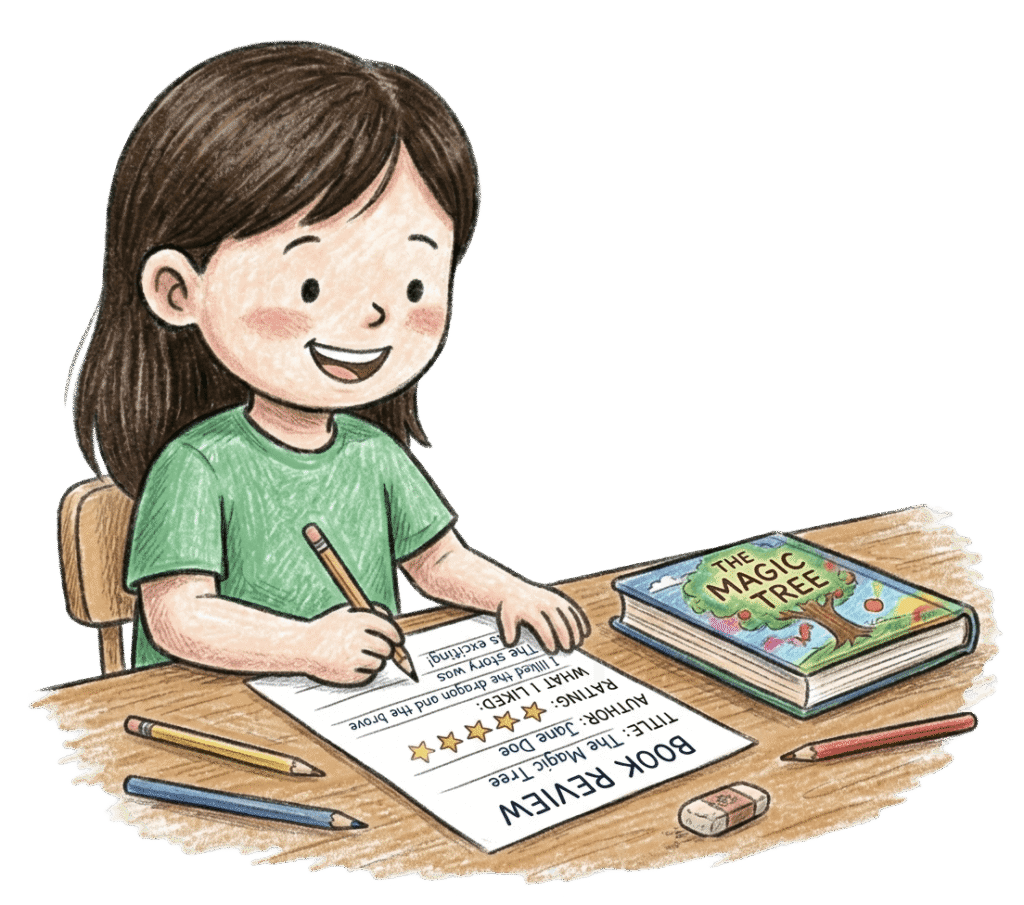
Write a book review
Fill in a short review while the book is still fresh — favourite moments, characters, whether they'd recommend it. Turns opinion into words.
Goal
Help your child organise their thoughts about a book and practise putting opinions into words — a skill that gets easier every time you do it.
You'll need
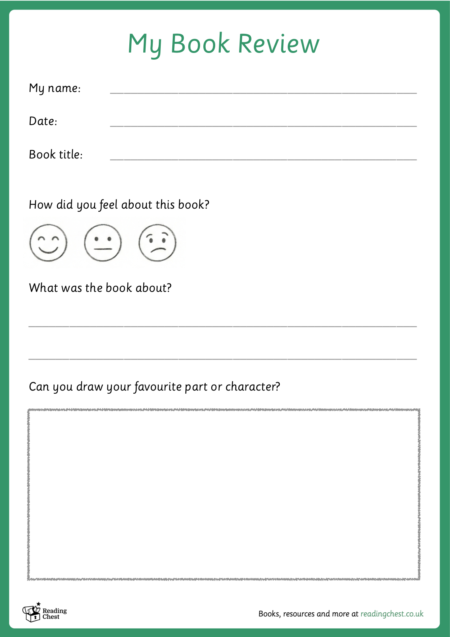
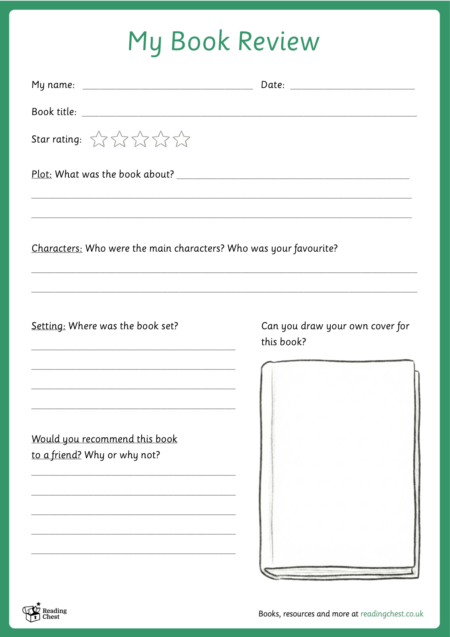
- Beginner, Intermediate or Advanced Book Review template — pick the right one for your child
- A book they've just finished
- Pencil and colouring pens
How to do it
Choose the right template — beginner for younger or less confident writers, advanced for those who have plenty to say. Sit down together soon after they've finished the book, while it's all still clear in their mind.
Go through the review together rather than leaving them to fill it in alone. Ask the questions out loud first: "What was your favourite bit? Who was your favourite character? Would you tell a friend to read it?" Let them answer verbally, then help them put the answer into the box.
The goal isn't a perfectly written review — it's the habit of thinking carefully about a book and forming an opinion. That habit, practised regularly, builds real readers.
Grab our resources
We have beginner, intermediate and advanced book review templates — pick the one that matches your child's confidence and let them share their thoughts.
And if your child struggles to find the words to summarise a book, this simpler activity helps them get to the heart of it in just five words:
The five-word summary
Sum up the whole story in exactly five words. Harder than it sounds, more fun than it should be, genuinely great for comprehension.
Goal
Practise distilling a story to its essence — what really mattered? What can't you leave out? Five words forces real thinking.
You'll need
Nothing needed — works right after any book, anywhere.
How to do it
When you've finished a story, set the challenge: "Can you sum up the whole thing in exactly five words?" Not roughly five — exactly five.
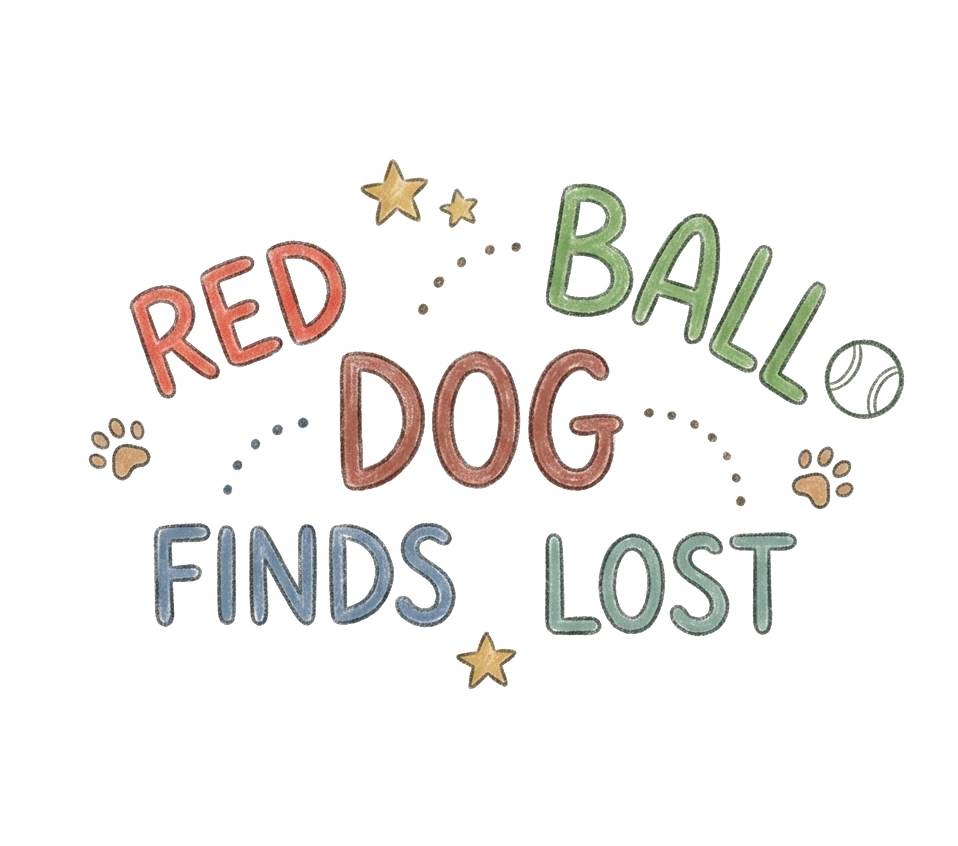
Give them a minute to think. "Dog finds lost ball. Hmm — that's four. Dog finally finds his ball — five!" The counting and refining is all part of it.
You have a go too. Compare your five words and talk about why you chose differently. There's no single right answer, and that's what makes it interesting. If they want to try again with four words, or seven, go for it.
Frequently asked questions
How long should a book review be?
It depends on the child’s age and what the review is for. A Year 1 review might be three to four sentences. A Year 5 or 6 review for school might be several paragraphs. If you’re unsure what’s expected, check with the teacher. In general, quality matters more than length — a short review with specific reasons is better than a long one that only restates the plot.
My child didn’t enjoy the book — can they write a negative review?
Yes, and a well-written negative review can be excellent. The same rules apply: specific reasons are better than general verdicts. “I didn’t enjoy it because the main character never seemed to change and I stopped caring what happened to her” is a much more interesting review than “It was boring.” Encouraging children to explain why they didn’t enjoy something builds exactly the same critical thinking skills as a positive review does.
Can a book review include spoilers?
For school tasks, it’s generally better to avoid spoilers in the summary section — the purpose of that section is to give a potential reader enough information to decide if they want to read the book. However, when evaluating specific elements (a plot twist, the ending, a character’s decision), some spoilers may be unavoidable. If the review is going to be shared or displayed, it’s considerate to note at the start: “This review contains spoilers.”
Is there a difference between a book report and a book review?
Yes, though the terms are often used interchangeably in primary school. A book report is typically more descriptive — it summarises the plot, characters, and setting. A book review also includes the writer’s opinion and an assessment of the book’s quality. Primary school tasks often blend both, asking for a summary and a personal response. If your child’s teacher has used a specific term, it’s worth asking what they expect to be included.
