Contents
Language development in the early years doesn’t just predict how well a child will speak — it predicts how well they’ll read. Children who arrive at school with a rich vocabulary, good listening comprehension, and experience of listening to stories learn to read faster and more easily than children who arrive without those foundations.
This is one of the best-supported findings in literacy research, and one of the most actionable. You don’t need a programme or a curriculum to build language in the early years. You need conversations, stories, and consistent exposure to a wide range of words.
What language development involves
Language development encompasses several related but distinct areas:
- Vocabulary — the words a child knows and can use. Children need both a receptive vocabulary (words they understand when they hear them) and an expressive vocabulary (words they can use themselves).
- Grammar — the rules that determine how words are combined into sentences. Children acquire grammar implicitly through exposure to language, not through formal teaching in the early years.
- Comprehension — understanding connected speech and narrative. A child can know many words and still struggle to follow a story if listening comprehension hasn’t developed.
- Narrative — the ability to recount events in sequence, describe something that happened, or tell a story. This is directly related to the reading comprehension skills that matter at school.
- Pragmatics — understanding how language is used in social context — knowing when to speak, how to take turns in conversation, how tone changes meaning.
Bite-sized reading tips, straight to your inbox
Get confidence-boosting tips to help your child learn to read. Short, useful, and easy to fit into (real) family life!
Even better? You'll also get 30% off your first month of Reading Chest.
Key milestones by age
These are typical ranges, not fixed benchmarks. Individual children develop at different rates, and the range of what’s “normal” is wide, especially in the toddler years.
- Around 12 months — first words. Most children have a small vocabulary of recognisable words. They understand much more than they can say.
- 18–24 months — vocabulary expands rapidly (often a “vocabulary explosion” around 18 months). Children start combining two words: “more milk”, “daddy gone”.
- 2–3 years — sentences of three or more words. Children ask questions (“Where is it?”), use negatives (“I don’t want”), and show beginning of narrative (“Then the dog…”).
- 3–4 years — complex sentences with connectives (“because”, “and then”, “so”). Vocabulary grows significantly. Stories become longer and more coherent. Most strangers can understand what the child says.
- 4–5 years (school entry) — rich, varied vocabulary; complex grammar; ability to retell events in sequence; good listening comprehension. Children at this stage who have had rich language exposure are well prepared for reading instruction.
The vocabulary gap
One of the most important things language research has established is the vocabulary gap between children from language-rich homes and children from homes where language is less abundant. Studies consistently find that children arrive at school with vocabularies ranging from a few hundred to several thousand words — a striking difference that predicts reading outcomes throughout schooling.
This gap is not fixed. Language-rich environments accelerate vocabulary growth at any stage, and parents have significant influence over how language-rich their home environment is. It doesn’t require expensive materials or specialist knowledge — it requires talk: responsive, varied, and plentiful.
What parents can do
The single most effective thing is to talk with your child, not just at them. Responsive conversation — where you respond to what your child says, extend it, ask questions, and wait for a response — does more for language development than any other single activity.
A few approaches that specifically support language and literacy:
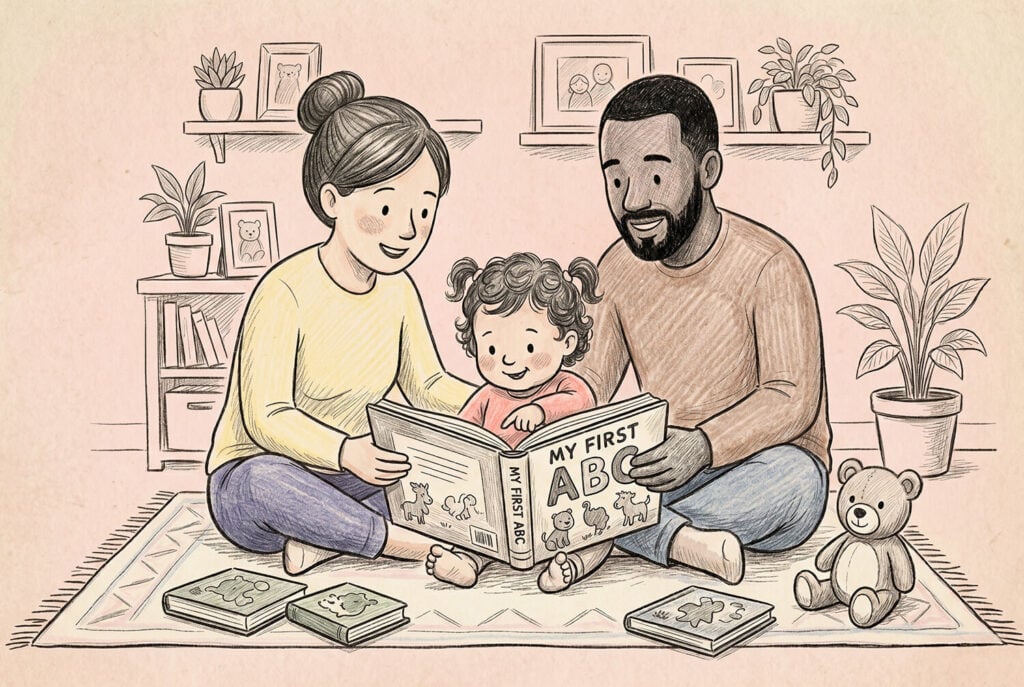
- Read aloud every day. Books expose children to vocabulary they won’t encounter in everyday conversation. A regular bedtime story routine is one of the most powerful things you can do for language development. The type of book matters less than the habit.
- Dialogic reading. Rather than reading through a book straight, pause to ask questions, point out details in the pictures, and invite your child to predict or respond. “What do you think will happen next? Why do you think the rabbit is hiding?” This turns a book into a conversation and dramatically increases language benefit.
- Use new vocabulary in context. When you encounter an interesting word, use it: “Look at that enormous lorry — enormous means really, really big.” Don’t avoid complex words with young children; they absorb context.
- Narrate daily life. Especially with babies and toddlers: describe what you’re doing, what you see, what’s happening next. “Now we’re going to the shops. Can you see the bright red bus? We’re going to wait at the bus stop.”
- Play. Play is a language-rich activity. Children narrate their play, negotiate with siblings or toys, and describe what’s happening. Time for unstructured, imaginative play is valuable language time.
The link to reading readiness
When a child starts learning to read, their spoken language does several things for them. Knowing a word in spoken form means that when they decode it from print, it “lands” — they recognise it and understand it. Children who decode a word they’ve never heard before can say the sounds but don’t know what they mean. That’s less helpful than it sounds.
Listening comprehension — understanding language when you hear it — is also the ceiling on reading comprehension.
A child can’t understand more from reading than they could understand if the same text was read aloud to them. Building comprehension of spoken language builds the capacity for reading comprehension later.
This is why reading is so important even in the years before a child can read independently. Being read to is building the language architecture that reading instruction will later fill in with letter-sound knowledge.
When to seek support
Language development varies widely, but some patterns are worth discussing with a health visitor, GP, or speech and language therapist:
- No first words by 18 months
- Not combining two words by 24 months
- Significant regression — losing words or language skills they previously had
- Very limited understanding as well as limited production
- At school age: significant difficulty following spoken instructions, understanding stories, or organising connected speech
Early intervention for language delay is effective and widely available. Raising concerns early — with your health visitor, GP, or school’s SENCO — gets support in place faster.
These activities build language through play — they’re appropriate for children across the early years age range:
Silly sentence builder
Pick word cards and build the most ridiculous sentence you can. Read it aloud, laugh at it, build another one. The sillier the better.
Goal
Practise reading words in context — and lower the stakes so much that reading feels like the fun bit, not the hard bit.
You'll need
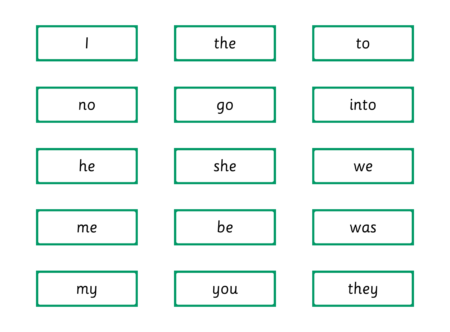
- Tricky Word Cards
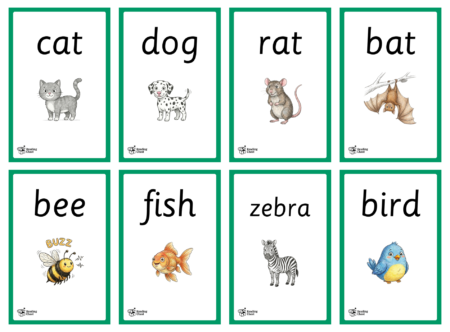
- Animal Phonics Flashcards
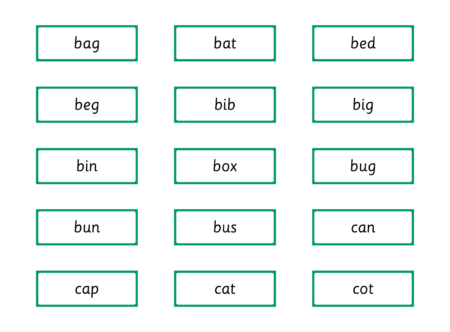
- CVC Word Cards
How to do it
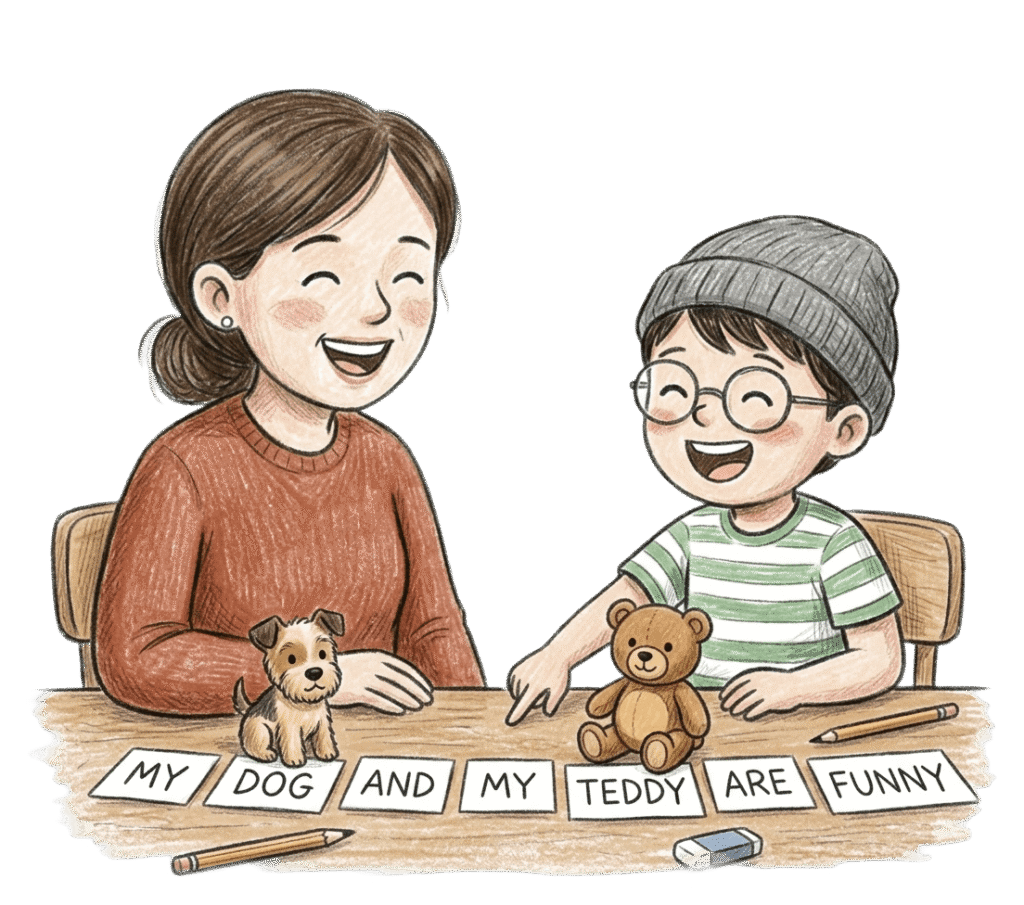
Spread out the word cards — tricky words, animals, CVC words, whatever you have. Each person picks two or three at random. The challenge: make the silliest sentence possible using those words.
"The blue frog sat on the moon." "A sad cat said the big dog was wet." Read your sentence aloud, as dramatically as you can. Then swap cards and go again.
There's real phonics work happening here — blending, reading tricky words by sight, understanding how sentences fit together — but it doesn't feel like it. Which is entirely the point.
Grab our resources
Print our tricky word cards and animal phonics flashcards to get started.
Soundtrack the story
Add sound effects as you read — splashes, creaks, whooshes, growls. Turns a reading session into a bit of a performance.
Goal
Bring stories to life through sound — builds expressive reading and keeps even reluctant readers properly engaged.
You'll need
- A book to read together
How to do it
As you read, add sound effects for what's happening — a splash when someone jumps in water, a creak for a spooky door, a whoosh for the wind, a growl for the monster. Your child joins in too.
This naturally slows down the reading, which is actually useful — it creates space to think about what's happening in the story. It also makes dull sentences feel exciting. "He walked through the door" becomes a whole moment with the right creak.
There are no wrong sound effects. The worse they are, the more fun this tends to be. It's especially good for books your child finds a bit dry — the soundtrack changes everything.
Frequently asked questions
Does bilingualism affect language development?
Growing up with two languages is not a risk factor for language development — it’s a different kind of development. Bilingual children may have smaller vocabularies in each individual language than monolingual peers, but their total vocabulary across both languages is typically equivalent or larger. The same principles apply: rich language exposure in both languages, lots of books and conversation, and responsive interaction. If you’re worried about a bilingual child’s language development, a speech and language therapist with bilingualism experience can give you a more specific picture.
My child watches a lot of educational TV — does that support language development?
Somewhat, but not as effectively as direct interaction. Screen-based media can expose children to vocabulary and stories, but it doesn’t respond to the child — and responsive interaction is what most accelerates language development. Watching programmes together, commenting on what you’re seeing, and asking questions can significantly increase the language benefit of screen time. Passive watching alone has limited impact, especially for children under three.
What does “dialogic reading” actually look like?
It’s simpler than it sounds. Rather than reading a page straight through, pause occasionally and ask a question: “What’s happening here?” “How do you think the rabbit feels?” “What do you think this word means?” “What would you do?” Let your child respond, and build on whatever they say. You don’t need to ask questions on every page — even a few genuine questions per book make reading a conversation rather than a performance. Children who are asked questions while being read to develop stronger vocabulary and comprehension than children who just listen.
