Contents
Every Thursday evening across the country, a version of the same scene plays out: child and parent hunched over a spelling list, running through the words one last time before the Friday test. The child learns them. Passes the test. And by the following Monday, roughly half of them have evaporated.
It’s not that the testing approach is useless — retrieval practice does help. It’s that learning spellings in isolation for a one-off test is a fairly inefficient way to commit them to long-term memory. The weekly list is a school reality, but there’s more you can do at home that will actually stick.
This guide is a practical toolkit for parents: what actually helps with spelling, how to make practice more effective, and when to take spelling difficulties more seriously.
Why spelling is hard (and it’s not your child’s fault)
English spelling is genuinely difficult. English has around 44 sounds but only 26 letters to represent them, which means many sounds are represented by multiple different spellings — the ee sound alone can be written as ee, ea, e, ie, ey, e-e, and more. Children learning to spell are navigating a system with real inconsistencies, and some words simply have to be learned rather than worked out.
Good phonics knowledge helps significantly — a child who understands how sounds and letters relate will make more educated spelling attempts even when they’re uncertain. But phonics alone doesn’t cover everything, which is why explicit spelling teaching (including lists, patterns, and rules) is also part of the national curriculum.
Bite-sized reading tips, straight to your inbox
Get confidence-boosting tips to help your child learn to read. Short, useful, and easy to fit into (real) family life!
Even better? You'll also get 30% off your first month of Reading Chest.
Why cramming the night before doesn’t work
Short-term memorisation for a test doesn’t build long-term spelling knowledge. This is well-established in learning science: massed practice (doing a lot in one go, right before a test) produces short-term results but poor retention. Spaced practice — returning to words across several days, with gaps in between — produces much better long-term learning.
The practical implication: if you want your child to actually remember spellings, practice needs to happen on more than just Thursday evening. A few minutes three or four times across the week is more effective than a marathon session the night before.
Spelling strategies that actually work
Look, Cover, Write, Check
This is the classic, and it works — when done correctly. The key is the “cover” step: the child looks at the word, covers it, writes it from memory, then checks. Many children rush this and copy rather than memorise. Slowing down the “look” step (asking the child to say the word aloud, trace it with a finger, look for tricky parts) makes it much more effective.
Word families and patterns
Rather than learning words in isolation, grouping them by pattern helps. If a child knows how to spell night, they can extend that to light, right, fight, might, tight. Pattern-spotting reduces the amount of individual memorisation needed and builds transferable knowledge.
Silly sentences and mnemonics
For words that are genuinely tricky, a memorable hook works better than rote repetition. “Big Elephants Can Always Understand Small Elephants” for BECAUSE. “Rhythm Helps Your Two Hips Move” for RHYTHM. The sillier the better — children remember absurdity. Invite them to make up their own; their mnemonics will work better than yours.
Dictation
Rather than just practising single words, try dictating short sentences that use the current spelling list. This requires the child to recall the spelling in context, which is closer to how they actually need to use it in writing. It’s a step up from the test format and better preparation for real writing tasks.
Games
Hangman, Boggle, word searches, Wordle-style games, and apps like Spelling Shed all make spelling practice feel less like work. This matters, because a child who’s unwilling to engage won’t practise enough to make progress. Finding a format they enjoy is worth more than finding the theoretically optimal strategy.
The connection between phonics and spelling
Spelling (encoding) and reading (decoding) are two sides of the same coin. A child with strong phonics knowledge — who can reliably connect sounds to letters — is better positioned to spell than a child who’s learned to read by sight-word recognition alone. This is one reason why the phonics-first approach to reading also benefits spelling: it builds an understanding of how words work rather than just what they look like.
If your child is still in the early phonics stages, our guide to phonics explains how this foundation develops.
What to expect by year group
The national curriculum sets out specific word lists for Years 3–4 and Years 5–6, as well as spelling rules for each year group. In Years 1 and 2, children are expected to learn common exception words (tricky words that don’t follow regular phonics rules), alongside age-appropriate phonics patterns.
If you want to know exactly which words your child should know by the end of their current year, the school will usually share these — and the DfE national curriculum appendix lists the statutory words for each stage.
When to take spelling difficulty more seriously
Struggling with spelling in the early years is very common and doesn’t on its own indicate a problem. But if a child in Year 3 or above is consistently making errors that suggest they haven’t grasped basic phonics patterns, or if their written work shows spelling far behind their oral language ability, it’s worth mentioning to the teacher.
Persistent, significant spelling difficulty can be one indicator of dyslexia — alongside difficulty with reading fluency and phonological awareness. If you have concerns, ask the school for an assessment. Early identification and targeted support make a meaningful difference.
Make spelling practice more enjoyable
This activity turns spelling practice into a game — the word ladder format gives children a clear goal and keeps sessions short and focused:
Word ladder game
Start with one word, change one sound, make a new word. Climb the ladder: cat, bat, sat, set, net. Phonics as a puzzle.
Goal
Practise changing one sound to make new words — builds phonemic awareness, blending and an instinct for how words are constructed.
You'll need
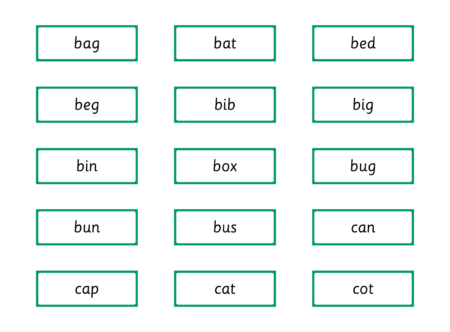
- CVC Word Cards
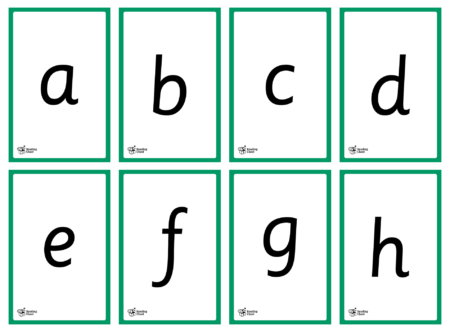
- Alphabet Flashcards (Lower Case)
- CCVC Word Cards
How to do it
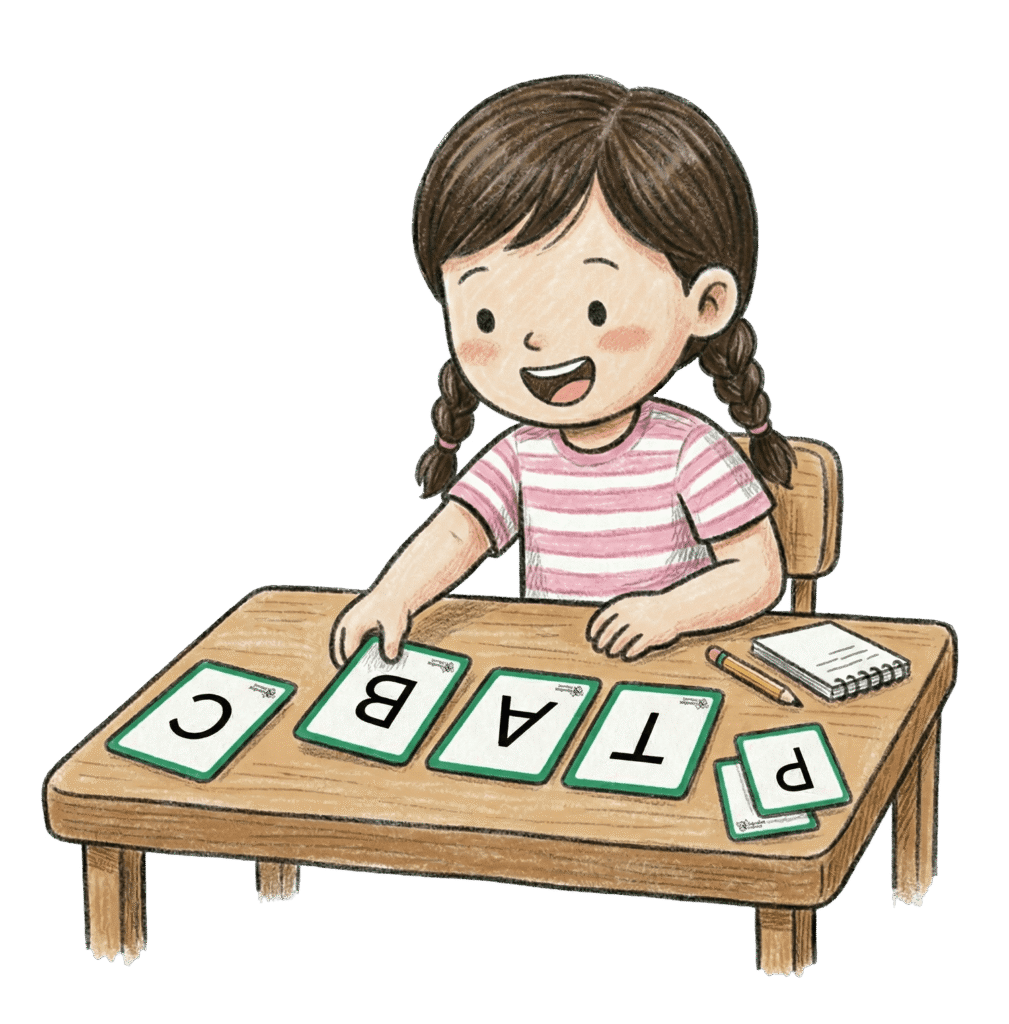
Pick a starting word — "cat" is a good one. Read it together. Now change one sound: swap the c for a b — "bat". Change the a for an i — "bit". Change the b for an s — "sit".
Use the letter cards to build each word physically. Reading the new word as soon as it's built — before moving on — is the key step.
Take turns choosing which sound to swap. See how many rungs you can climb before you run out of real words. You can use the word cards as inspiration if you get stuck. It's a puzzle, and children who don't like "practice" often love puzzles.
Grab our resources
Print our cvc word cards and alphabet flashcards (lower case) to get started.
Frequently asked questions
How often should my child practise spellings?
Little and often works better than a big session once a week. Five minutes a day across four or five days — rather than one 20-minute session the night before a test — is more effective for long-term retention. The spacing matters: each practice session should feel like the child is trying to retrieve the spelling from memory, not just copying it.
My child passes their spelling tests but then can’t spell the same words in their writing — why?
This is extremely common and is exactly the limitation of test-based spelling learning. When writing, children are focused on ideas, grammar, and expression — applying memorised spellings on top of that cognitive load is harder. Practising spellings in the context of writing (dictated sentences, free writing) rather than just word lists builds the transfer to actual use.
What are the Year 3 and Year 4 spelling words?
The national curriculum sets a list of 100 statutory words that children are expected to be able to spell by the end of Year 4. These include words like “accident”, “experience”, “frequently”, and “necessary” — words that are common in writing but have irregular or tricky patterns. Your child’s school should share these lists, and they’re freely available in the DfE national curriculum documentation online.
Are there good apps to help with spelling?
Spelling Shed is widely used in schools and has a home version that’s popular with children. Squeebles Spelling Test and Reading Eggs (which has a spelling component) are also well-regarded. Most work on the principle of spaced repetition — revisiting words at intervals — which aligns with what the research says is most effective. The best app is the one your child will actually use.
