Contents
Letters and Sounds was the DfE’s original phonics framework, published in 2007, and it shaped how a generation of children in England learned to read. If you went through school in the UK in the 2000s or 2010s — or have an older child who did — this is the programme behind it. Many primary school teachers were trained on it.
It’s less commonly used now. The DfE didn’t validate Letters and Sounds under its newer systematic synthetic phonics criteria, and most schools have since adopted programmes like Little Wandle or Read Write Inc in its place. But if you’ve seen it referenced in older resources, or you want to understand the historical context, here’s what it involved.
What Letters and Sounds was
Letters and Sounds was a six-phase phonics framework produced by the DfE and published for schools to use freely. Rather than a complete commercial programme — with specific books, training, and prescribed lesson plans — it was a framework: a structured sequence for teaching the relationship between sounds and letters, which schools could adapt and supplement as they saw fit.
This flexibility was both its strength and its weakness. Schools could implement it however they chose, which meant quality varied significantly. When the DfE introduced validation criteria for phonics programmes in the 2010s, Letters and Sounds wasn’t submitted for validation — partly because it was a framework rather than a fully packaged programme, and therefore harder to assess consistently.
Bite-sized reading tips, straight to your inbox
Get confidence-boosting tips to help your child learn to read. Short, useful, and easy to fit into (real) family life!
Even better? You'll also get 30% off your first month of Reading Chest.
The six phases
Letters and Sounds was organised into six phases, each building on the last:
- Phase 1 — environmental sounds, instrumental sounds, body percussion, rhythm and rhyme, alliteration, voice sounds, and oral blending and segmenting. This phase is about developing phonological awareness before letter-sound correspondence begins, and much of it happens in nursery.
- Phase 2 — the first nineteen letter-sound correspondences, introduced in groups: s, a, t, p first, then others. Children begin blending and reading simple CVC words. This is typically the first half of Reception.
- Phase 3 — the remaining graphemes including digraphs (ch, sh, th, ng) and vowel digraphs (ai, ee, igh, oa, oo, ar, or, ur, ow, oi, ear, air, ure, er). Second half of Reception.
- Phase 4 — no new graphemes, but consonant clusters: reading and spelling words with adjacent consonants like frog, lamp, best. Children practise blending longer words.
- Phase 5 — alternative spellings for sounds already learned (e.g., the /ai/ sound can be written ai, ay, a-e) and alternative pronunciations for existing graphemes. This is the bulk of Year 1.
- Phase 6 — spelling patterns and conventions: past tense, suffixes, word roots. Focus shifts increasingly towards writing as well as reading.
Phase 2 sounds are still widely referenced in phonics resources and flashcard sets, even ones designed for other programmes, because the sound sequence is broadly similar across schemes. If you see “Phase 2 flashcards”, they’re usable regardless of which programme your school uses.
Why schools have moved away from it
The shift away from Letters and Sounds accelerated after the DfE introduced its phonics programme validation process. To receive validation — and access to the government’s match-funded offer, which subsidised the cost of adopting a validated programme — programmes needed to demonstrate they met specific quality criteria. Letters and Sounds, as an unfunded DfE framework rather than a commercial product, wasn’t in a position to go through that process.
This created an incentive for schools to adopt validated programmes, and Little Wandle became the most common choice — it’s essentially a significantly updated and more fully developed version of Letters and Sounds, produced by a consortium of schools. Read Write Inc and other validated programmes also gained schools that previously used Letters and Sounds.
If your school still uses it
Some schools continue to use their own adapted versions of Letters and Sounds, sometimes supplemented with materials from other programmes. This is most common in schools that invested heavily in training and materials and have adapted the approach to work well for their pupils.
If your child’s school uses a version of Letters and Sounds, the phonics your child is learning is broadly the same as in any other validated programme — the core sequence of sounds and the approach to blending and spelling are consistent. The difference is mainly in lesson structure and materials.
How to support your child at home
Whether your child’s school uses Letters and Sounds, Little Wandle, or another programme, home support works the same way: regular reading practice, encouragement to sound out rather than guess, and building the habit of reading for pleasure.
If your child is in the early stages and working on Phase 2 sounds, daily sound practice is valuable:
Sound of the day
Pick one sound and spend the day noticing it everywhere — on signs, packets, toys, and out in the world. Quick to set up, surprisingly addictive.
Goal
Help your child notice sounds in everyday life — building phonemic awareness without needing to sit down and "do phonics".
You'll need
Just a focus sound — like sh or ee — and your normal day.
How to do it
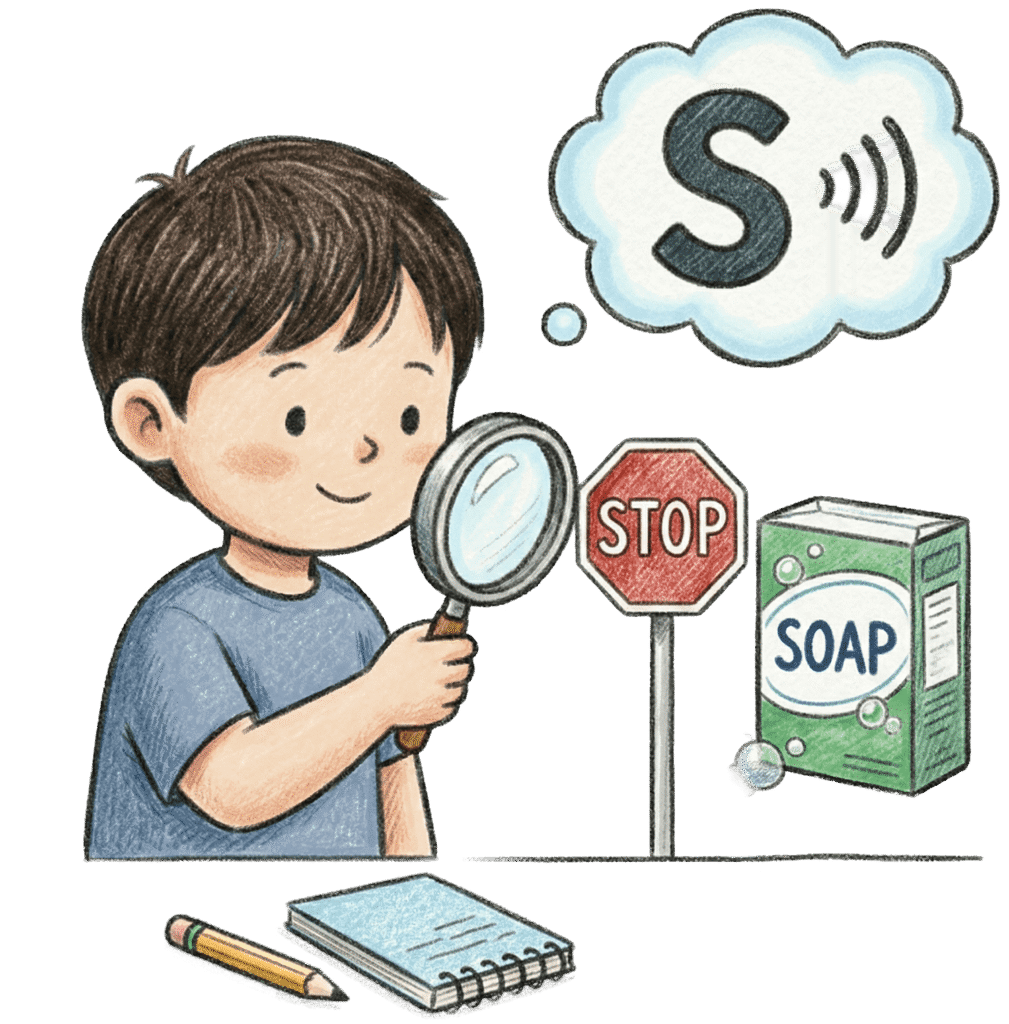
Pick a sound in the morning. Say it together clearly: sh, ee, m — whatever you're working on. That's your sound of the day.
Then just keep going with your normal day. Whenever you spot it — on a cereal box, a road sign, a shop name, a toy — point it out and say the sound together. Let your child spot them too and make a fuss when they do.
By the end of the day, you'll have done phonics practice a dozen times without sitting down once. That's the magic of making it ambient rather than formal.
And this one makes phonological awareness playful — good for children in Phase 1 and early Phase 2:
I spy sounds
Play I spy the phonics way — using sounds, not letter names. "I spy something beginning with s" (and you mean the ssss sound, not "ess").
Goal
Practise hearing and producing initial sounds through a game everyone already knows — with one small but important tweak.
You'll need
- Digraphs & Trigraphs Flashcards
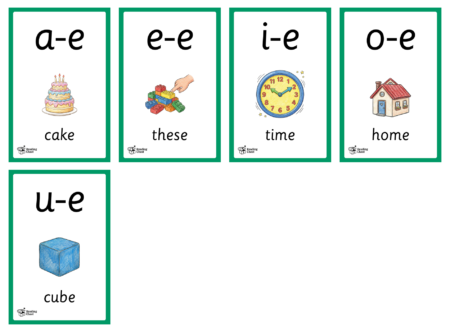
- Split Digraph Flashcards
How to do it
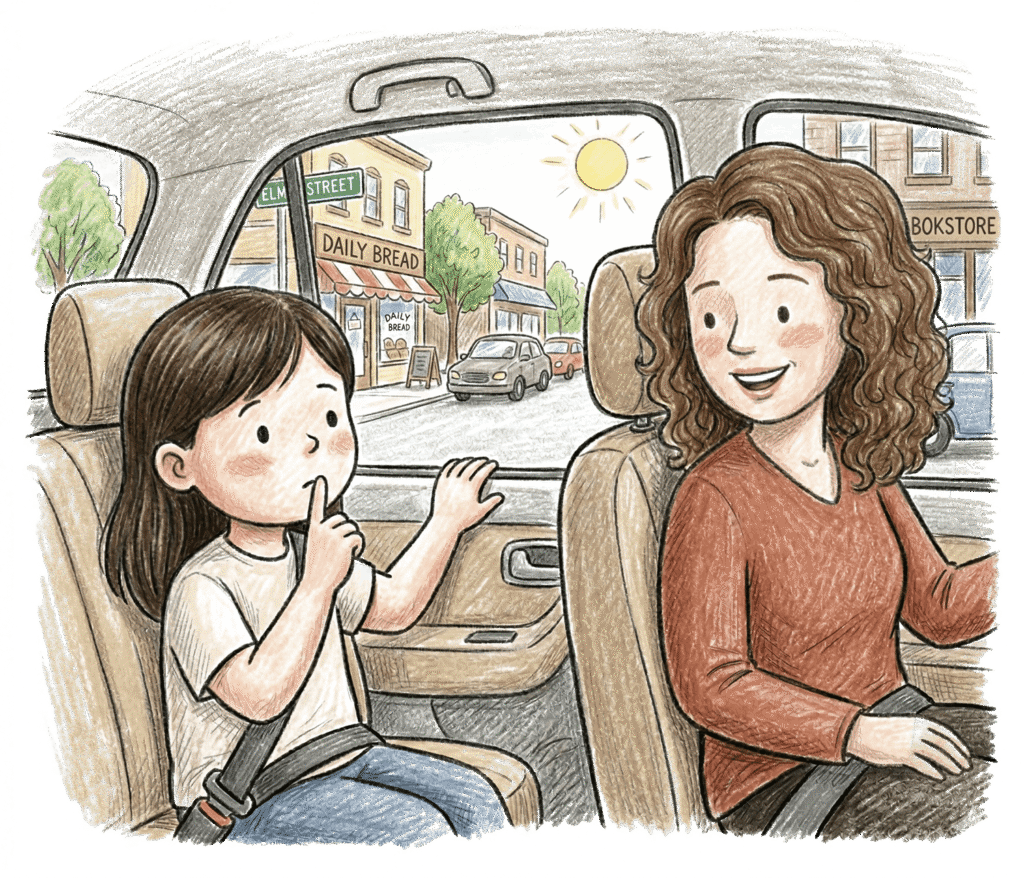
Play I spy as normal, but say the sound, not the letter name. "I spy with my little eye something beginning with s" — that ssss sound, not "ess".
Once they've got the hang of single sounds, you can move to digraphs: "something beginning with sh" or "something with the ch sound". Use the flashcards to remind them what digraphs they know.
This is one of those activities that takes zero prep and can fill a five-minute wait anywhere. The slight phonics twist makes it genuinely useful without making it feel like anything other than I spy.
Grab our resources
Print our digraphs & trigraphs flashcards and split digraph flashcards to get started.
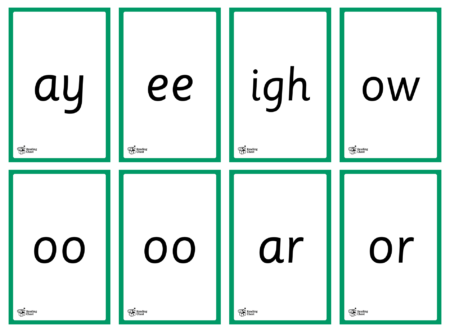
Our free digraph and trigraph flashcard set is useful when your child moves into Phase 3 and starts working on two- and three-letter sounds:
Frequently asked questions
Is Letters and Sounds still used in UK schools?
Some schools still use adapted versions of Letters and Sounds, but the majority of English primary schools have now moved to DfE-validated programmes — most commonly Little Wandle or Read Write Inc. The shift accelerated after the DfE’s match-funding offer made it financially attractive to adopt a validated programme. If you’re unsure what your school uses, it’s worth asking — they should be able to name their current programme.
Is Little Wandle the same as Letters and Sounds?
Little Wandle is based on Letters and Sounds — it uses the same broad sound sequence — but it’s a significantly more developed and fully packaged programme. It includes prescribed lesson plans, specific teaching materials, decodable books, a training programme for teachers, and assessment tools. It also incorporates research findings that have emerged since the original Letters and Sounds document was published. The two are related but not the same.
My child’s older sibling learned with Letters and Sounds — will the transition to a new programme affect my younger child?
The core phonics content is broadly the same across programmes — the same sounds, the same principles of blending and segmenting. Your younger child might use different books and encounter sounds in a slightly different order, but the fundamental approach is consistent. The most important thing is that your child’s school uses their current programme consistently and well.
What does Phase 2 mean in practice?
Phase 2 is the stage when children begin learning specific letter-sound correspondences — the link between written letters and the sounds they represent. The Letters and Sounds framework introduced sounds in groups: s, a, t, p first, then i, n, m, d, and so on. By the end of Phase 2, children can blend a small set of CVC words and are learning to recognise a few tricky words. In practice, Phase 2 typically happens in the autumn and early spring of Reception year.
