Contents
If you’ve ever wondered whether your child is reading at the right level for their age — or found yourself squinting at a coloured sticker on a school book wondering what it actually means — you’re in good company. Reading levels in UK primary schools can feel like a secret code, but the underlying framework is genuinely straightforward once someone explains it clearly.
This guide covers how reading expectations are set in England, what children are broadly expected to be able to do at each stage, and how the book band system connects to national curriculum levels. It won’t tell you exactly where your child should be (that depends on the child), but it will give you the context to understand what their school is working towards.
One thing worth keeping in mind: averages are averages. A wide range is entirely normal at every year group, and reading progress isn’t linear. Some children sprint ahead and then plateau; others take a while to click into gear and then accelerate. Both are fine.
How reading expectations are set
In England, reading expectations for primary school children are set by the national curriculum. Schools are required to teach reading in line with these expectations, and children are assessed at the end of Key Stage 1 (Year 2) and Key Stage 2 (Year 6) against national standards.
The key phrase you’ll encounter is age-related expectations (ARE) — a shorthand for what most children are expected to achieve by the end of a given year group. Schools track whether children are working at ARE, below ARE, or above ARE. This isn’t a pass/fail; it’s a benchmark for planning teaching.
Reading assessment in primary school covers two distinct things: decoding (the ability to sound out and read words accurately) and comprehension (the ability to understand, interpret, and respond to what’s been read). A child can be a strong decoder but a weaker comprehender, or vice versa. Both matter, and schools are expected to develop both.
Bite-sized reading tips, straight to your inbox
Get confidence-boosting tips to help your child learn to read. Short, useful, and easy to fit into (real) family life!
Even better? You'll also get 30% off your first month of Reading Chest.
Reading expectations year by year
Reception (age 4–5)
In Reception, the focus is on phonics foundations: learning letter sounds, beginning to blend simple words, and developing a love of books through shared reading. By the end of Reception, most children are expected to read simple words and phrases using their phonics knowledge, and to begin recognising a small bank of common words on sight.
Year 1 (age 5–6)
Year 1 is when phonics really kicks in. Children work through their school’s phonics programme (Read Write Inc, Little Wandle, or similar) and sit the Year 1 Phonics Screening Check in June — a short assessment of 40 words designed to check that decoding is on track. By the end of Year 1, most children are expected to be reading simple sentences fluently, using a range of phonics sounds including common digraphs and vowel teams.
Year 2 (age 6–7)
Year 2 is the end of Key Stage 1, and children are assessed against national reading standards. At the expected standard, a Year 2 child should be able to read aloud books appropriate to their age with accuracy and fluency, discuss what they’ve read, and begin to make inferences. Any child who didn’t meet the expected standard in the Phonics Screening Check in Year 1 retakes it in Year 2.
Year 3 (age 7–8)
Year 3 marks the transition from learning to read to reading to learn. The decoding focus reduces, and comprehension becomes more central. Children are expected to read longer books with greater independence, discuss characters and themes, and begin to read across different genres and text types. Fluency (reading at a natural pace, with expression) is also developed during this year.
Year 4 (age 8–9)
By Year 4, most children are expected to read chapter books independently, retrieve and infer information from texts, and begin to understand how authors make choices. Vocabulary broadens significantly at this stage, and children are expected to work out the meaning of unfamiliar words from context.
Year 5 and 6 (age 9–11)
In upper Key Stage 2, the focus is on reading complex texts across a range of genres, analysing language and structure, and comparing different perspectives. By the end of Year 6, children should be confident, independent readers who can discuss and evaluate what they’ve read. This is assessed in the KS2 SATs reading paper in Year 6.
How book bands connect to national curriculum levels
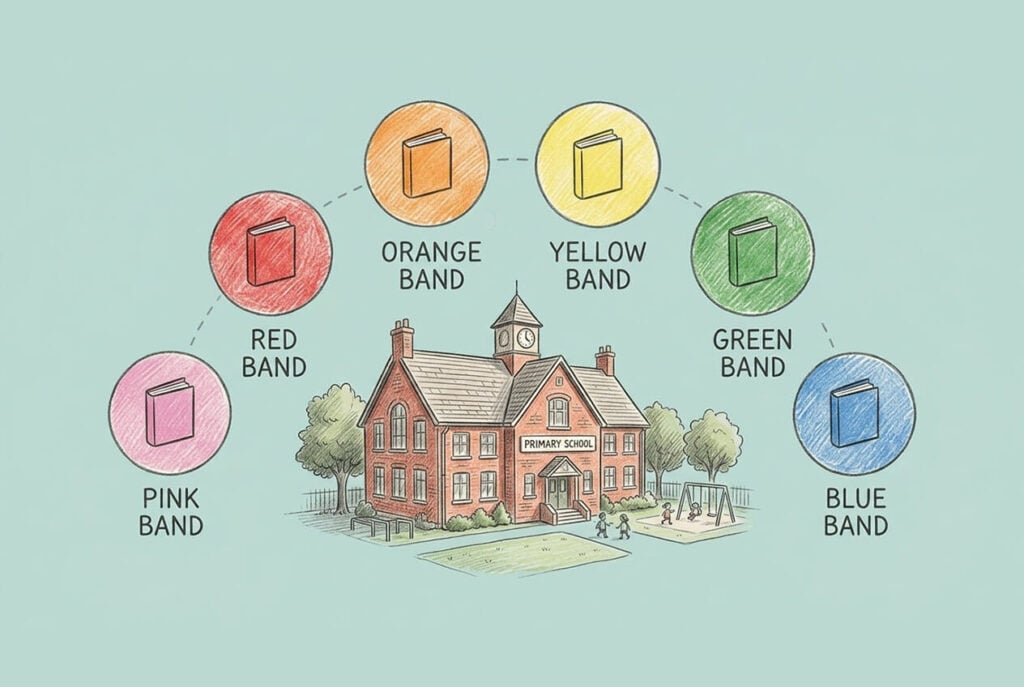
Book bands — those colour-coded levels on school reading books — are a separate framework from the national curriculum, but they map to it roughly. They were developed to give schools and parents a practical way to match books to a child’s current reading ability.
As a general guide, children working at age-related expectations tend to move through the bands roughly as follows:
| Book band | Colour | Year group |
|---|---|---|
| Pink book band | Reception | |
| Red book band | Reception | |
| Yellow book band | Year 1 | |
| Blue book band | Year 1 | |
| Green book band | Year 2 | |
| Orange book band | Year 2 | |
| Turquoise book band | Year 3 | |
| Purple book band | Year 3 | |
| Gold book band | Year 4 | |
| White book band | Year 4 | |
| Lime book band | Years 5 and 6 | |
| Extended book band | Years 5 and 6 |
It’s worth noting that there’s significant variation — many Year 2 children are still on Yellow, and many Year 1 children reach Blue or Green. None of that is cause for concern on its own.
If you’re curious about what the bands mean in more detail, our guide to book bands explains the full colour sequence and what each level looks like in practice.
If your child is behind or ahead
If your child is significantly below age-related expectations, it’s worth having a conversation with their teacher about what support is in place. Schools are required to identify children who need extra help and put interventions in place — this might be small-group reading sessions, targeted phonics catch-up, or a referral for a SEND assessment if there are broader concerns.
If your child is ahead of expectations, the same principle applies: talk to the teacher. More able readers benefit from depth, not just faster progression through levels. Rich discussion about books, exposure to complex texts, and writing opportunities are more valuable than simply moving up bands.
At home, the most useful thing you can do regardless of level is read with your child regularly. Consistency matters more than the number of minutes, and a positive reading habit built now pays dividends for years.
A simple way to build the habit
Whatever level your child is currently at, regular practice at home is the single most effective thing you can do. This activity makes it easy to build a daily reading habit without it feeling like a task:
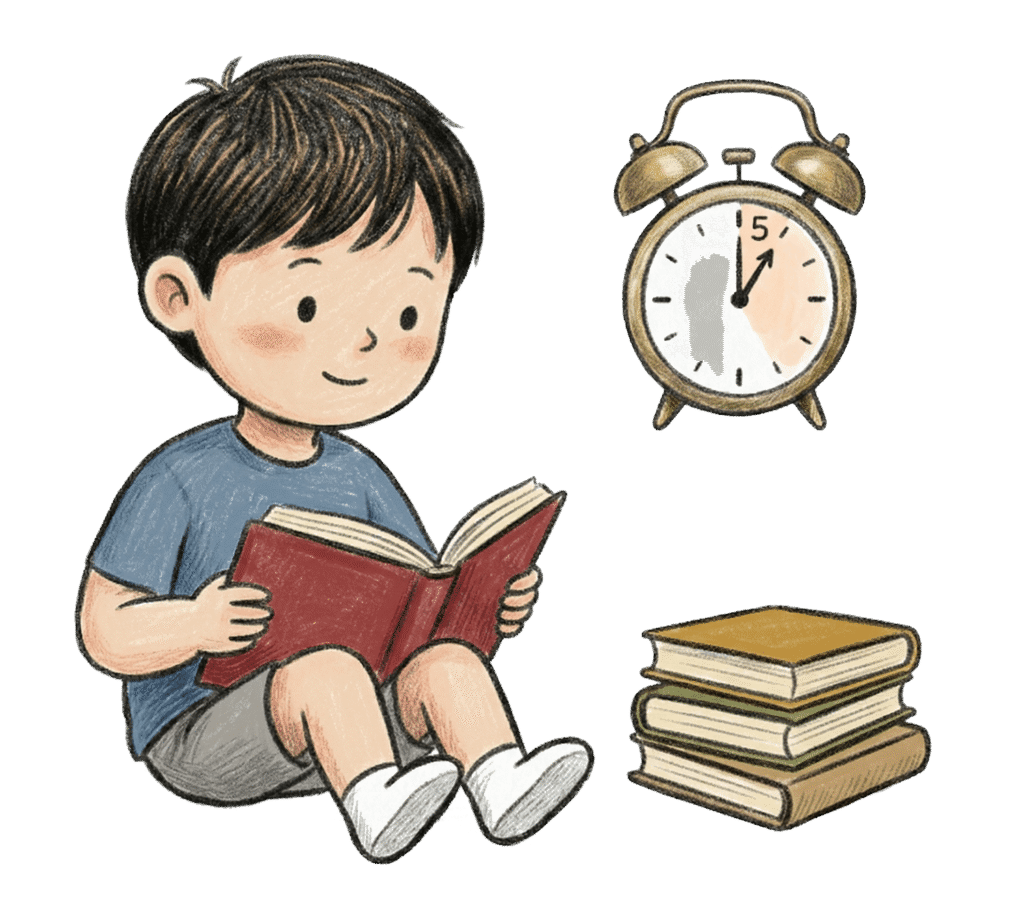
The five-minute reading habit
Five focused minutes with the right book beats an hour of reluctant page-turning. Short daily sessions are where the real progress happens.
Goal
Build confidence and fluency through short, consistent daily reading — because regularity matters more than duration.
You'll need
- A decodable book at the right level
- A comfy spot
- A bit of patience
How to do it
Sit together and read a couple of pages. Let your child point to each word as they sound it out. If they get stuck, give them a moment before you step in — sometimes they just need a second.
When they do need help, try: "Say the sounds, then blend" rather than just saying the word for them. Keep the session upbeat. End it before anyone gets tired.
Five minutes every day adds up to over 30 hours of reading practice in a year. That's not nothing — that's everything. The habit matters more than the duration.
Grab our resources
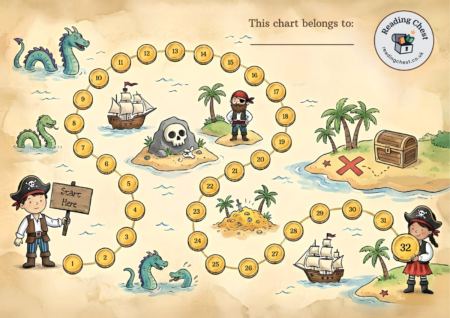
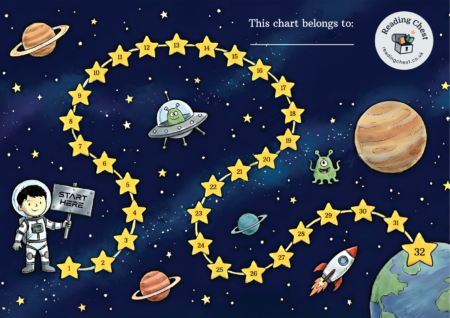
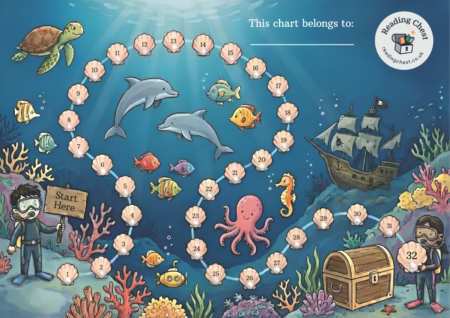
Our handy star charts are the perfect way to track your daily progress as you tick off those five minute reads!
Once the habit is in place, this activity is a great way to keep motivation up and help your child feel proud of their progress:
Star-chart streaks
Set a small reading streak and add a star each day. Short targets, visible progress, genuine celebration when they get there.
Goal
Build a daily reading habit through small, achievable targets — because streaks work, and children (and most adults) love a chart filling up.
You'll need
- Star chart (Space, Underwater or Pirate theme)
How to do it
Choose a star chart and set a modest first target — three days in a row, or five stars in a week. Stick it somewhere your child will see it every day.
Add a star each time they read (or give reading a genuine go). Make the moment of adding the star feel like something — a small celebration counts.
When they reach the target, acknowledge it properly and set a new one. Keep targets just within reach: achievable enough to feel doable, stretching enough to feel worth doing. The chart filling up is surprisingly motivating, even for children who say they don't care about stickers. They always care about stickers.
Grab our resources
Print our space star chart and underwater star chart to get started.
Frequently asked questions
What reading level should my child be at in Year 2?
At the expected standard at the end of Year 2, children should be able to read books appropriate for their age with reasonable accuracy and fluency, and discuss what they’ve read. In book band terms, most Year 2 children working at ARE are typically around Orange to Turquoise by the end of the year, though the range is wide and what matters most is steady progress rather than hitting a specific band.
Are primary school reading levels the same across England?
The national curriculum sets the framework for all state schools in England, so the broad expectations are consistent. However, individual schools may use different reading schemes, book band systems, or assessment tools, which can make comparisons tricky. If your child changes school, it’s worth asking the new school how their levelling system maps to the national curriculum.
What’s the difference between reading levels and reading age?
Reading levels (like book bands or national curriculum stages) describe what a child can do. Reading age is a standardised score that compares a child’s reading performance to the average for their chronological age. They’re related but not the same thing — a child can be at the expected book band level for their year group but still have a reading age slightly below their actual age, or vice versa.
My child passed the Phonics Screening Check but is still on a low book band — is that normal?
Yes, this is quite common. The Phonics Screening Check tests decoding accuracy, but reading fluency and comprehension develop more gradually. A child can decode reliably but still read slowly, struggle with unfamiliar vocabulary, or find it hard to track meaning across longer texts. These skills develop with practice — the check passing is a good sign, and the rest catches up.
