Contents
Sounds-Write is a systematic phonics programme with a distinctive approach: it treats writing as a code for sounds, and teaches children — from the very beginning — that the same sound can be spelled in more than one way. If your child’s school uses Sounds-Write, you’ll notice this idea comes up earlier than it does in other programmes.
It’s one of the DfE-validated phonics programmes used in UK primary schools, and it has a particularly strong reputation among specialists working with children who find reading difficult. Here’s what it involves and how you can support your child at home.
What Sounds-Write is
Sounds-Write is a UK-developed systematic synthetic phonics programme — meaning it teaches reading and spelling by working systematically through the relationship between sounds and their written forms. It was developed by John Walker and is used in thousands of UK primary schools, as well as many schools internationally.
What sets it apart from programmes like Read Write Inc or Little Wandle is its starting principle: Sounds-Write frames literacy as a code. Writing is a way of representing the sounds of speech on paper, and that code is not always a simple one-to-one match. The programme teaches children to work with that complexity from the beginning, rather than building up to it.
Bite-sized reading tips, straight to your inbox
Get confidence-boosting tips to help your child learn to read. Short, useful, and easy to fit into (real) family life!
Even better? You'll also get 30% off your first month of Reading Chest.
The three core skills
Sounds-Write organises its teaching around three fundamental skills that underpin all reading and spelling:
- Blending — putting individual sounds together to read a word: c–a–t becomes cat.
- Segmenting — breaking a spoken word into its component sounds to spell it: shop becomes sh–o–p.
- Phoneme manipulation — changing sounds within words: replace the c in cat with b to make bat. This builds flexibility and a deeper understanding of how the code works.
These aren’t just the first things children learn — all three skills are woven throughout the programme, at every level of complexity.
Code knowledge: one sound, many spellings
The concept Sounds-Write places most emphasis on is code knowledge — the understanding that in English, a single sound can be spelled in multiple ways, and a single spelling can represent different sounds in different words.
Take the /ee/ sound. It can be spelled as ee (feet), ea (seat), e (she), ie (field), or ey (key). A child using Sounds-Write learns early on that this is how the code works — and that meeting a new spelling of a familiar sound is a normal part of reading, not a baffling exception.
This is a genuine difference from some other programmes, which introduce multiple spellings of the same sound more gradually. Sounds-Write’s approach means children develop a flexible, code-based understanding of spelling patterns, rather than accumulating a list of rules with exceptions.
What it looks like at school
Sounds-Write lessons are structured and move at a brisk pace. Children practise the three core skills daily, working through units that introduce new sound-spelling correspondences steadily. The programme uses phonics-based decodable books alongside its teaching materials — books designed so that every word can be decoded using sounds the child has been taught.
Unlike some other programmes, Sounds-Write doesn’t use characters or pictures as memory hooks for each sound. The emphasis is on the sounds themselves and their written forms. Some children respond very well to this clean, systematic approach; others may benefit from the extra scaffolding that mnemonic images provide.
Sounds-Write is designed for whole-class teaching from Reception, with specific intervention resources for children who need additional support later on. It has a particularly strong reputation in dyslexia and SEN work, partly because of its explicit focus on how the alphabetic code operates.
How to support your child at home
If your child’s school uses Sounds-Write, the most important thing is to follow the school’s approach and read together regularly. A few things are worth keeping in mind:
- Use decodable books. In the early stages, Sounds-Write children read books that contain only the sounds they’ve been taught so far. Stick to these — they let your child practise blending without needing to guess.
- Encourage sounding out. When your child gets stuck on a word, prompt them to identify the sounds rather than guess from pictures or context. “What sounds can you see?” is a useful question.
- Point out different spellings of the same sound. If your child is working on words with the /ee/ sound, notice and name different spellings of that sound when you encounter them in books, signs, or packaging.
- Focus on sounds, not letter names. Sounds-Write teaches the sounds letters represent first. When reinforcing at home, say “that letter makes the s sound” rather than “that’s the letter S”.
This daily activity is a natural fit for Sounds-Write at home — it focuses on one new sound at a time, which mirrors how the programme works:
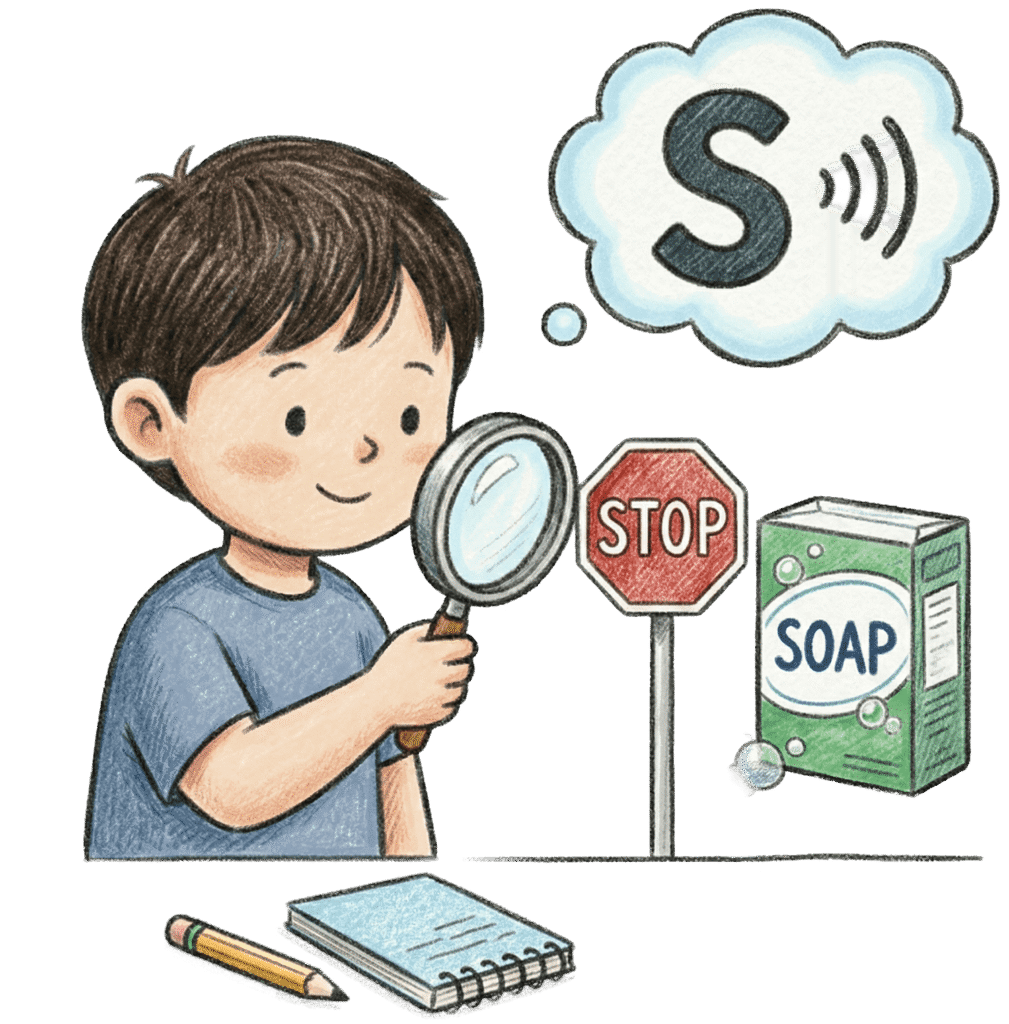
Sound of the day
Pick one sound and spend the day noticing it everywhere — on signs, packets, toys, and out in the world. Quick to set up, surprisingly addictive.
Goal
Help your child notice sounds in everyday life — building phonemic awareness without needing to sit down and "do phonics".
You'll need
Just a focus sound — like sh or ee — and your normal day.
How to do it
Pick a sound in the morning. Say it together clearly: sh, ee, m — whatever you're working on. That's your sound of the day.
Then just keep going with your normal day. Whenever you spot it — on a cereal box, a road sign, a shop name, a toy — point it out and say the sound together. Let your child spot them too and make a fuss when they do.
By the end of the day, you'll have done phonics practice a dozen times without sitting down once. That's the magic of making it ambient rather than formal.
Once your child is blending simple words, this one builds reading skills through hands-on word building:
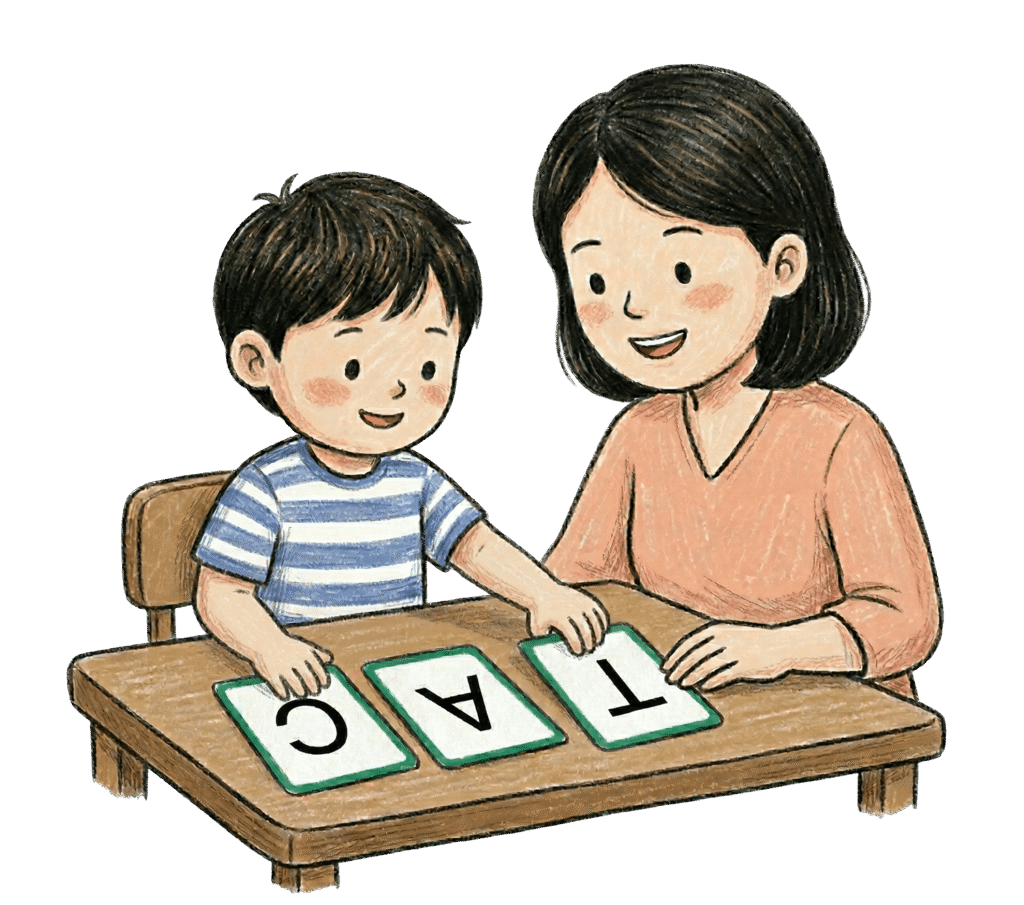
CVC word builder
Use letter cards to build simple three-letter words — consonant, vowel, consonant. Sound them out, blend them together, read the word. The basics, done brilliantly.
Goal
Practise blending CVC sounds into whole words — the foundation everything else builds on.
You'll need
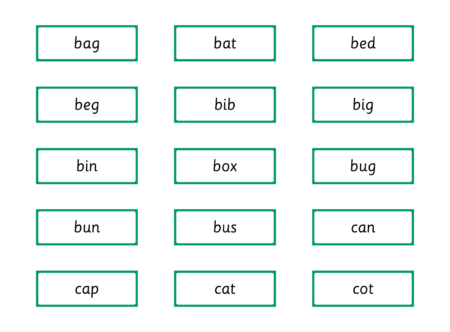
- CVC Word Cards
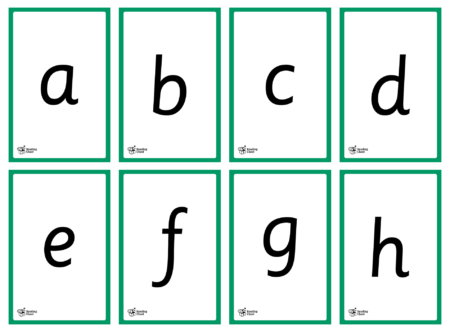
- Alphabet Flashcards (Lower Case)
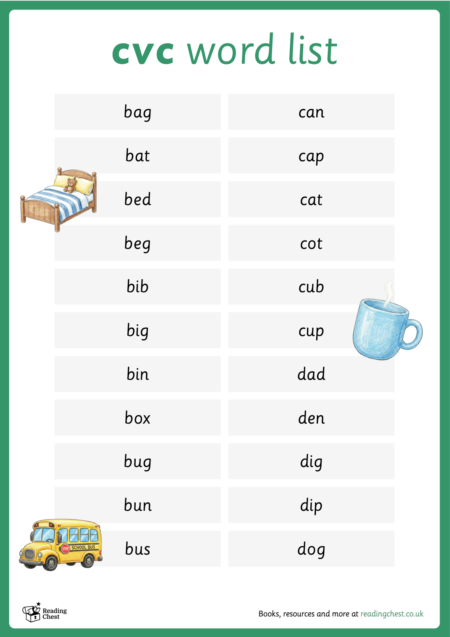
- Phonics CVC Words List
How to do it
Pick a CVC word — "cat", "dog", "sit" are good starting points. Use the alphabet cards to find each letter. Say each sound as you place it: c... a... t. Then blend: "cat".
Let your child build the next one. You say the word; they find the letters and lay them out. If they get stuck on blending, try the slow-to-fast trick: sound it out like a robot, then speed up until it sounds like a real word.
Work through a few words from the cards or list. Keep sessions short — five or six words is plenty. The goal is confident blending, not endurance.
Grab our resources
Print our cvc word cards and alphabet flashcards (lower case) to get started.
Frequently asked questions
How is Sounds-Write different from Read Write Inc?
Both are systematic synthetic phonics programmes and both are DfE-validated. The main difference is in how they approach multiple spellings of the same sound. Read Write Inc introduces these gradually across sets, while Sounds-Write frames the concept of “one sound, many spellings” explicitly from the start. Sounds-Write also doesn’t use the same characters and mnemonic images that RWI uses for its sounds — the focus is directly on the code itself.
Is Sounds-Write recommended for children with dyslexia?
Sounds-Write is well-regarded in specialist dyslexia and SEN contexts. Its explicit teaching of how the alphabetic code works — rather than asking children to memorise patterns or use whole-word approaches — aligns with the structured, systematic methods recommended for children with reading difficulties. If your child has been identified as having dyslexia or is making slow progress, it’s worth asking their school or a specialist whether Sounds-Write would suit them.
Do I need to buy any materials to support Sounds-Write at home?
No. The most useful things are decodable books at the right level — which your school should be sending home — and regular reading practice. If you want to reinforce the specific sound-spelling pairs your child is currently working on, ask their teacher which unit they’re covering and practise those sounds together. You don’t need workbooks or apps.
Why haven’t I heard of Sounds-Write before?
Sounds-Write has been used in UK schools since the early 2000s, but it’s less prominent in parent-facing resources than programmes like Read Write Inc or Little Wandle, which are more widely adopted overall. It’s particularly common in schools that have prioritised provision for struggling readers and in some independent and specialist settings. The relative scarcity of accessible parent information about it is part of what prompted us to write this guide.
