Contents
Homophones are words that sound the same but have different spellings and different meanings. There, their and they’re. To, too and two. Here and hear. Sea and see. You know them. You’ve probably typed the wrong one at least once this week.
Children run into homophones as soon as they start writing independently — usually around Year 1 or Year 2 — and they genuinely are tricky, because phonics alone can’t solve them. Two words, same sounds, different letters. Only context and memory can tell you which one to use.
The good news is they can be learned, and there are some approaches that work a lot better than just drilling the spelling list.
Homophones: same sound, different meaning
The word “homophone” comes from the Greek homos (same) and phone (sound). A homophone is a word that is pronounced identically to another word but differs in meaning and spelling.
What makes them tricky is that phonics — sounding out the letters — will get you to the right sound, but it won’t tell you which spelling to use. When a child is writing and reaches for the word that means “in that place”, their phonics knowledge tells them it sounds like air at the end. But it doesn’t tell them whether to write there, their, or they’re. For that, they need to understand the meaning.
This is why homophones tend to be taught alongside grammar and reading comprehension, not just spelling — meaning is everything.
Bite-sized reading tips, straight to your inbox
Get confidence-boosting tips to help your child learn to read. Short, useful, and easy to fit into (real) family life!
Even better? You'll also get 25% off your first month of Reading Chest.
The homophones children encounter most
Here are the homophones children most commonly encounter in primary school, grouped by the ones that cause the most confusion:
The there/their/they’re family
- there — a place: “Put it over there.”
- their — belonging to them: “It’s their turn.”
- they’re — they are: “They’re coming at three.”
to / too / two
- to — a preposition or infinitive marker: “Go to bed.” / “I want to read.”
- too — also, or excessively: “Me too.” / “It’s too loud.”
- two — the number: “Two biscuits, please.”
here / hear
- here — this place: “Come here.”
- hear — to detect sound: “Can you hear that?”
Other common ones
- sea / see — the ocean vs to look at
- bear / bare — the animal vs without covering
- know / no — to understand vs a negative
- right / write — correct or a direction vs to put pen to paper
- by / buy / bye — near / to purchase / a farewell
- flour / flower — for baking vs the plant
- night / knight — the dark hours vs armoured soldier
- new / knew — not old vs past tense of “know”
- whole / hole — complete vs an opening
- weather / whether — sun and rain vs a question of choice
Why phonics doesn’t solve them
When children are learning phonics, they’re being taught that sounds map to spellings in a reliable way. And mostly, that’s true. But homophones are the awkward exception: two different spellings that map to the exact same sound.
The reason English has so many homophones is partly historical — words that were once pronounced differently have converged over centuries, and spelling hasn’t always followed. “Knave” and “nave”, for instance, once sounded different. Now they don’t. The spelling preserves the old distinction even though the speech has moved on.
For children, this means homophones need to be learned as meaning pairs, not just spelling lists. The question isn’t “how do you spell it?” but “which one do you mean?” That’s a comprehension and grammar question as much as a spelling one.
If your child is working on homophones as part of a spelling unit, it’s worth checking the year group spelling lists to see which ones are expected. Homophones appear in the Year 2, Year 3 and Year 4 statutory word lists in the National Curriculum.
What actually helps children learn homophones
Mnemonics
Silly memory tricks are remarkably effective for homophones. Some classics:
- “hear” contains the word “ear” — you hear with your ear
- “here” contains the word “here” (obviously) — not useful by itself, but pairing it with the ear trick locks both in
- “there” contains “here” — both are about places
- “their” ends in “heir” — an heir inherits things; things belong to them
- “two” has a “w” — remember “tw” as in “twice” or “twin”
The best mnemonics are the ones your child makes up themselves — even if they’re completely ridiculous. Personally memorable is more effective than technically perfect.
Silly sentences
Writing or saying sentences that contain both (or all three) homophones at once forces children to think carefully about meaning: “I can hear you from over here.” Or: “There is a bear over there with no shoes on its bare feet.” The more outlandish, the better — memorable sentences stick.
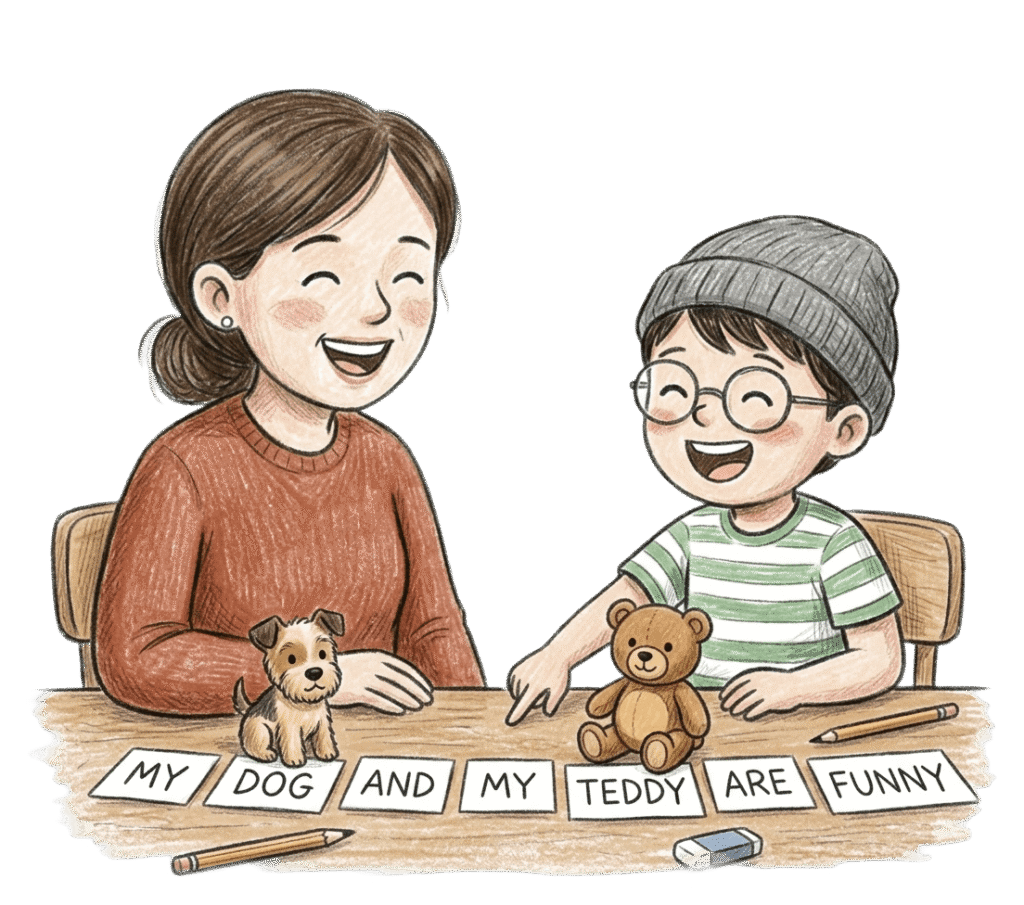
Silly sentence builder
Pick word cards and build the most ridiculous sentence you can. Read it aloud, laugh at it, build another one. The sillier the better.
Goal
Practise reading words in context — and lower the stakes so much that reading feels like the fun bit, not the hard bit.
You'll need
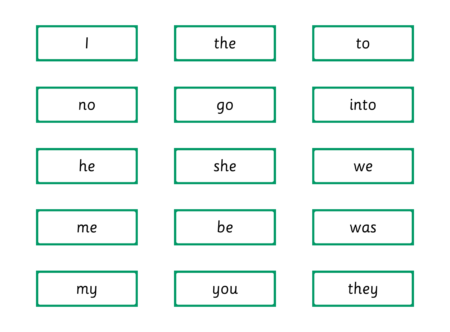
- Tricky Word Cards
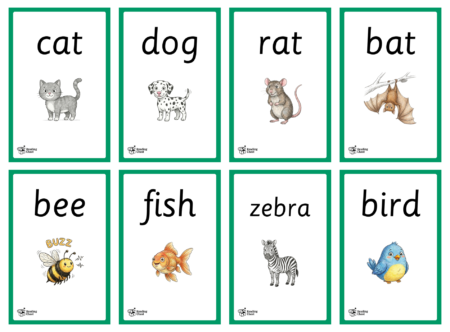
- Animal Phonics Flashcards
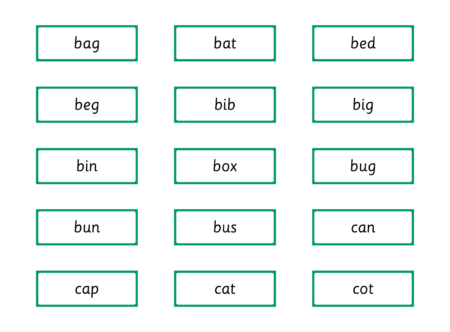
- CVC Word Cards
How to do it
Spread out the word cards — tricky words, animals, CVC words, whatever you have. Each person picks two or three at random. The challenge: make the silliest sentence possible using those words.
"The blue frog sat on the moon." "A sad cat said the big dog was wet." Read your sentence aloud, as dramatically as you can. Then swap cards and go again.
There's real phonics work happening here — blending, reading tricky words by sight, understanding how sentences fit together — but it doesn't feel like it. Which is entirely the point.
Grab our resources
Print our tricky word cards and animal phonics flashcards to get started.
Spot the error
Write a sentence with the wrong homophone and ask your child to find it: “The dog wanted too go outside.” Children love catching mistakes, and the act of evaluating a wrong answer builds the same understanding as getting the right answer.
Visual anchors
Some children find it helpful to draw a quick picture that links the word to its meaning: draw an ear in the “a” of “hear”, or a map point in the “e” of “there”. Visual anchors are particularly useful for the words that cause the most confusion.
This word-building activity is good for exploring how similar-sounding words relate to each other:
Word ladder game
Start with one word, change one sound, make a new word. Climb the ladder: cat, bat, sat, set, net. Phonics as a puzzle.
Goal
Practise changing one sound to make new words — builds phonemic awareness, blending and an instinct for how words are constructed.
You'll need
- CVC Word Cards
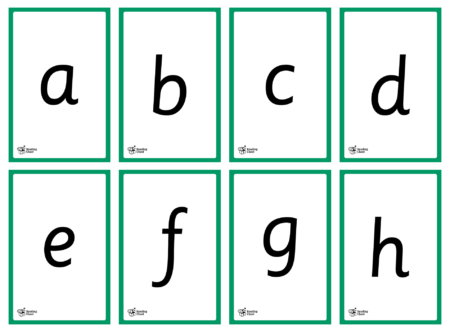
- Alphabet Flashcards (Lower Case)
- CCVC Word Cards
How to do it
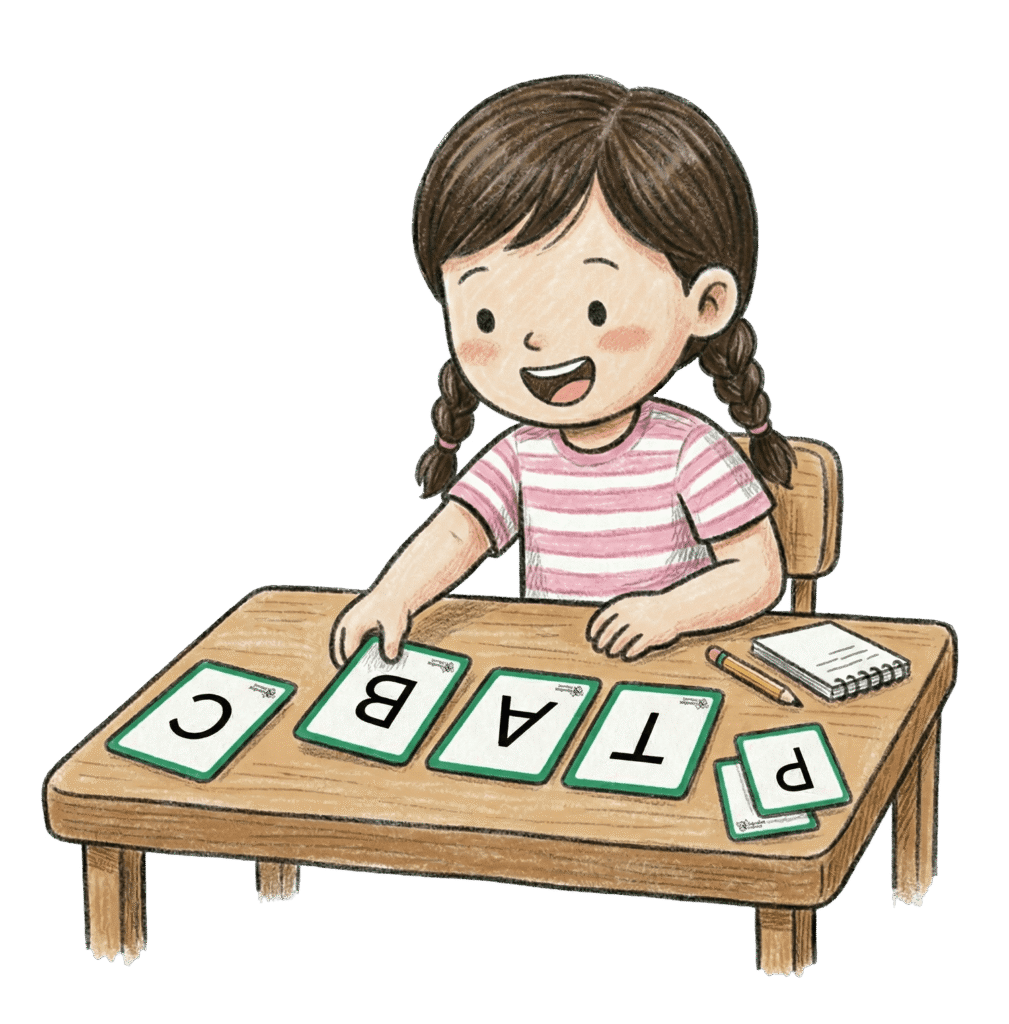
Pick a starting word — "cat" is a good one. Read it together. Now change one sound: swap the c for a b — "bat". Change the a for an i — "bit". Change the b for an s — "sit".
Use the letter cards to build each word physically. Reading the new word as soon as it's built — before moving on — is the key step.
Take turns choosing which sound to swap. See how many rungs you can climb before you run out of real words. You can use the word cards as inspiration if you get stuck. It's a puzzle, and children who don't like "practice" often love puzzles.
Grab our resources
Print our cvc word cards and alphabet flashcards (lower case) to get started.
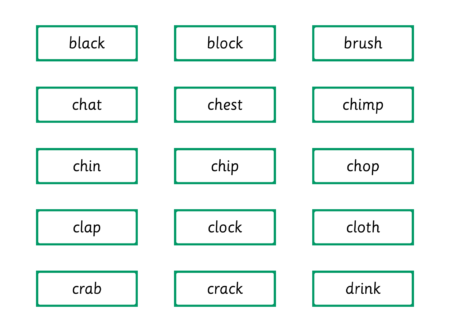
Our alternative spellings flashcards also include some common homophone pairs — useful for showing children how the same sound maps to different spellings in different contexts.
Frequently asked questions
What’s the difference between a homophone and a homonym?
A homophone sounds the same as another word but is spelled differently. A homonym looks the same (and often sounds the same too) but has different meanings — like “bat” (the animal) and “bat” (for cricket), or “bark” (of a tree) and “bark” (a dog’s sound). Homophones always involve different spellings; homonyms may or may not. In primary school, children are usually just introduced to homophones — the homonym distinction comes later.
At what age do children learn homophones?
Children typically encounter their first homophones in Year 1 and Year 2, where common pairs like to/too/two and there/their/they’re appear in the statutory spelling curriculum. More complex homophones are introduced in Year 3 and Year 4. By Year 6, children are expected to be confident with a wide range of them in their own writing.
Is “its” and “it’s” a homophone?
Technically, yes — they sound identical. “Its” is the possessive form (the dog wagged its tail) and “it’s” is a contraction of “it is” or “it has” (it’s been a long day). This particular pair trips up even adult writers, so be gentle with children who mix them up — and gently correct it when it comes up rather than making a big deal of it.
Are homophones the same as tricky words?
Not quite — though there’s some overlap. Tricky words (common exception words) are words whose spellings don’t follow regular phonics patterns and have to be learned by sight. Homophones are about meaning and context — the challenge isn’t that either spelling is irregular, it’s that you have to know which meaning you’re after. Some tricky words are also homophones (like their and there), but many aren’t.
The short version
Homophones are words that sound the same but mean different things and are spelled differently. They’re tricky because phonics can get you to the right sound, but only understanding the meaning tells you which spelling to use. The most effective way to help children learn them is through meaning-focused practice: mnemonics, silly sentences, and spotting errors — not just memorising lists.
The hardest ones tend to be the most common ones — there/their/they’re, to/too/two — because children write them so often that errors become habitual. Little and often, in context, is the most reliable fix.
