
Contents
Your child comes home from school and you ask what they did today. “Phonics,” they say. But what actually happens in that lesson? What does the teacher do, and what is your child doing? Understanding the shape of a phonics lesson can make a real difference to how you support things at home.
This guide breaks down how phonics teaching works in UK primary schools — the structure of a typical lesson, how sounds are introduced and why, and what you can do at home that genuinely helps without muddying the waters.
You don’t need to become a phonics expert. But a basic understanding of how teaching phonics works means you can back up what school is doing, rather than accidentally pulling in a different direction.
What a phonics lesson looks like
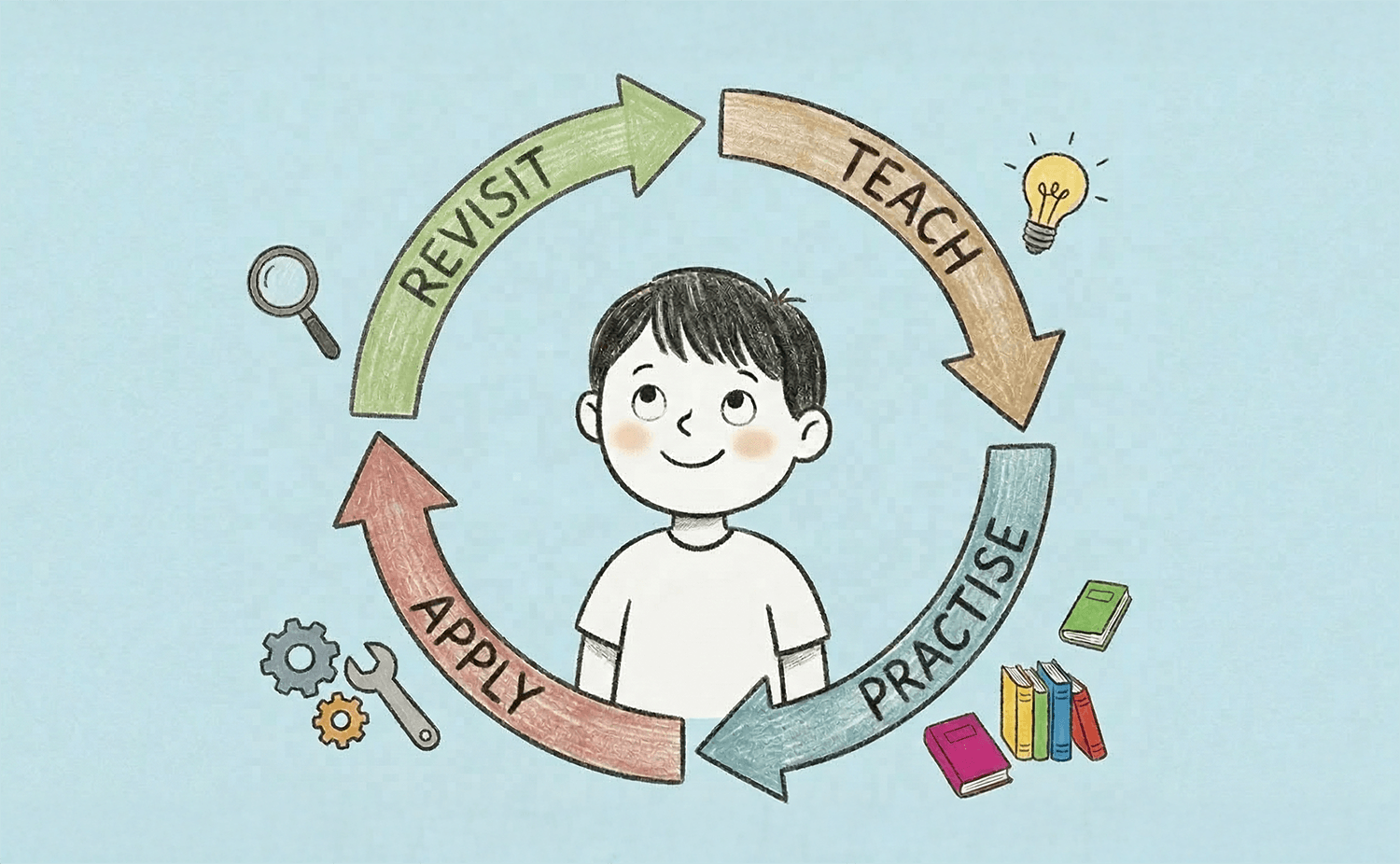
In most UK primary schools, phonics is taught in a short, focused daily lesson — usually 20 to 30 minutes. It follows a consistent four-part structure that teachers return to every single day. That repetition is deliberate: it builds habits, reduces cognitive load, and keeps the pace brisk.
The four parts are: revisit, teach, practise, apply. Here’s what each one looks like in practice.
Revisit
The lesson opens with a quick-fire review of sounds already taught. Think flashcards held up one by one, the class calling out the sound in unison. Teachers call this “speed sounds” — and speed is genuinely the point. The aim is for children to recognise the sound instantly, without having to sound it out slowly from scratch. What felt effortful last week should feel automatic this week.
Teach
One new sound is introduced — just one, always. The teacher shows the grapheme (the written letter or letters) and says the phoneme (the sound it makes). Often there’s a mnemonic or a short story attached: a character, a gesture, a picture. In Read Write Inc, for instance, each sound has a picture and a phrase (“a, ants on your arm“). In Little Wandle it’s a different set of images and mnemonics. The stories vary by scheme; the approach is the same.
One thing that surprises many parents: children learn the sound of a letter before its name. The letter m is taught as m (a short hum), not as “em”. This matters, because when children are blending sounds into words, they need the pure sound — “emm-a-tuh” doesn’t blend into “mat”.
Practise
Now the children apply the new sound, reading words and short sentences that contain it. Often this is done as a whole class, reading aloud together — what teachers call choral response. Everyone reads at the same time, which takes the pressure off individual children and keeps the energy up. Children might also write a few words containing the new sound, helping to cement the link between seeing, hearing and producing it.
Apply
The lesson ends with reading: usually a short decodable book or a set of sentences that uses only sounds the children have already been taught. This is the payoff — children getting to actually read something. Decodable books are carefully controlled so that nothing appears on the page that hasn’t been explicitly taught yet. Your child isn’t expected to guess or use picture clues — they decode every word using the sounds they know.
You may have heard the phrase “decodable readers” or seen your child bring home books that seem very simple or repetitive. This is intentional. Every word in those books is there because your child should be able to sound it out. That predictability is what builds confidence.
Bite-sized reading tips, straight to your inbox
Get confidence-boosting tips to help your child learn to read. Short, useful, and easy to fit into (real) family life!
Even better? You'll also get 25% off your first month of Reading Chest.
Why sounds are taught in a specific order
Phonics doesn’t start with the alphabet — it starts with the most useful sounds first. The sequence is designed so that children can start reading and writing real words as quickly as possible.
The first sounds are typically high-frequency consonants and short vowels: s, a, t, p, i, n. With just those six sounds, a child can read and spell dozens of words: sat, pin, tan, nap, sip, tip. Compare that to teaching the alphabet in order, where you’d be waiting until z before you could do very much at all.
From there, the sequence gradually introduces more complex sounds: digraphs like sh, ch and th, then vowel digraphs like ai, ee and oa, and eventually alternative spellings for the same sound (Phase 5 — the stage where children learn that ai can also be spelled ay, a-e or eigh, depending on the word).
If you’d like to see all the sounds in the order they’re typically taught, our phonics sounds guide walks through them with examples.
RWI, Little Wandle, Sounds-Write: what’s different?
UK schools use a variety of government-validated phonics programmes, and the most common ones your child might be taught with are Read Write Inc (RWI), Little Wandle Letters and Sounds, and Sounds-Write. If you’ve heard these names and wondered what they mean, here’s the short version.
All three follow the same underlying principles: they teach phonics systematically and synthetically, working through a structured sequence of sounds, and they all use the revisit-teach-practise-apply lesson format. What differs is the materials they use, the mnemonics and stories attached to each sound, the decodable books that accompany the scheme, and the pace and grouping structure.
The most important thing to know is that switching between schemes at home — using RWI flashcards when your school uses Little Wandle, for example — can cause confusion. Stick to what school is doing.
How you can help at home
You don’t need to teach phonics yourself — that’s the school’s job. But there’s plenty you can do to support it.
Ask which sounds are being taught this week
Most schools send home a sheet of sounds your child is currently working on, or you can ask the teacher. Once you know which sounds are live, you can practise those — pointing them out in books, on signs, on cereal boxes. Even a few minutes in the car or at the dinner table makes a difference.
Don’t get ahead of the sequence
It can be tempting to try to teach your child “extra” sounds or show them words the class hasn’t reached yet. Resist. The sequence is carefully built so each sound prepares children for the next. Jumping ahead can mean children encounter patterns they haven’t got the tools to decode yet, which can knock their confidence rather than build it.
Read decodable books together
The books your child brings home from school are chosen to match where they are in the sequence. Read them together — but let your child lead. The goal isn’t a polished performance; it’s decoding practice. If they get stuck, try: “What sounds do you know in that word?” rather than just telling them the answer.
If you want to top up their reading at home with extra decodable books at the same level, Reading Chest has thousands of scheme books you can borrow by post — it’s an easy way to get more practice without having to hunt through shops.
Practise sounds as sounds, not letter names
When you’re going over sounds at home, say the phoneme, not the letter name. s as in sun, not “ess”. This is especially important when blending — children blend sounds, not letter names.
If you want a structured activity to make sound practice fun, this one works well for any sound your child is currently learning at school.
Sound of the day
Pick one sound and spend the day noticing it everywhere — on signs, packets, toys, and out in the world. Quick to set up, surprisingly addictive.
Goal
Help your child notice sounds in everyday life — building phonemic awareness without needing to sit down and "do phonics".
You'll need
Just a focus sound — like sh or ee — and your normal day.
How to do it
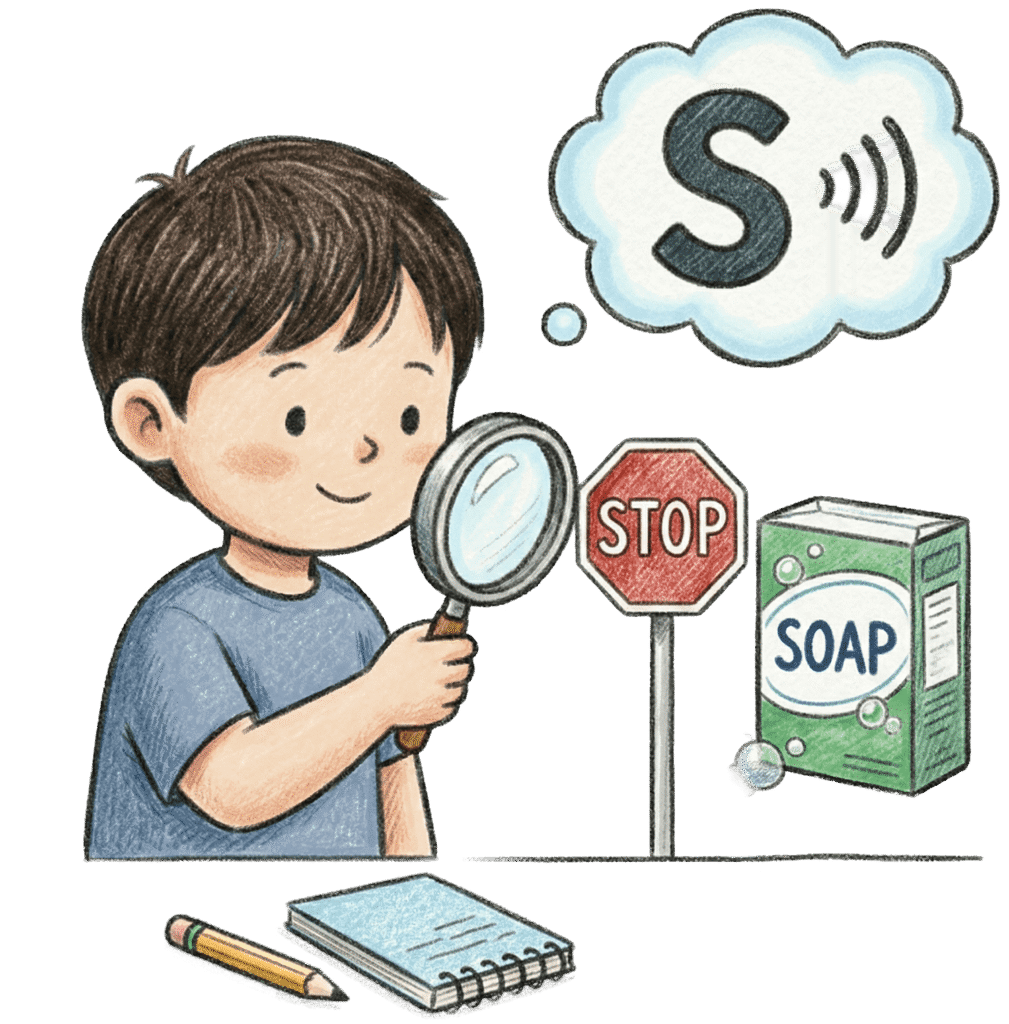
Pick a sound in the morning. Say it together clearly: sh, ee, m — whatever you're working on. That's your sound of the day.
Then just keep going with your normal day. Whenever you spot it — on a cereal box, a road sign, a shop name, a toy — point it out and say the sound together. Let your child spot them too and make a fuss when they do.
By the end of the day, you'll have done phonics practice a dozen times without sitting down once. That's the magic of making it ambient rather than formal.
When your child is struggling
If your child seems to be falling behind, the first step is to talk to the teacher. Ask specifically which sounds they’re not secure on, and whether the school has any catch-up support in place. Most schools have intervention programmes for children who need more time with the basics.
Don’t try to diagnose the problem yourself or switch to a different approach at home without talking to the teacher first — consistency matters a lot in early phonics.
If you’d like to try a low-pressure game at home to reinforce sounds, try this one with a favourite toy. It’s a gentle way to build familiarity with new phonemes without it feeling like a test.
Teach the teddy sounds
Your child becomes the teacher. They show a teddy (or any toy) the letter cards and explain each sound. Teaching something is the best way to really learn it.
Goal
Practise letter-sound recall by putting your child in charge — teaching takes the pressure off and reveals exactly what they know.
You'll need
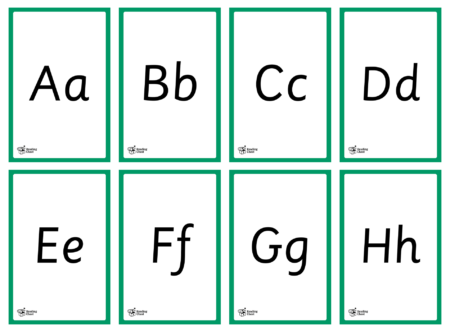
- Alphabet Flashcards (Both Cases)
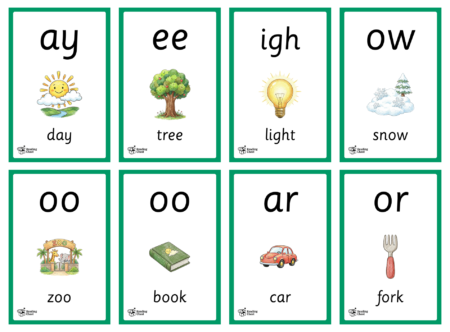
- Digraphs & Trigraphs Picture Flashcards
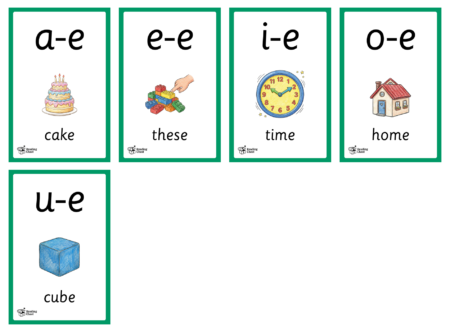
- Split Digraph Flashcards
How to do it
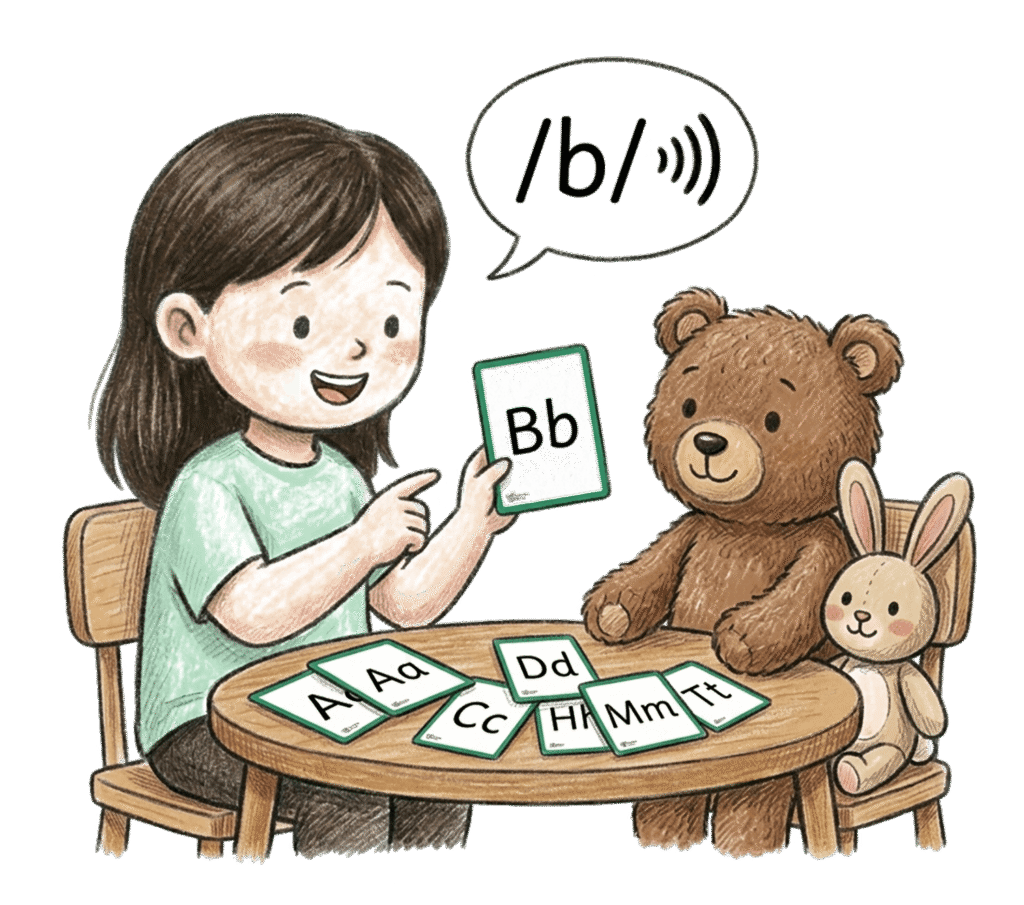
Choose a teddy, doll or soft toy to be the "pupil". Give your child a stack of flashcards — a mix of letters and digraphs. Their job: teach the teddy each sound.
They hold up a card, say the sound clearly, maybe give an example word. You can play the teddy if you like — getting confused, needing things repeated, asking "what word does that make?" Children love being the expert.
If your child gets stuck on a card, the teddy can get it "wrong" too — which takes the pressure off. It's much easier to correct a teddy's mistake than to admit your own. And the teaching still works either way.
Grab our resources
Print our alphabet flashcards (both cases) and digraphs & trigraphs picture flashcards to get started.
Frequently asked questions
How long is a phonics lesson in primary school?
Most schools run phonics lessons of around 20–30 minutes every day in Reception and Year 1. The lessons are kept short and focused because young children’s concentration benefits from a brisk pace — lots of variety and quick transitions rather than long stretches on one thing.
At what age do children start phonics in the UK?
Children typically begin phonics in Reception (age 4–5), usually in the autumn term. How is phonics taught in Reception? Much the same way as in Year 1 — the same four-part lesson structure, just with simpler sounds and shorter books. Schools are required by the National Curriculum to teach phonics from the start of Key Stage 1 (Year 1), but most begin earlier. By the end of Year 1, children sit the Phonics Screening Check, which assesses whether they’ve reached the expected standard.
What is the difference between phonics and whole-word reading?
Phonics teaches children to decode words by sounding out and blending the individual sounds (phonemes) in a word. Whole-word reading — sometimes called “look and say” — asks children to memorise words as whole shapes. The evidence strongly favours systematic phonics for teaching children to read, and it has been the required approach in UK schools since 2006. Some very common words (like the and said) are taught as “tricky words” alongside phonics, because they don’t follow regular phonics patterns.
Should I teach phonics differently at home than school does?
No — the most helpful thing is to follow what school is doing, not add a second approach. Ask the teacher which sounds are currently being taught, use the same vocabulary (phoneme, grapheme, blending, segmenting), and stick to the school’s scheme materials if possible. Consistency between home and school makes everything easier for your child.
What is the Phonics Screening Check?
The Phonics Screening Check is a short assessment taken by all Year 1 children in England, usually in June. It contains 40 words — 20 real words and 20 nonsense words — and children read them one by one to their teacher. The nonsense words (like zog or bim) are there to test pure decoding ability, since children can’t have seen them before.
The key things to take away
Phonics in UK schools follows a clear, evidence-based structure: a short daily lesson built around revisiting previous sounds, introducing one new sound, practising it in words and sentences, and applying it in a decodable book. Sounds are taught in a deliberate order, from the most useful to the most complex, and every good phonics programme follows this same basic shape — regardless of which scheme your school uses.
Your job at home is to back it up, not replicate it. Ask what’s being taught, practise those sounds in low-key ways, let your child lead when reading, and raise any concerns with the teacher early. That combination is genuinely powerful.
If you’d like to go deeper on the theory behind why phonics is taught this way, our guide to systematic synthetic phonics explains the research behind the approach.
