Contents
Teaching a child to read is not something most parents do alone — school handles the systematic instruction. But what you do at home, before and alongside school, makes a significant difference to how quickly and confidently your child develops as a reader.
This guide covers the full journey: from the early language and phonological awareness that sets the foundation, through systematic phonics and blending, to the fluency that marks a confident independent reader. It’s a roadmap, not a curriculum — follow your school’s sequence, and use this to understand where your child is in the bigger picture.
Before phonics starts: the foundation
Reading doesn’t begin with letters. It begins with language. Children who arrive at school with strong spoken language — large vocabularies, good listening comprehension, and familiarity with stories and books — tend to learn to read faster and with less difficulty. That foundation is built long before Reception.
The most important things you can do before formal reading instruction begins:
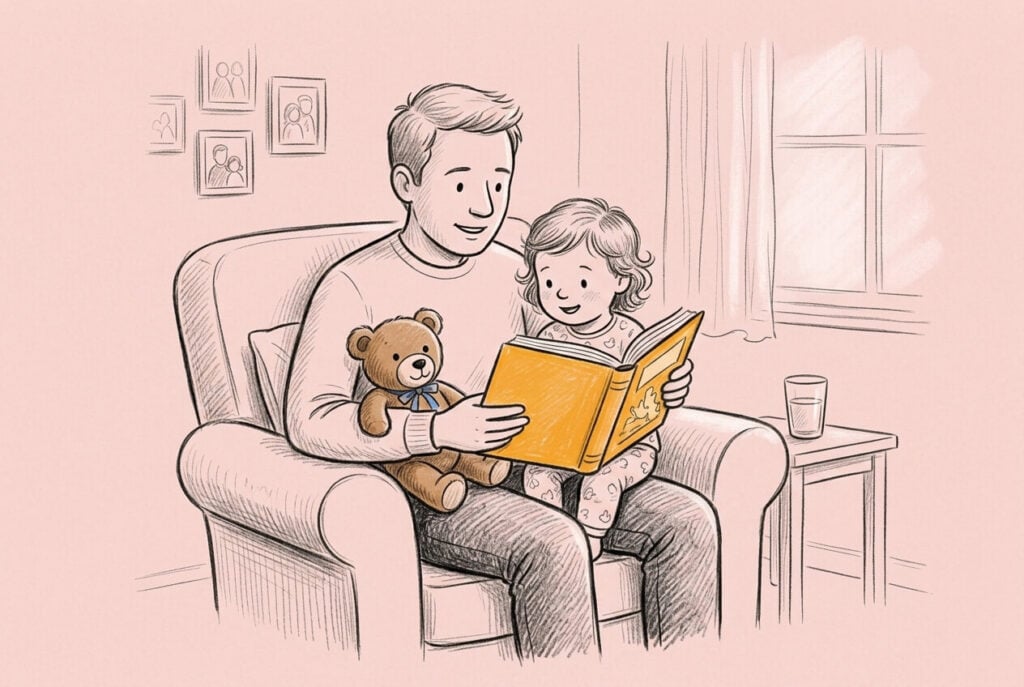
- Read aloud regularly. Books, stories, poetry — anything that exposes your child to language they wouldn’t encounter in everyday conversation. The vocabulary, sentence structures, and narrative patterns in books build knowledge that later supports reading comprehension.
- Play with sounds. Nursery rhymes, tongue twisters, clapping syllables in names, games like I Spy that focus on initial sounds — all of these develop phonological awareness, the ability to hear the sound structure of spoken language. This is one of the strongest predictors of early reading success.
- Talk about letters and words. Point out letters in the environment, spell your child’s name, show them how you write a shopping list. Familiarity with print as a meaningful system is helpful before formal instruction begins.
Our early language development guide covers the language milestones that underpin later reading in more detail.
Bite-sized reading tips, straight to your inbox
Get confidence-boosting tips to help your child learn to read. Short, useful, and easy to fit into (real) family life!
Even better? You'll also get 30% off your first month of Reading Chest.
Stage 1: sound awareness and phonological skills
The first stage of formal phonics teaching focuses on sounds in spoken language before letters are introduced. Children learn to:
- Recognise and generate rhymes
- Clap syllables in words
- Identify the initial sound in a word (the c in cat)
- Blend spoken syllables into words and segment words into syllables
This work happens at the beginning of Reception, often before any letter-sound correspondence is introduced. The goal is to develop children’s awareness that spoken words are made of sounds, so that when letters are introduced, there’s something to attach them to.
Stage 2: letter-sound correspondence
This is where phonics instruction formally begins. Children learn which sounds specific letters represent, starting with the most common and useful letter-sound correspondences: typically s, a, t, p, i, n first.
A few things matter here:
- Sounds before letter names. Most phonics programmes introduce the sound a letter makes before its name. The letter s makes the /s/ sound — that’s what matters for reading. Teaching letter names first is less effective because names like “aitch” and “doubleyou” don’t help a child decode.
- Pure sounds. When sounding out a letter, say just the sound — /s/, not “suh”. Adding a vowel sound distorts the blending process.
- Matching the school’s programme. Different schemes introduce letters in slightly different orders. Ask your child’s teacher which sounds have been taught so far, and practise only those at home.
Stage 3: blending sounds into words
Blending is reading: putting sounds together to build a word. A child who can identify c, a, and t and then say them faster and faster until the word cat emerges is blending. This is the core reading skill, and it takes practice to become automatic.
At home, blending practice happens through decodable books — books designed so that every word can be sounded out using the letter-sound knowledge your child has been taught. These are not the same as picture books. Decodable books may not be the most beautiful things you’ve read together, but they serve a specific purpose: repetition of the blending process until it becomes automatic.
You can also blend spoken sounds into words in games — “Can you guess what I’m thinking of? /c/–/a/–/t/. Yes, cat!” — to practise the mental process without print.
Stage 4: tricky words and sight recognition
Alongside decodable work, children learn a set of high-frequency words that don’t follow standard phonics patterns: words like the, said, was, and come. These are called tricky words (or common exception words) and they need to be recognised rapidly on sight rather than sounded out each time.
Tricky words are practised through repetition: flashcards, reading games like snap and pairs, spotting them in books. The goal is automatic recognition, not just knowing the word when given time to think about it.
Stage 5 and beyond: digraphs, vowel patterns, fluency
Once children have the single-letter sounds and basic blending, phonics instruction expands to cover digraphs (two letters that make one sound, like sh, ch, th), vowel digraphs (ai, ee, igh), and eventually alternative spellings — the understanding that the same sound can be written in different ways.
At this stage, reading is still practice, and the books children read should be matched carefully to their current phonics knowledge. As decoding becomes more automatic, fluency develops — reading becomes faster, more accurate, and more expressive.
What not to do
A few common home approaches that can actually hinder reading development:
- Asking your child to “guess” from pictures. Picture clues can be useful for comprehension, but guessing at words from context or illustrations undermines phonics practice. The point of phonics is to decode the word, not to predict it.
- Correcting every error immediately. Let your child have a second attempt before you step in. Immediate correction can make reading feel like a test and increase anxiety.
- Skipping levels or pushing ahead. Moving through reading levels too quickly means your child won’t have enough practice at each level for decoding to become automatic. Fluency requires repetition, not speed.
- Teaching letter names before sounds. If your child is learning to read, focus on sounds first. Letter names are useful to know, but they’re secondary to letter-sound correspondences in early reading.
Games and activities that help
Sound practice doesn’t have to feel like work. This activity builds sound awareness through a fun daily routine:
Sound of the day
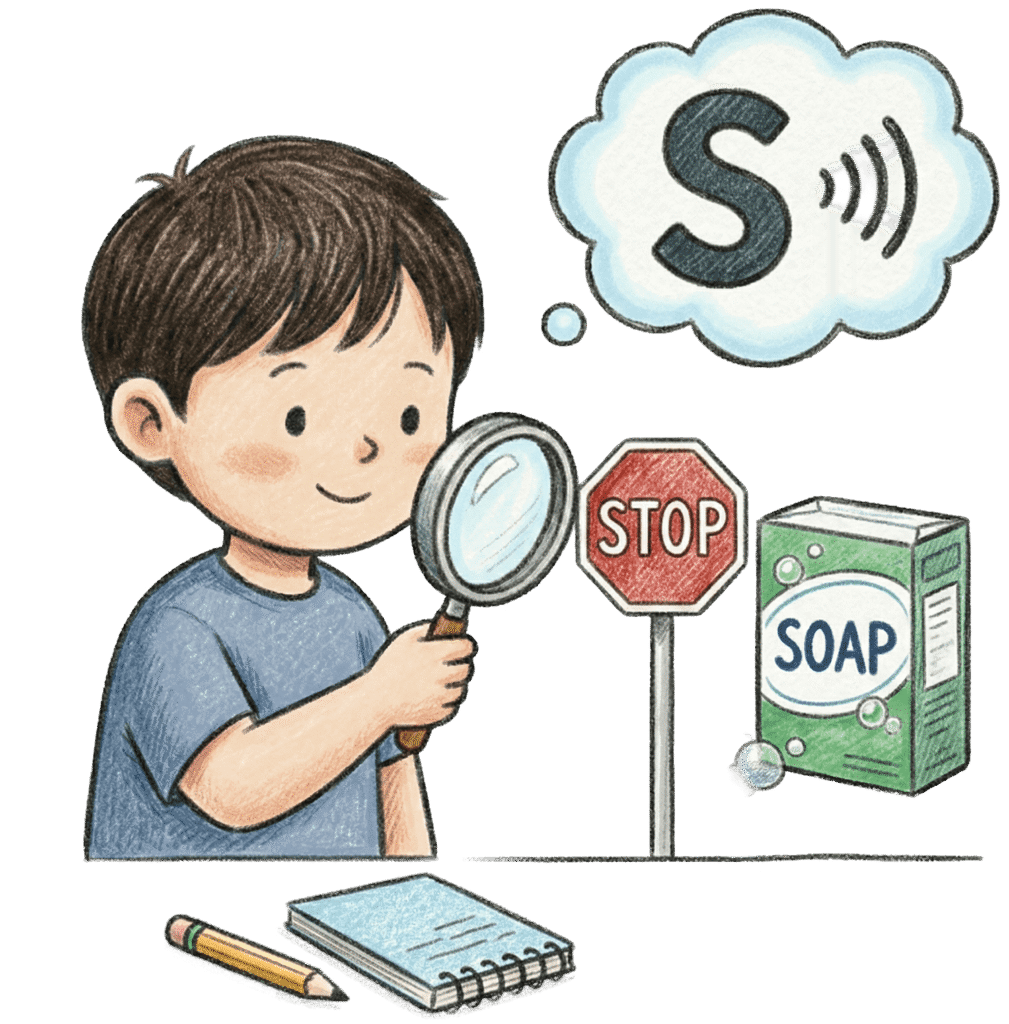
Pick one sound and spend the day noticing it everywhere — on signs, packets, toys, and out in the world. Quick to set up, surprisingly addictive.
Goal
Help your child notice sounds in everyday life — building phonemic awareness without needing to sit down and "do phonics".
You'll need
Just a focus sound — like sh or ee — and your normal day.
How to do it
Pick a sound in the morning. Say it together clearly: sh, ee, m — whatever you're working on. That's your sound of the day.
Then just keep going with your normal day. Whenever you spot it — on a cereal box, a road sign, a shop name, a toy — point it out and say the sound together. Let your child spot them too and make a fuss when they do.
By the end of the day, you'll have done phonics practice a dozen times without sitting down once. That's the magic of making it ambient rather than formal.
And this one uses a teddy bear as a teaching prop — children who “teach” a toy often consolidate their own knowledge better than children who are being drilled:
Teach the teddy sounds
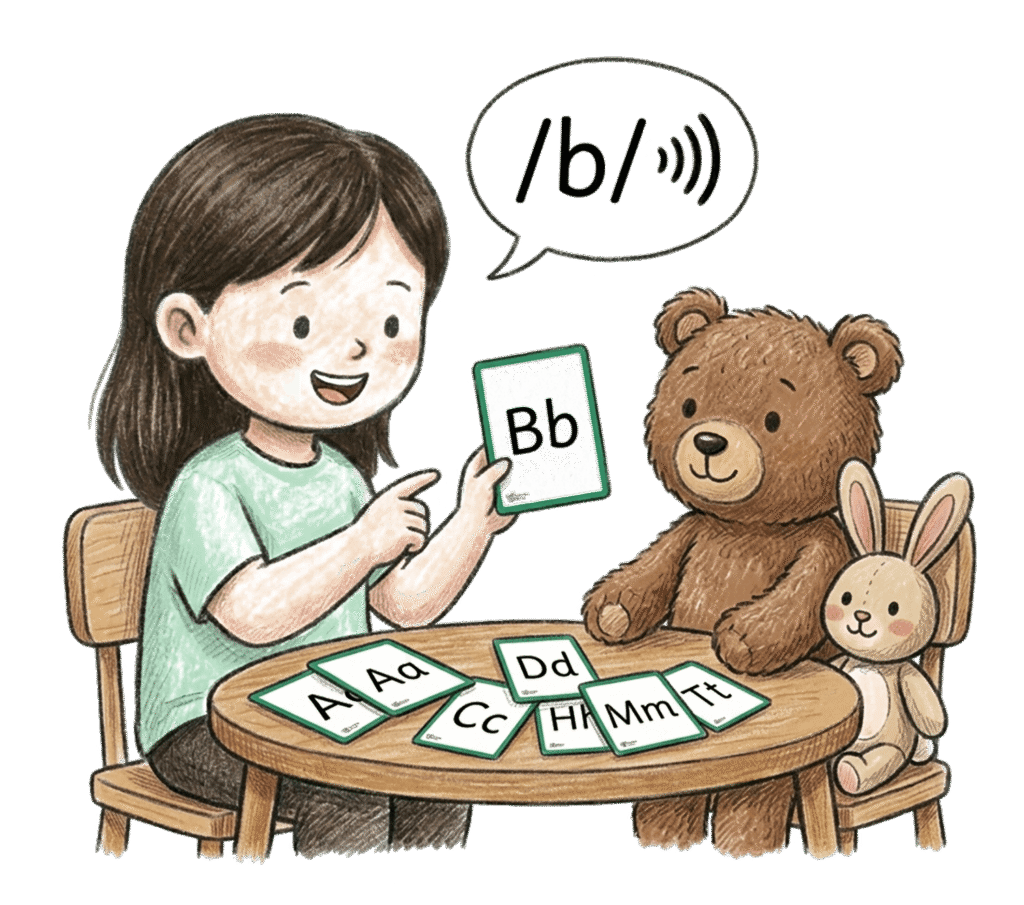
Your child becomes the teacher. They show a teddy (or any toy) the letter cards and explain each sound. Teaching something is the best way to really learn it.
Goal
Practise letter-sound recall by putting your child in charge — teaching takes the pressure off and reveals exactly what they know.
You'll need
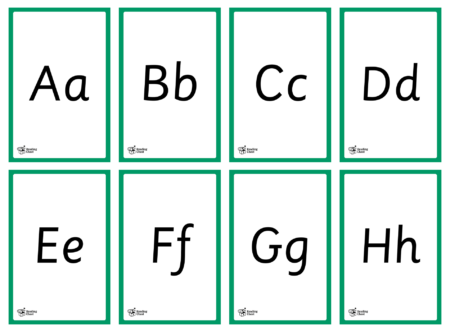
- Alphabet Flashcards (Both Cases)
- Digraphs & Trigraphs Picture Flashcards
- Split Digraph Flashcards
How to do it
Choose a teddy, doll or soft toy to be the "pupil". Give your child a stack of flashcards — a mix of letters and digraphs. Their job: teach the teddy each sound.
They hold up a card, say the sound clearly, maybe give an example word. You can play the teddy if you like — getting confused, needing things repeated, asking "what word does that make?" Children love being the expert.
If your child gets stuck on a card, the teddy can get it "wrong" too — which takes the pressure off. It's much easier to correct a teddy's mistake than to admit your own. And the teaching still works either way.
Grab our resources
Print our alphabet flashcards (both cases) and digraphs & trigraphs picture flashcards to get started.
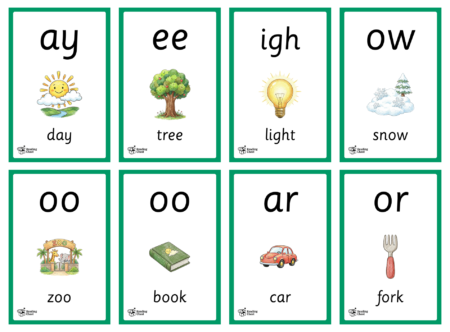
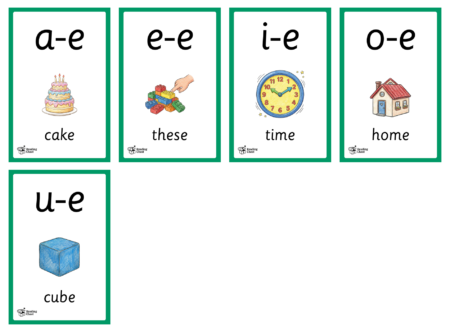
For a broader set of game-based ideas at every stage of learning to read, our learning to read games guide has plenty of options that don’t require any preparation.
Frequently asked questions
Should I teach my child to read before they start school?
You don’t need to and probably shouldn’t try to run ahead of the school’s phonics sequence. What you can do — and what makes a real difference — is read aloud to your child as much as possible, play with sounds through rhymes and games, and talk about letters and words in everyday life. These build the foundation that makes formal reading instruction more effective. If your child shows an interest in letters and sounds, follow it; just don’t feel you need to get through a reading curriculum before Reception.
My child can “read” but is clearly just memorising the words — is that a problem?
It can be. Some children who have been read the same books many times appear to read them by heart rather than by decoding. This is different from reading, and if it persists it means the child isn’t developing the letter-sound knowledge they’ll need for unfamiliar words. The test is simple: give them a book they’ve never seen before. If they can read it, they’re decoding. If they can only “read” books they already know, the phonics foundation needs more work.
How do I know which phonics scheme my school uses?
Ask the school directly — at a parents’ evening, by email, or by asking the class teacher. Most schools are happy to tell you and many proactively share information about their phonics programme at the start of Reception. Knowing which scheme is used matters because different programmes introduce sounds in slightly different orders and use different terminology, and home practice is most effective when it aligns with what’s being taught.
