Contents
A reading age is a standardised score that compares a child’s reading ability to the average performance of children of a given age. If a child has a reading age of 8, it means they’re reading at the level of an average 8-year-old, regardless of how old they actually are.
If your child has come home from school with a reading age score — or you’ve seen one pop up in an app or assessment report — it’s easy to feel either relieved or worried before you’ve had a chance to understand what it actually tells you. The honest answer: it tells you something, but not as much as it might seem.
Here’s a calm, clear guide to what reading age means, how it’s measured, and how to put the number in context.
How reading age is measured
Reading age scores come from standardised assessments — tests that have been given to large groups of children across different ages so that an average can be established. Common standardised reading tests used in UK schools include the YARC (York Assessment of Reading for Comprehension), NFER reading tests, and the Salford Sentence Reading Test.
These tests typically ask a child to read words or passages aloud and/or answer comprehension questions. The results are compared against the norm for the child’s age group to produce a reading age score.
Not all reading age assessments are equal. Some apps and online tools claim to produce a reading age score but use much simpler methods than formal standardised testing. A score from a quick app assessment and a score from a carefully standardised school test are not directly comparable.
Bite-sized reading tips, straight to your inbox
Get confidence-boosting tips to help your child learn to read. Short, useful, and easy to fit into (real) family life!
Even better? You'll also get 30% off your first month of Reading Chest.
What a reading age tells you — and what it doesn’t
A reading age is a snapshot of how a child performed on a particular test, on a particular day. It’s a useful data point, but it has real limitations:
- It’s not a complete picture. Most reading age tests focus on either decoding (reading words accurately) or comprehension (understanding text) — rarely both equally. A child can have a high decoding reading age but lower comprehension, or vice versa. One number rarely captures both.
- It can vary. A child who’s tired, anxious, or having a bad day may score lower than their actual ability suggests. A good day can produce a higher score. Single assessments have a margin of error.
- It’s a comparison, not a target. A reading age of 7 means “similar to the average 7-year-old on this test.” It doesn’t mean there’s a ceiling to reach or that anything below the chronological age is a problem.
- It’s a blunt instrument. Reading is complex. Vocabulary, fluency, inference, motivation, breadth of reading experience — none of these are captured neatly in a single score.
A reading age slightly below chronological age in the early years is very common and doesn’t necessarily indicate a problem. Many children who are behind at 6 or 7 catch up fully by 9 or 10.
Reading age vs book bands and curriculum levels
Reading age and book bands are two different frameworks. Book bands describe the level of books a child is currently reading — they’re based on text features like sentence length, vocabulary load, and print size. Reading age is a standardised score based on a test.
There’s overlap between the two, but they don’t map neatly. A child on Purple book band might have a reading age of 7½ or 8½ depending on the test used and the child’s particular profile. Using both frameworks together gives a more rounded picture than either alone.
You can read more about how book bands work in our guide to reading levels in UK primary schools.
When reading age matters more
Reading age scores are particularly useful in specific contexts:
- SEND assessments. When a child is being assessed for a specific learning difficulty like dyslexia, standardised reading age tests are one of the tools used to identify the gap between a child’s reading performance and what would be expected at their age.
- Reading intervention decisions. Schools use reading age data to decide which children need targeted support and to measure whether an intervention is having an effect.
- Tracking progress over time. A reading age score on its own is limited; two scores six months apart tell you something much more useful about whether a child is making expected progress.
If your child’s school has shared a reading age score with you and you’re unsure what it means in the context of your specific child, the best next step is to ask their teacher. They’ll have more information about how the score was obtained and what it means alongside everything else they know about your child’s reading.
What you can do at home
Whatever a child’s reading age score, the most evidence-backed thing you can do at home is read together regularly. Not drilling — just reading. Books at a comfortable level, books that interest them, books that are slightly challenging, and books that are pure fun. Variety and volume matter more than any single assessment score.
If you’re worried about your child’s reading, it’s also worth talking to their teacher about what specific strategies would be most helpful to practise at home. Schools have much more information about a child’s reading profile than a single test score provides.
This activity is a good way to make regular reading feel enjoyable rather than effortful:
The reading relay
Take turns reading a sentence or page each — you share the load, keep the momentum, and finish the book together. A proper team effort.
Goal
Make reading feel shared and manageable — less pressure, more momentum, and a natural model of fluent reading built right in.
You'll need
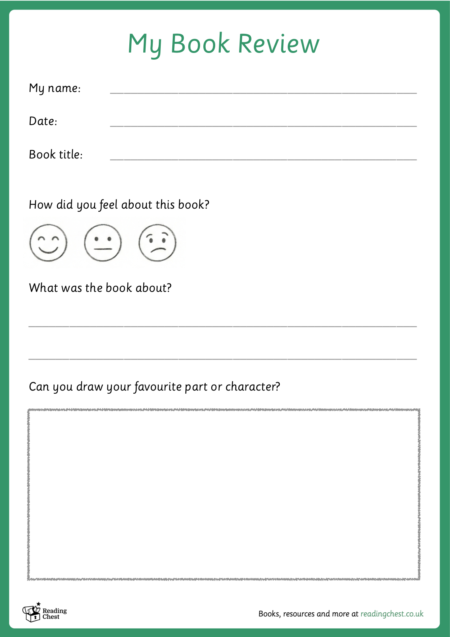
- Beginner Book Review
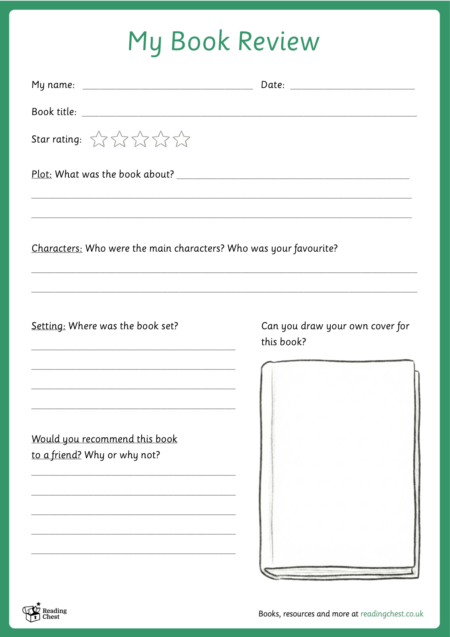
- Intermediate Book Review
How to do it
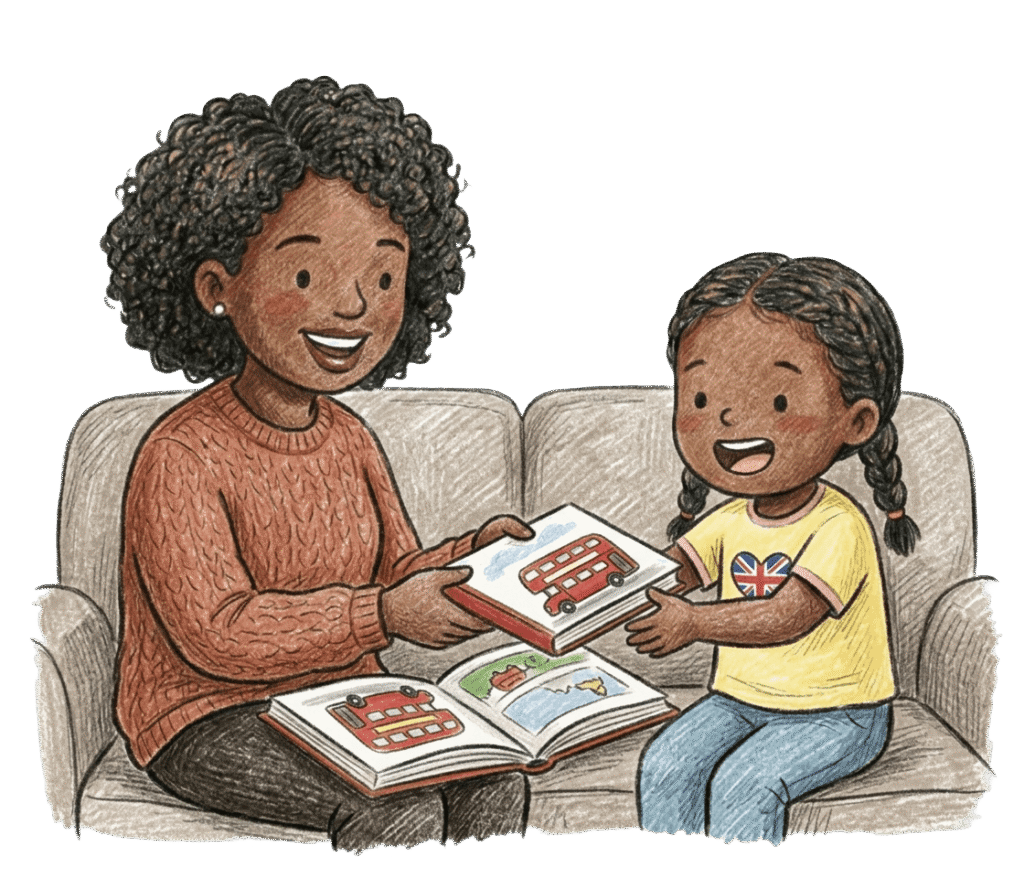
Pick a book and take turns: you read a sentence (or paragraph), they read a sentence. Pass it back and forth. If they stumble on a word, carry on — don't stop to correct mid-relay unless they ask for help.
Hearing you read fluently between their turns is genuinely useful — they're getting a live model of what reading sounds like at full speed. The relay format also keeps the story moving, which helps with children who find long reading sessions exhausting.
Fill in a book review together when you're done. Writing about it while the story's fresh is much better than coming back to it later.
Grab our resources
Print our beginner book review and intermediate book review to get started.
And this one builds comprehension gently — the kind of deep understanding that reading age tests often measure:
Before and after reading
One question before you open the book. One after you close it. That's it — but it shifts everything from just decoding words to actually thinking about them.
Goal
Help your child get more from every reading session by tuning in to meaning, not just getting through the words.
You'll need
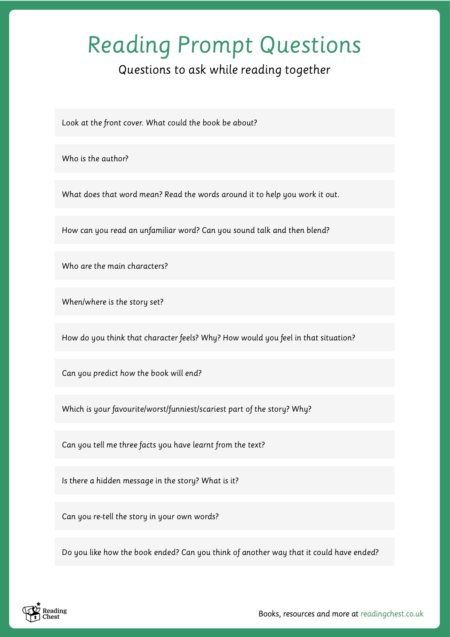
- Reading Prompt Questions
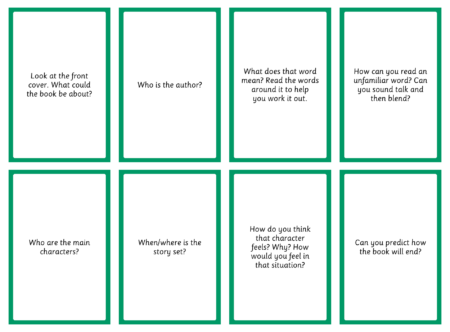
- Reading Prompt Cards
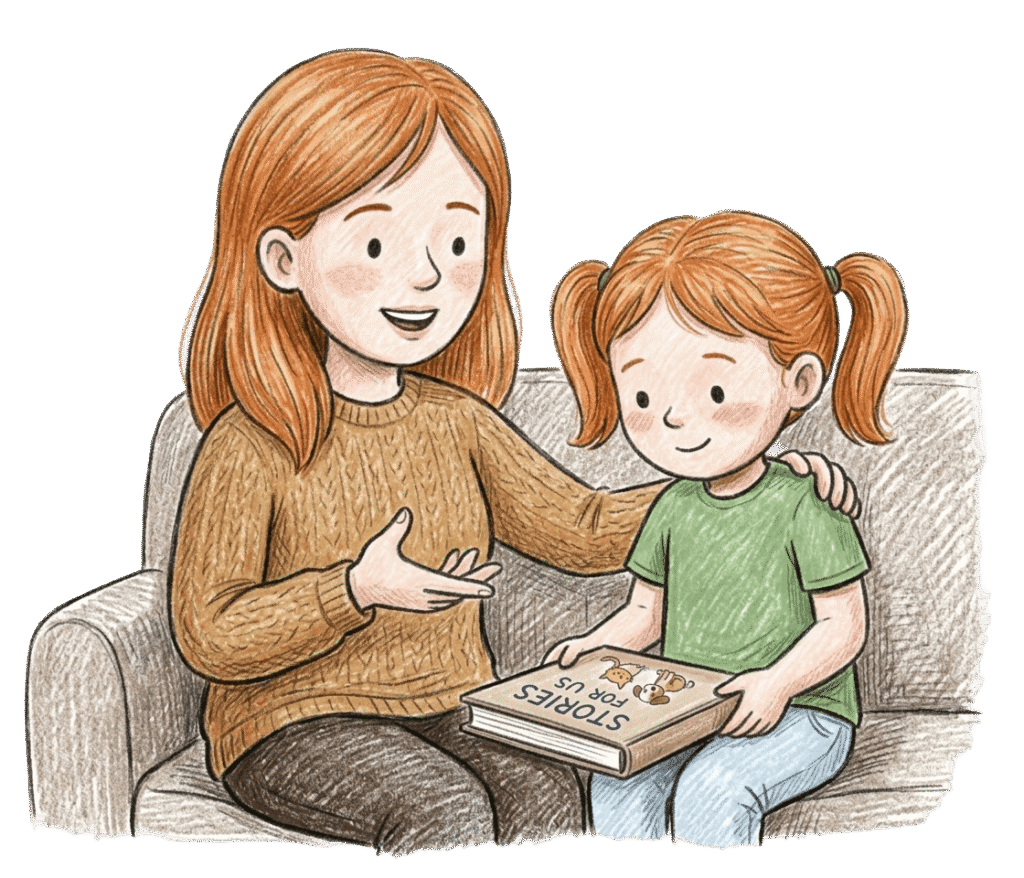
How to do it
Before you open the book, ask one simple question: "What do you think this might be about?" or "What do you notice on the cover?" That's all — don't overthink it.
Read together. When you finish, ask one follow-up: "What was your favourite part?" or "What would you do if you were that character?" Use the prompt cards if you want more ideas.
Keep it brief. You're not running a comprehension test — you're just helping them connect with what they've read. That habit of pausing to think is one of the most useful things a reader can learn.
Grab our resources
Print our reading prompt questions and reading prompt cards to get started.
Frequently asked questions
What is a good reading age for a 7-year-old?
A reading age roughly in line with chronological age is generally considered “on track” — so a reading age of around 7 for a 7-year-old. But there’s a wide range of normal. A reading age 6 months below chronological age in Year 2 isn’t automatically concerning; context matters, and a single test is a limited snapshot.
Can you test a child’s reading age at home?
Some apps and websites offer informal reading age assessments, but these aren’t the same as formal standardised tests. They can give a very rough indication but shouldn’t be treated as equivalent to a school-administered assessment. If you have specific concerns about your child’s reading, it’s better to speak to their teacher or request a formal assessment through school.
My child has a reading age two years above their actual age — what should I do?
A high reading age is a positive sign, but it’s worth understanding what’s behind the score. Some children are strong decoders but read with less comprehension than the score implies; others genuinely read at a much higher level across the board. The most useful thing is to make sure they’re reading widely — varied genres, non-fiction, books that stretch their thinking — rather than simply moving through levels faster.
Is reading age the same as the national curriculum reading level?
No — they’re different frameworks. National curriculum levels describe what a child can do in relation to the expected standard for their year group. Reading age is a standardised score comparing performance to the average for a given age. Schools use both, plus other tools like book bands and teacher assessment, to build a complete picture of a child’s reading.
