
Contents
Systematic synthetic phonics (SSP) is the method used in UK schools to teach children to read. It’s the approach behind programmes like Read Write Inc, Little Wandle, and Sounds-Write. It has been government policy since 2006 and is backed by a substantial body of research showing it to be the most effective way to teach children to decode written language.
If you’ve come across the phrase in an Ofsted report, a school prospectus, or a conversation about your child’s reading progress and wanted to understand what it actually means — this guide has the full picture.
It’s two ideas packed into one term. “Systematic” describes how it’s taught. “Synthetic” describes the method children use to read. Here’s what each one means.
“Systematic”: taught in a deliberate sequence
Systematic means the sounds of the language are taught in a carefully planned order — not randomly, not as they come up in books, but according to a structured progression that’s been designed to build skills as efficiently as possible.
The sequence starts with the sounds that are most useful. Children first learn a small set of high-frequency consonants and short vowel sounds — typically s, a, t, p, i, n — because this combination lets them read and spell dozens of real words almost immediately. From there, more sounds are added in a progression from simple to complex: single-letter sounds first, then digraphs, then vowel digraphs, then the alternative spellings of Phase 5.
The systematic part means every child gets taught every sound, in order, with no gaps assumed. This is in contrast to a more ad hoc approach where sounds are introduced as the teacher sees fit or as words appear in a reading book — which can leave holes in a child’s phonics knowledge.
It also means the books children read at each stage are carefully controlled. Decodable readers are matched to which sounds have been taught so far — no child should encounter a word in their reading book that contains a sound they haven’t yet been taught to decode.
Bite-sized reading tips, straight to your inbox
Get confidence-boosting tips to help your child learn to read. Short, useful, and easy to fit into (real) family life!
Even better? You'll also get 25% off your first month of Reading Chest.
“Synthetic”: blending sounds together
The word “synthetic” here doesn’t mean artificial — it comes from the Greek word for putting things together. Synthetic phonics means that children synthesise (blend) individual sounds to form words.
When a child using synthetic phonics sees the word “cat”, they say each phoneme in order — c… a… t — and then push the sounds together to produce “cat”. They’re working from the phonemes up to the whole word, sound by sound.
This is distinct from analytic phonics, an older approach where children start from whole words and analyse the sounds within them. In analytic phonics, you might teach the sound by showing a picture of a cat and drawing attention to the initial c sound, then other words that start with c. Synthetic phonics goes in the other direction: teach the sounds first, then build up to words.
The research strongly favours the synthetic approach for early reading. Blending sounds from left to right is a powerful, generalisable strategy — it works on any word, even words a child has never seen before.
Why SSP became government policy
The adoption of systematic synthetic phonics as the required approach in UK schools followed a major government review led by Jim Rose, published in 2006. The Rose Report concluded that SSP should be the “first and fast” approach to teaching reading, ahead of other methods.
“The case for systematic phonic work is overwhelming and much strengthened by a synthetic approach, the key features of which are to teach beginner readers: grapheme/phoneme (letter/sound) correspondences (the alphabetic principle) in a clearly defined, incremental sequence.” (The Rose Report, 2006)
Since then, SSP has been embedded in the National Curriculum, and all primary schools in England are required to teach phonics using a validated SSP programme. The Year 1 Phonics Screening Check, introduced in 2012, was designed in part to ensure that schools were delivering SSP effectively and that struggling readers were identified early.
The international evidence base for SSP is also strong. Research in Australia, the US, and Scotland has consistently found that systematic phonics instruction outperforms other approaches — particularly for children from disadvantaged backgrounds or with language difficulties, who benefit most from explicit, structured teaching rather than relying on the incidental learning that comes from a print-rich environment.
The main SSP programmes in UK schools
The government maintains a list of validated SSP programmes — schemes that have been assessed and approved for use in schools. The most widely used are:
Read Write Inc (RWI)
Developed by Ruth Miskin and published by Oxford University Press. One of the most commonly used programmes in England, particularly in primary schools. Uses distinctive mnemonics and pictures (“ants on your arm” for a), and groups children by reading level rather than age for phonics lessons.
Little Wandle Letters and Sounds Revised
A revised version of the original government Letters and Sounds framework, developed by Little Wandle. Increasingly popular in primary schools, particularly following updates in 2021. Has a strong emphasis on fluency reading as well as decoding.
Sounds-Write
A linguistically-based programme that places strong emphasis on teaching children the concept of phoneme–grapheme correspondence explicitly from the start. Particularly well-regarded for use with children who have dyslexia or other reading difficulties.
All three programmes follow the same underlying principles: systematic sequencing, synthetic blending, decodable books matched to teaching, and a structured daily lesson. The differences lie in the materials, mnemonics, pacing, and grouping arrangements.
If your child is moving from a school that uses one programme to one that uses another, the transition is usually straightforward — the sounds are the same, just the mnemonic pictures and story characters differ. It’s worth letting the new teacher know which programme your child was on so they can bridge any small gaps.
What this means for you at home
Understanding the SSP approach helps you support your child more effectively, because you can work with the method rather than around it.
The most important things to know:
- Follow the school’s sequence. Don’t try to race ahead or introduce sounds the school hasn’t taught yet. The sequence is deliberate, and jumping ahead can confuse children more than it helps them.
- Use sounds, not letter names. When helping your child sound out a word, say the phoneme (m) not the letter name (“em”). Letter names come later — decoding is built on phonemes.
- Encourage blending, not guessing. If your child gets stuck on a word, prompt them to say each sound and blend: “What’s the first sound? And the next? Now push them together.” Resist the urge to tell them the word or ask them to look at the picture for a clue — that’s the analytic approach, and it bypasses the phonics skills they’re building.
- Keep decodable books at home. The books that come home from school are chosen because every word in them is decodable with the sounds your child knows so far. If you want more reading practice, Reading Chest has thousands of decodable scheme books to borrow by post — you can filter by scheme and level to match exactly what school is doing.
If you’d like a structured activity to practise sounds at home, this one works with whichever sounds your child is currently learning:
Sound of the day
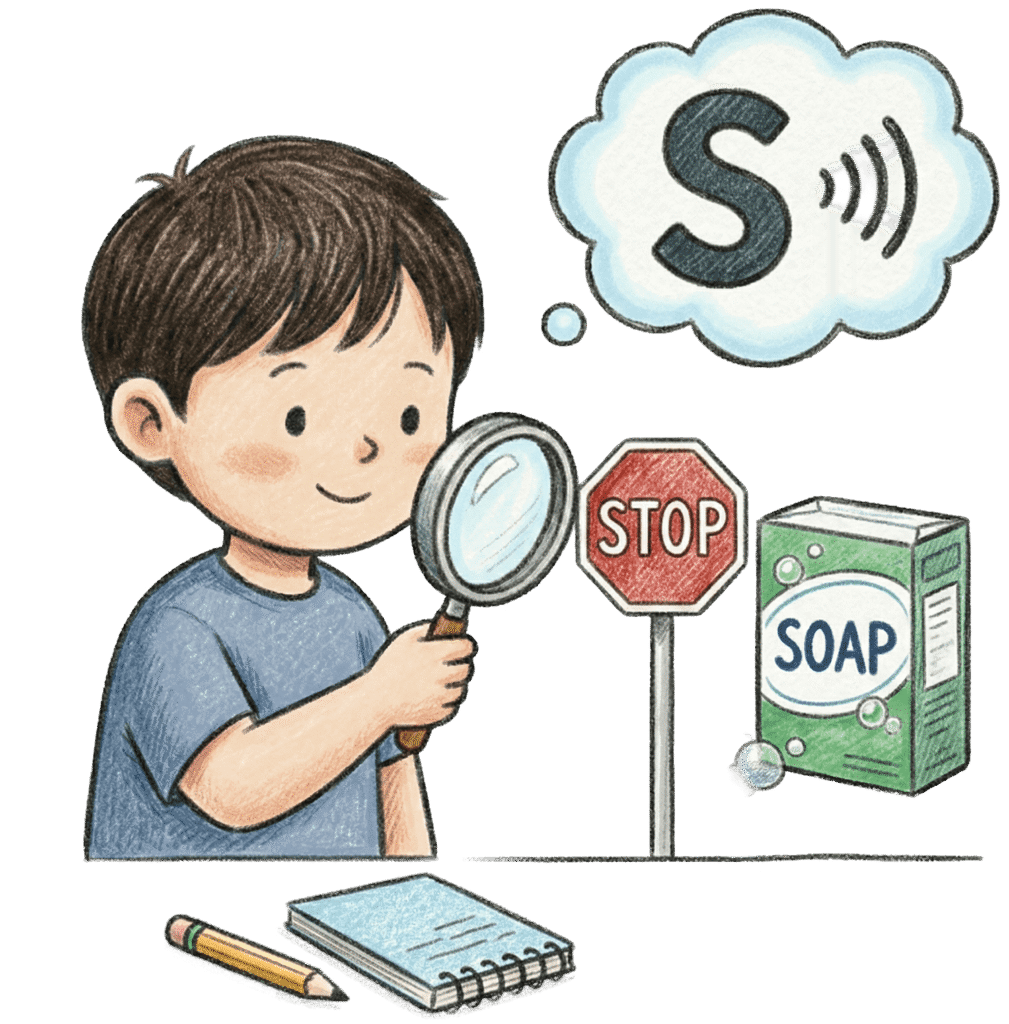
Pick one sound and spend the day noticing it everywhere — on signs, packets, toys, and out in the world. Quick to set up, surprisingly addictive.
Goal
Help your child notice sounds in everyday life — building phonemic awareness without needing to sit down and "do phonics".
You'll need
Just a focus sound — like sh or ee — and your normal day.
How to do it
Pick a sound in the morning. Say it together clearly: sh, ee, m — whatever you're working on. That's your sound of the day.
Then just keep going with your normal day. Whenever you spot it — on a cereal box, a road sign, a shop name, a toy — point it out and say the sound together. Let your child spot them too and make a fuss when they do.
By the end of the day, you'll have done phonics practice a dozen times without sitting down once. That's the magic of making it ambient rather than formal.
And once your child has some Phase 5 sounds under their belt, this is a good way to practise distinguishing short and long vowel patterns:
Short vs long vowel sort
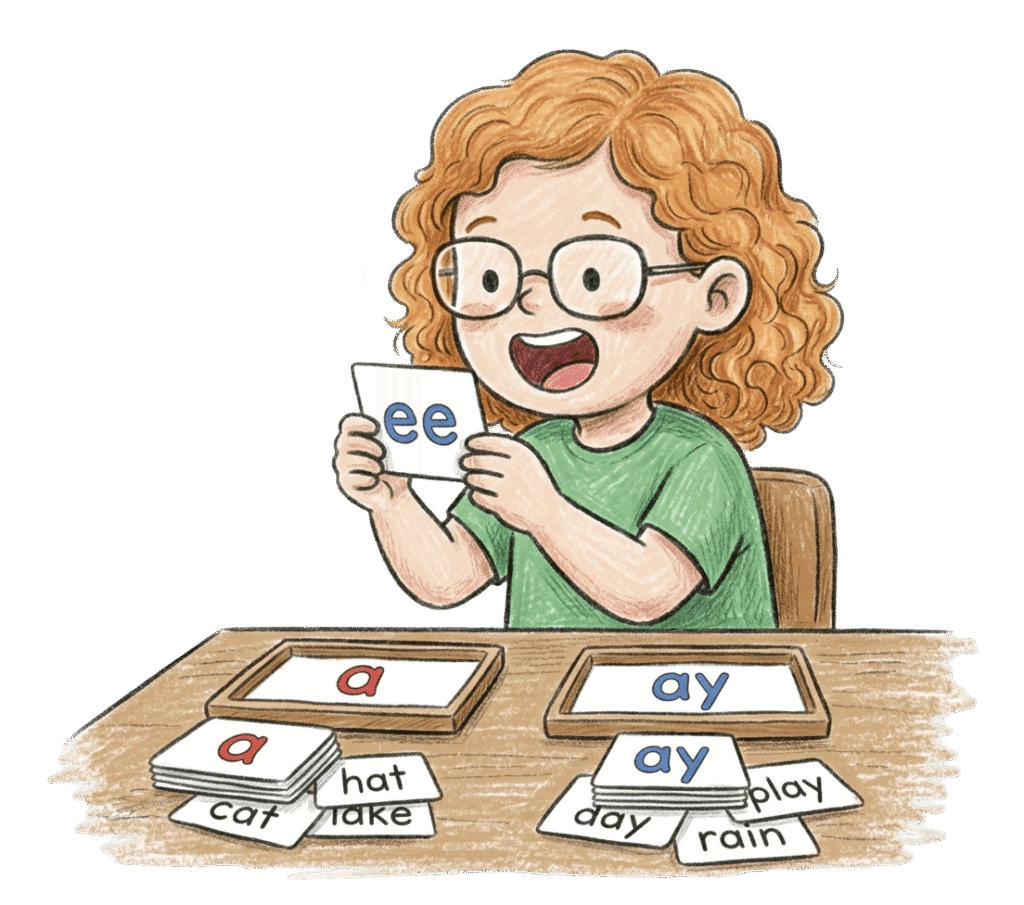
Sort word cards into two piles: short vowel sounds (cat, sit) and long vowel sounds (cake, bite). Hearing the difference is the tricky bit — this makes it concrete.
Goal
Help your child hear and distinguish short and long vowel sounds — a key step in understanding why English spelling works the way it does.
You'll need
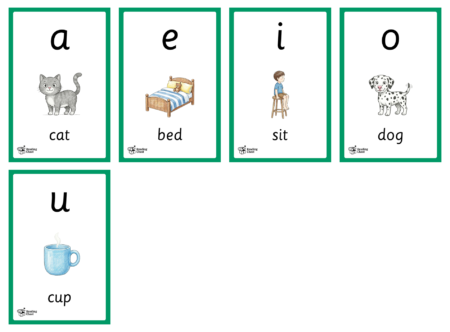
- Short Vowel Sounds Flashcards
- Long Vowel Sounds Flashcards
How to do it
Mix up the short and long vowel flashcards. Set out two spaces — one for short vowels, one for long. Say a short vowel together (a as in "cat") and a long one (a as in "cake") so the distinction is clear in their ears.
Work through the cards together, saying each word aloud before sorting. If they're unsure, exaggerate the vowel sound — stretch out the long ones, clip the short ones. Hearing the difference is the whole challenge here.
Once they're confident sorting, try asking them to think of their own examples for each pile. That's when you know it's really clicked.
Grab our resources
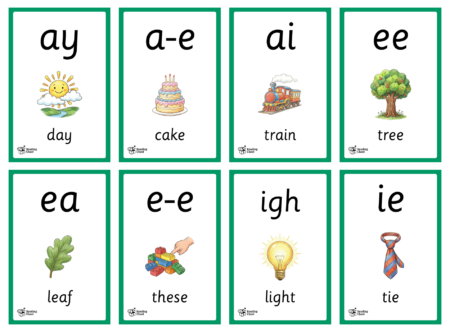
Print our short vowel sounds flashcards and long vowel sounds flashcards to get started.
Frequently asked questions
Is synthetic phonics the same as phonics?
“Phonics” is the general term for any reading instruction that focuses on the relationships between letters and sounds. Synthetic phonics is a specific type of phonics instruction — the one where children learn to blend individual sounds together to decode words. It’s now the dominant approach in UK schools. When people in the UK say “phonics”, they almost always mean systematic synthetic phonics.
What is the difference between SSP and the “whole language” approach?
The whole language approach (sometimes called “balanced literacy”) teaches reading through meaningful texts, context clues, and picture cues, with less emphasis on explicit letter-sound instruction. SSP teaches children to decode by sounding out words, regardless of context. The research strongly supports SSP, particularly for early readers and those with reading difficulties. Context clues are still useful — but they’re a supplement to decoding, not a substitute for it.
What is the Phonics Screening Check?
The Phonics Screening Check is a short assessment taken by all Year 1 children in England, usually in June. It includes 40 words — 20 real and 20 nonsense — that children read aloud to their teacher. It’s designed to check whether children have secured the phonics knowledge they should have by the end of Year 1.
What if my child’s school doesn’t use a validated SSP programme?
All state schools in England are expected to use a validated SSP programme. If you’re concerned that phonics isn’t being taught systematically, it’s worth speaking to the class teacher or headteacher. You can check the government’s list of validated programmes at gov.uk. Independent and international schools have more flexibility, but many still follow an SSP approach.
Can SSP help children with dyslexia?
Yes — systematic synthetic phonics is considered one of the most effective interventions for children with dyslexia, as it provides explicit, structured, and multisensory teaching of the letter-sound relationships that dyslexic learners often struggle to acquire incidentally. Programmes like Sounds-Write are particularly well-regarded in this context. Early identification and consistent SSP teaching make a significant difference to outcomes.
The key points
Systematic synthetic phonics is the government-mandated, evidence-backed approach to teaching reading in UK schools. “Systematic” means sounds are taught in a deliberate, sequenced order with no gaps. “Synthetic” means children blend individual phonemes together to decode words. The main programmes — Read Write Inc, Little Wandle, Sounds-Write — all follow the same principles, using different materials.
As a parent, the most useful things you can do are follow the school’s sequence, encourage blending rather than guessing, and read decodable books together regularly. The approach is powerful and the research behind it is solid — your job is to back it up consistently at home.
